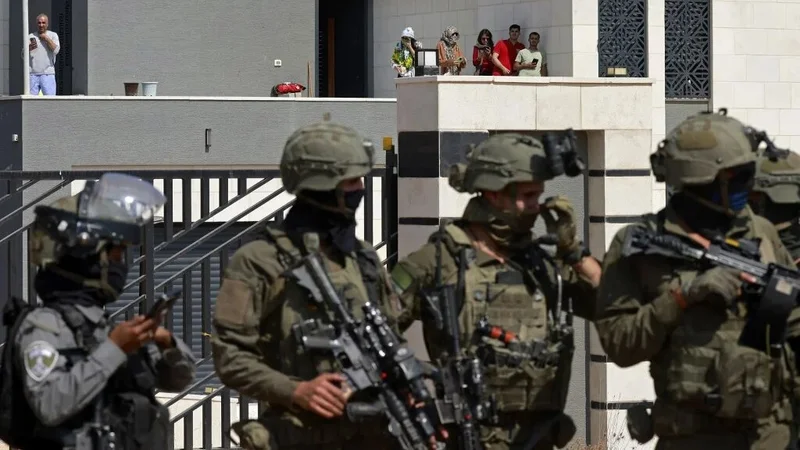
As the world fixates on Hamas, who will disarm the Israeli settlers storming West Bank villages?
In Qusra, in the occupied West Bank, Palestinian families have spent August imprisoned inside their own homes.
Israeli settlers pitched tents in their yards and cut them off from the outside world. Water and electricity were severed. Food ran short.
Armed men gathered outside, smashed windows, threw stones, and stole appliances. Inside, parents tried to calm frightened children, never knowing whether the next sound at the door would be the start of another attack.
In one home, Qusai Abu Rida was trapped with his teenage son. Thousands of miles away in Ohio, his brother Loai watched through security cameras as settlers surrounded the house - until Israeli soldiers removed the camera.
Nearby, Ruqaya Hassan endured the siege with her children, among them four-year-old Kinda, who she said were living in fear.
Elsewhere in Qusra, Marmar Ouda has effectively turned his home into a cage to protect his family. Metal fencing surrounds the house, and bars cover the windows. Nearby, someone spray-painted in Hebrew: “Death to Arabs.”
Five months earlier, Ouda says a settler shot dead his nephew and wounded his brother in front of him. He complained to Israeli police, but the attacks continued.
This is Qusra in August 2026 - and the village is not an aberration. It is a window onto what is being unleashed across the occupied West Bank.
Escalating violence
Across the territory, Palestinian communities are being subjected to a campaign of violence whose vocabulary has become horribly familiar.
Homes attacked. Cars torched. Sheep stolen. Farmers beaten. People shot. Water seized. Olive trees uprooted and burned. Families driven from communities where they have lived for generations.
The pattern repeats from village to village.
A settler outpost appears. Palestinians discover that grazing land used for decades is suddenly inaccessible. Roads are blocked, shepherds are harassed, livestock disappears, and homes are raided.
These are not simply attacks on individuals. They are attacks on the conditions that make Palestinian life possible
As such violence becomes routine, the Israeli army does not protect Palestinians. In documented cases, soldiers have accompanied and assisted the attackers.
Human Rights Watch warned in July that escalating settler violence threatened mass atrocities. The previous month, Amnesty International published an extensive investigation describing the forcible displacement of Palestinian communities in the occupied West Bank as ethnic cleansing.
Israeli human-rights organisation B’Tselem puts the relationship between settlers and the state more starkly: “Settler Violence = State Violence.”
On 6 June, according to B’Tselem, dozens of armed settlers raided four Palestinian villages south of Nablus. At least eight Palestinians were injured. Twenty-year-old Omar Abd al-Hakim Dar Muhammad was hospitalised in intensive care with a brain haemorrhage and severe facial fractures.
The attackers stole at least 44 sheep, a donkey, three vehicles and equipment. They vandalised other vehicles and attempted to burn a local council building. At least one soldier accompanied them.
Permanent danger
In Khirbet Susiya in February, around 20 settlers armed with clubs and flammable materials descended on the village at night, attacking homes and cars, and setting tents, chicken coops and vehicles ablaze.
Around 300 Palestinians live there. Half are children. B’Tselem reported that none of the attackers were detained.
In the Jordan Valley, 26 families - 124 people, including 59 children - fled Ras Ein al-Auja in January after prolonged settler harassment. B’Tselem says their displacement followed repeated raids and violence backed or enabled by Israeli military and police.
These are not simply attacks on individuals. They are attacks on the conditions that make Palestinian life possible.
During the 2025 olive harvest, the United Nations documented 178 settler attacks in just two months, affecting 88 Palestinian communities. Farmers were attacked in their groves and on their way to them. Crops and equipment were stolen. More than 6,000 trees and saplings were damaged.
In Ein Yabrud, near Ramallah, Palestinian families were granted just three days by the Israeli military to reach olive groves on their own land.
Three days to harvest their own olives. After settlers attacked them as they worked, they were too afraid to return, and the harvest was abandoned.
Consider the cruelty in that. A farmer can see his trees. He has tended them through the year, watched them flower, and their fruit ripen. They represent months of labour, his family’s livelihood, an inheritance handed down from parents and grandparents.
The land is his. The trees are his. The olives are ripe - and he cannot reach them. By destroying his trees and preventing the olive harvest, settlers have effectively severed his relationship with the land.
When that danger becomes permanent, farming becomes impossible. And when farming cannot continue, families cannot remain on their land.
Instruments of displacement
That is why these assaults on olive groves cannot be dismissed as vandalism. Within the broader pattern documented by the UN and human rights organisations, the destruction of agriculture and the denial of access to farmland are instruments of displacement.
In Fasayil in the Jordan Valley, farmer Saad Nemer watched settlers take control of a freshwater spring on which Palestinian farmers had long depended. The water has been diverted. Part of it now fills a pool at a settler tourist site, while Palestinian farmers struggle to irrigate their crops.
The contrast is almost obscene: a farmer watches his fields thirst, while water from the spring that sustained them fills a recreational pool. More than 160 settler attacks involving water have been documented in 2026 alone.
Land, water, roads, grazing grounds, crops: these are not abstractions. They are the foundations of human existence.
And the settlers carrying out these attacks do not operate in a political vacuum. Over the last three years, Israeli National Security Minister Itamar Ben Gvir has dramatically expanded civilian armament.
His ministry announced the purchase of 10,000 assault rifles for civilian security teams, explicitly including teams in West Bank settlements. Gun-licensing requirements were loosened; by March 2024, Ben Gvir said 100,000 new licences had been issued.
Settlement emergency squads are armed and trained with military weapons. Settler-only reserve units now operate within the Israeli military structure.
On the ground, the line between settler, soldier and armed civilian can become frighteningly blurred. For Palestinians facing their guns, the distinction is almost meaningless.
Creeping annexation
Between 7 October 2023 and 24 July 2026, at least 1,122 Palestinians were killed by Israeli forces or settlers in the occupied West Bank, including East Jerusalem, according to figures published by the UN Office for the Coordination of Humanitarian Affairs. At least 246 of them were children. Seventy-six Palestinians were killed in the first seven months of 2026 alone.
Israeli Finance Minister Bezalel Smotrich has hardly concealed his ambitions for the West Bank. A settler himself, he holds extraordinary authority over aspects of the civilian administration of the occupied territories. He has publicly advocated Israeli sovereignty over 82 percent of the West Bank.
And the machinery is advancing. The Israeli government has approved 104 new settlements in the past four years, while Defence Minister Israel Katz wants to transfer policing powers over Israeli civilians in the occupied West Bank from the military to civilian police - pushing the territory further towards annexation, experts warn.
What security threat is posed by a shepherd and his flock? What act of terrorism is committed by a farmer trying to harvest his own olives?
For nearly three years, Israel and its western allies have framed extraordinary violence against Palestinians through the prism of 7 October 2023: Hamas, hostages, security, self-defence. Again and again, the Gaza genocide has been explained to the world as a response to Hamas.
But look away from Gaza for a moment, and towards the occupied West Bank.
Hamas does not govern there. The Palestinian Authority administers Palestinian enclaves and has maintained security coordination with Israel for decades.
Yet Palestinian land is still taken. Homes are still attacked. Farmers are still driven from their fields. Olive trees are still burned and cut down.
Shepherding communities are still forced to leave. Palestinians are still shot. Families are still besieged inside their homes. And the territory in which they live is still being steadily carved up by settlements and outposts.
Right to exist
The occupied West Bank therefore poses a series of devastating questions to anyone who insists that the destruction visited upon Palestinians can be understood simply as a war against Hamas.
What Hamas fighter is hiding inside an olive tree? What security threat is posed by a shepherd and his flock?
What act of terrorism is committed by a farmer trying to harvest his own olives? What did four-year-old Kinda Hassan do to warrant being trapped inside her home while armed hordes gathered outside?
The justifications change with the times. Once it was the Palestine Liberation Organisation; today it is Hamas. But strip away the changing pretexts, and the underlying trajectory becomes harder to conceal: the dispossession and ethnic cleansing of Palestinians from their land.
It has unfolded over decades, and it is accelerating - emboldened by impunity, international inaction, and the political and military backing of Israel’s western allies.
One phrase has always dominated western discussions of Palestine: Israel’s right to exist and to defend itself. But what of the Palestinian people? Do they have a right to exist? Not merely to survive, but to exist as a people on their own land, with the ordinary rights that make human life possible?
Do Palestinians have a right to drink from their own springs, harvest their own trees, walk their own roads, tend their own fields, and graze their own flocks? Should they be allowed to raise their children without teaching them to fear footsteps approaching the house?
Do Palestinians have a right to defend their homes, their families, their farms and their lives? The West asks Palestinians to disarm - but who will disarm the settlers storming their villages?
Western discourse demands that Palestinians prove, endlessly, that they accept another people’s right to exist. Who will affirm Palestinians’ right to exist?
The views expressed in this article belong to the author and do not necessarily reflect the editorial policy of Middle East Eye.