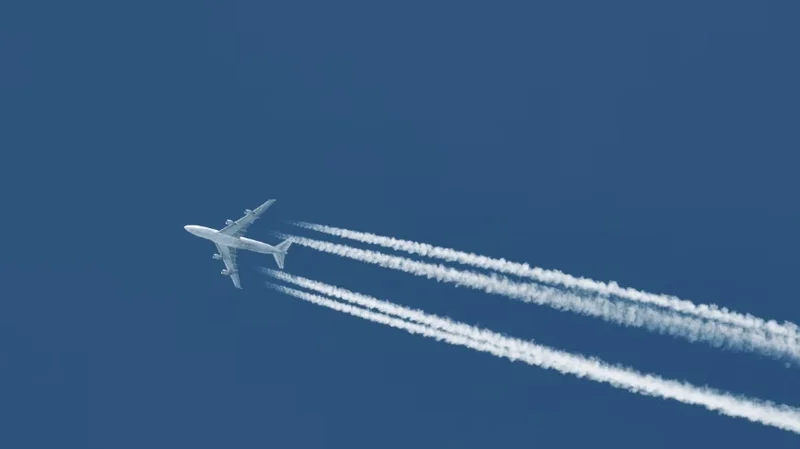
The UK government and Google are launching a trial to steer aircraft around climate-warming contrails. Google announced Operation Blue Skies on Tuesday. It is the first such effort across an entire ocean airspace. AI forecasts will predict where contrails form over the North Atlantic, and controllers will nudge planes to avoid those patches of sky.
Contrails are the thin white lines behind aircraft. They form when water vapour in jet exhaust freezes around soot particles into ice. Many vanish in minutes. In cold, humid air they persist, spread into cirrus cloud, and trap heat. Google and the project partners put contrail warming at roughly a third of aviation’s total climate impact.
Paul Hodgson, Google’s technical lead on the trial, gave the BBC a blunter version of the science. His five-year-old calls the lines “sky graffiti”, he told the broadcaster’s Tech Life programme. He added that the exact figure is uncertain. Scientists are confident it is “either quite a large problem or a very large problem”, he said.
What the trial actually does
Operation Blue Skies runs in Shanwick airspace, the eastern half of the North Atlantic corridor. That zone accounts for about 5 percent of global contrail warming, most of it in winter. The figure comes from the Aerospace Technology Institute, which is coordinating the public funding.
The intervention is small. Google builds AI forecasts from satellite imagery, flight data and Met Office weather models to predict where persistent contrails will form. Those forecasts go to NATS, the UK air traffic control provider. Its controllers can then tell pilots to change altitude by up to 2,000 feet, enough to miss the contrail-forming layer.
That manoeuvre is routine. Controllers already move aircraft to dodge turbulence and weather. The ATI said the deviations use standard air traffic control channels. New Scientist and the BBC reported that the trial focuses on evening and night flights. Those produce the strongest warming, because daytime contrails also reflect some sunlight back to space.
The numbers behind it
The programme is a £5mn, 30-month effort, the ATI said. The Department for Transport is putting in £2.65mn through the ATI Programme, and industry partners cover the rest. Google is taking part pro bono, contributing £1.4mn in kind through research, engineering time and computing.
There are two operational trials, each about four months. They run across the winters of 2026 to 2027 and 2027 to 2028, with roughly 20 to 40 test days per winter. Around 10,000 flights pass through Shanwick during trial hours each year. Only a fraction will be re-routed, enough to produce a statistically useful data set.
The consortium is a UK line-up. Google UK builds and verifies the models. NATS runs the airspace side and controller training. Contrails.org designs the trial parameters. Imperial College London and the University of Cambridge provide independent verification, and the Met Office supplies the forecasting. The ATI said all of the government grant goes to the academic, non-profit and aviation partners, not to Google.
Does avoiding a contrail actually help?
The obvious objection is fuel. Changing a plane’s altitude burns more of it, which emits more carbon dioxide, so the trial has to show the climate benefit outweighs the penalty.
The partners argue it does, and by a wide margin. A full deviation through Shanwick means about 100kg of extra fuel per aircraft, Hodgson told the briefing reported by New Scientist. He put the resulting carbon penalty at under 1 percent of the contrail warming avoided. He measured that warming “in the tonnes or even the tens of tonnes”.
The approach has a track record at smaller scale. Google has run earlier forecasts with American Airlines and others. The BBC reported those airline-level trials cut contrail formation or warming by around 60 to 70 percent. What is new here is that the instruction comes from the controller and covers every plane in the airspace, so airlines cannot opt out.
The awkward backdrop
The trial arrives as Google’s own climate footprint grows. The BBC noted that Google, like its rivals, is spending billions on power-hungry data centres to run AI, which environmentalists warn adds to the emissions the company is elsewhere trying to cut.
The desk has tracked that tension. Google’s $15bn India data centre ran into water and wildlife objections this month. The company has also promised $44bn of rent on data-centre buildings it will never own.
That buildout is the backdrop the BBC set the trial against. Google’s AI power demand is reshaping where it builds, and its data centres draw large and rising amounts of electricity. The company is cutting aviation emissions in one place while its own energy use climbs in another.
The UK government framed the trial as part of a broader push. Aviation minister Keir Mather called it “British ingenuity leading the way”, and pointed to £219mn already committed to sustainable aviation fuel. That sits alongside the government’s wider climate record, which this year included a UK solar generation record.
What would prove it works
Contrail avoidance is cheap next to rebuilding fleets or inventing new engines, which is what makes it attractive. It is also unproven at this scale, which is the entire point of the trial.
Three results would settle it.
A verified cut in contrail warming across the airspace, confirmed by the Cambridge and Imperial teams rather than the operator. Evidence that the fuel penalty stays as small as the partners claim once thousands of flights are involved. And a safety record clean enough that regulators would let controllers do this routinely.
The findings are due in academic literature after the two winters run, opened to outside scrutiny. Until then it is the largest test yet of a cheap idea. Europe’s worsening climate strain is the reason it is being tried at all.
Get the TNW newsletter
Get the most important tech news in your inbox each week.