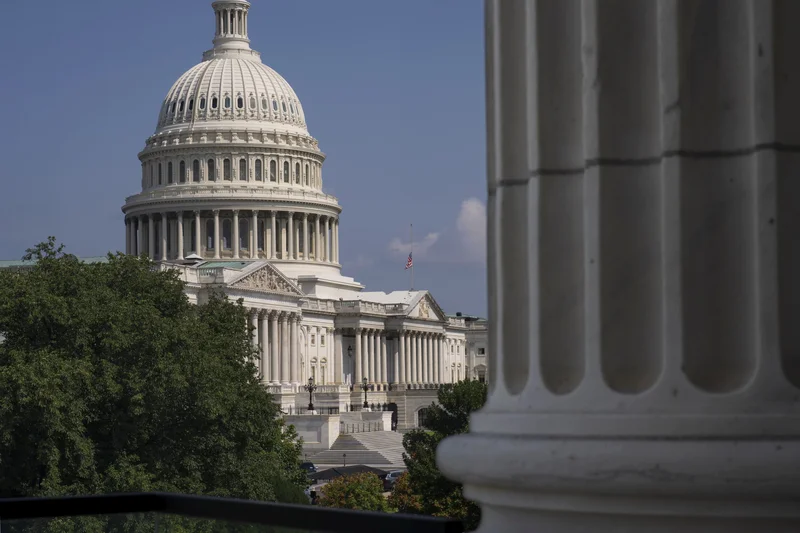
The U.S. House narrowly passed a defense policy bill Wednesday authorizing a record $1.15 trillion for the Pentagon.
Though it traditionally sees significant bipartisan support, the 2027 National Defense Authorization Act (NDAA) passed the lower chamber in a 216-212 vote, a sign of the growing polarization under President Donald Trump.
The bill, which must still pass the Senate, provides approximately $250 billion more than the 2026 NDAA, including a 5-7% pay raise for service members.
"This legislation provides our brave servicemembers with an overdue pay raise, strengthens our nuclear deterrence and missile defense – including construction of the Golden Dome," House Speaker Mike Johnson said.
Sponsored by Rep. Mike Rogers, the National Defense Authorization Act (NDAA) for Fiscal Year 2027 received support from 209 Republicans, six Democrats and one Independent.
Seven Republicans objected to the bill.
The bill establishes policies and authorities for Department of Defense activities, military construction and Energy Department national security programs.
A major component of the bill, Section 219, establishes the United States-Israel Defense Technology Cooperation Initiative.
The law mandates the Pentagon to designate an executive agent to "expand and accelerate bilateral defense technology research."
The initiative focuses on integrating Israeli-origin and jointly developed technologies into formal U.S. military programs through 2030, covering 10 specific areas including counter-unmanned systems, missile defense and artificial intelligence.
The cooperative efforts also target quantum computing, directed energy and anti-tunneling technology to counter subterranean threats.
The NDAA authorizes the procurement of aircraft and ships while setting active-duty personnel strength levels and military compensation policies.
The bill also addresses Pentagon interactions with partners in Europe and the Asia-Pacific, emphasizing the need for an expedited qualification process for strategic materials such as specified alloys and magnets.
In addition, the legislation mandates that the Defense Department include projected demand for foreign military sales in its munitions production planning.
The bill also sets policy and authorizes appropriations for the National Nuclear Security Administration (NNSA), the Naval Petroleum Reserves and other defense-related programs within the Department of Energy.