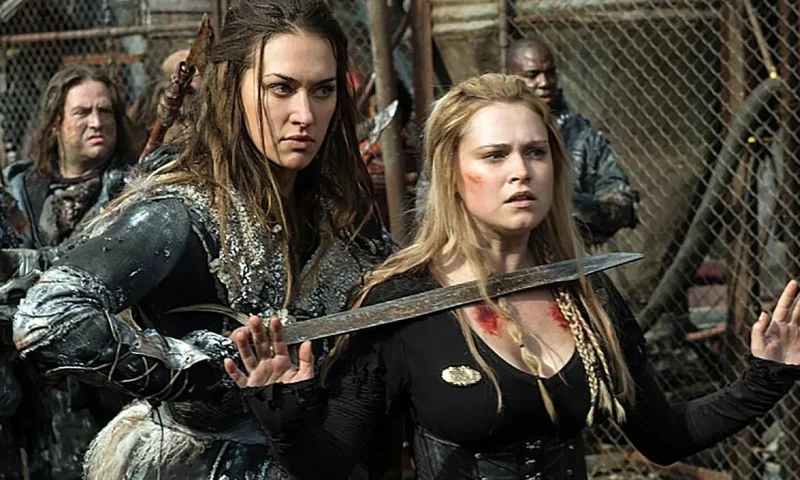
At seven seasons, The CW’s YA The 100 became our most deeply explored TV apocalypse, telling the story of the descendants of refugees of nuclear devastation who return to Earth from their habitat in space to encounter the remnants of humanity that has survived. Naturally, the first people sent to scope things out are the juvenile delinquents, and they discover that three civilizations have risen up in the aftermath of the apocalypse—all pretty darned scary (including one populated by cannibals, naturally). After a rocky first few episodes, it evolved into something impressively smart and complex, a reminder that YA doesn't need to lack depth. In its absence, enjoy these other shows that explore dystopias near and distant, particularly when they involve throwing teenagers at apocalyptic problems.
Silo (2023 – )
This futuristic neo-noir (kicking off, as it does, with a murder mystery) inverts, to a point, the premise of The 100: While that show finds people from a space station visiting a blasted Earth, Silo finds the remnants of humanity trapped underground. Rebecca Ferguson stars as Juliette Nichols, an engineer who gets wrapped up in an investigation involving the local sheriff (played by David Oyelowo). The usual stuff—except that the characters all inhabit a massive silo, 144 levels deep, protecting the remaining 10,000 humans from the allegedly poisoned world above. Those running the silo have managed to convince everyone left that only strict adherence to rules and procedures will keep them safe from the dangers outside. The tones are very different, but both 100 and Silo turn on the significance of manipulations and lies that keep the lead characters from ever understanding the full picture. **Stream Silo on **
Apple TV.
Snowpiercer (2020 – 2024)
Though initially feeling like an unnecessary extension of Bong Joon Ho's allegorical post-apocalyptic film, Snowpiercer (the show) ultimately takes on a life of its own, a clever sci-fi melodrama that realizes there are no heroes and few true villains at the end of the world, but mostly just people doing whatever they can to survive. In a frozen future (2026, to be precise), humanity survives on an extremely long train that circumnavigates the globe. If it stops, the power will go out and everyone (literally everyone) will die. Those who came aboard with wealth live near the front in relative luxury, while the poor live on scraps (or worse) in the tail. Daveed Diggs stars as former detective Andre Layton, a "Tailie" deputized by Jennifer Connelly's Melanie Cavill (engineer and the train's head of hospitality) to solve a series of murders. The inevitable uprising that follows sets the two of them on different sides of a violent conflict, as each comes to realize they're just pawns of the elites—same as it ever was. Stream Snowpiercer on Peacock
, Hulu
, and
Prime Video.
The Wilds (2020 – 2022)
Situated between flashbacks and flash-forwards, mystery/thriller The Wilds sees an airplane full of teenage girls crash on the way to an empowerment program in Hawaii. It quickly becomes clear that the accident was engineered and that the whole thing is some sort of social experiment, and the survivors are forced to compete against each other if they want to live—it's reminiscent of the manipulations at the heart of The 100, even if the setting is less overtly sci-fi. The show understands the ways in which young women are exploited and expected to compete against each other in the real world, making clear that a Lord of the Flies-esque scenario with women at its center isn't going to go any better, even if it would play out differently. Stream The Wilds
on Prime Video.
Tribes of Europa (2021)
We've got just a few short years before the global technological collapse, posits Tribes of Europa, and I for one am here for it—it's set in 2074, and it's been 45 years since we all lost access to Insta. Except that the shows sees it as a bad thing, with a complete societal breakdown and the dissolution of governments into a bunch of warring micro-states. Three groups are important here: the aggressive Crows; the militaristic and politically minded Crimsons; and the peaceful Origines, three of whom happen upon advanced technology that makes the teenagers targets for just about everyone. Stream Tribes of Europa on Netflix.
Shadowhunters (2016 – 2019)
A lot of streaming dystopias are more adult-oriented (which isn't necessarily to say smarter or more mature), so this urban fantasy is a match largely by demographic, being, like 100, adapted from a popular YA novel series. Both series likewise put young women as reluctant warriors at the front, fighting for their families and friends in the face of world-ending consequences. From the long-running Cassandra Clare-written Mortal Instruments series, Shadowhunters finds Clary Fray (Katherine McNamara) discovering that her mom's been lying to her for her whole life: She's the daughter of a rogue Shadowhunter who split off to form his own group of, like, magical bigots, going extreme in his mission to defend people from demons and supernatural beings, not all of who are bad. Though cancelled after three seasons, the show adapts the initial run of books and comes to a perfectly satisfying conclusion. Stream Shadowhunters on Hulu.
12 Monkeys (2015 – 2018)
Another future dystopia involving the aftermath of global catastrophe—only here we're counting on time travel to save us. James Cole, a scavenger from 2043, travels back in time to 2015 to stop a deadly plague. Though the series at first felt like a retread of the Terry Gilliam film (and of La Jetée, on which that was based), it eventually began to luxuriate in its extended timeline and use it to ruminate on ideas of free will versus predetermination, even while throwing in plenty of action and mystery; extended plot-lines, complex character dynamics, and impossible choices are points of convergence. It’s sort of a pre-apocalypse story, dealing with a bleak past and an even darker future. ** Stream 12 Monkeys on Prime Video**.
Heavenly Delusion (Tengoku Daimakyō) (2023)
We follow two parallel narratives in this (deeply weird) post-apocalyptic anime: In one, a group of children live in a confined, sterile, closely monitored school environment called "Heaven" and are protected from what we quickly learn is the monster-filled devastation outside; in the other, bodyguard Kiruko and their companion Maru travel across a devastated Japan. Those relatively straightforward dystopian strands soon give way to some wild twists and turns as the plot lines dovetail into a story involving gender and sexual politics, as well as a whole lot of dark secrets. Think of it as the psychedelic anime take on the kids' apocalypse, in which some people have seeming safety while others have to face brutal reality. Stream Heavenly Delusion
on Hulu
.3% (2016 – 2020)
It would be tempting to see this as a metaphor for the American dream, but, of course, it’s a Brazilian show, and it’s not as though inequality was invented in the United States—we’re just particularly good at it. In 3%, the impoverished young Inlanders have one shot at success: completing “The Process,” a series of interviews, puzzles, and escape rooms designed to test their worthiness to join a futuristic offshore utopia. Most fail, and many don’t survive, leaving a success rate of...3%. This is very much Hunger Games territory, but there's also a very 100%-esque sense of young people being seen as expendable, particularly when they don't occupy the right spot in the social order. **Stream 3% on **
Netflix.
The Rain (2018 – 2020)
Welcome to the apocalypse, but, you know...wetter. In this three-season Danish import, a virus spread by rainfall wipes out most of the population of Scandinavia. Siblings Simone and Rasmus emerge from their bunker six years later, setting off across the countryside with the hope of finding a safe haven, and maybe tracking down their father. It turns out that one of them holds the key to wiping out the virus and saving the world. It’s not the most original premise (The Last of Us game came out five years earlier), but the setting gives it a unique feel, and the series comes to a decisive ending. ** Stream The Rain on Netflix**.
All of Us Are Dead (2022 – )
In All of Us Are Dead, high school becomes hell, almost literally, when a viral outbreak causes a Hyosan school to become ground zero for a strange plague. The teenage students soon realize they've been quarantined from the rest of the city, and help isn't coming (adults can't be trusted in the apocalypse, is what I'm getting from these shows). Nihilism isn't uncommon in zombie narratives, nor are themes involving the breakdown of social structures. But All of Us Are Dead explores the world of a cloistered high school under constant threat as a parallel to our own: Class and background continue to be potent forces, even (or especially) amid the trauma of the attacks, and arbitrary social hierarchies solidify under the constant trauma. In contrast to the wide-open world of The 100 (at least when we're on the ground and outside), the closed school location is brilliantly utilized, and there's some appropriately soapy drama, too. ** Stream All of Us Are Dead on Netflix**.