The eye contact is a little disconcerting. Buddhist master Thich Truc Tu Kien holds my gaze like a taut rein, demanding attention as he shares his wisdom, almost daring me to lose focus. The crinkles around his sparkling, clear eyes deepen as he grins, making a joke that transcends the unfamiliar flicked-rubber-band cadences of the Vietnamese language.
“Today, we are lucky we have a chance to sit here in this palace and learn about Zen meditation,” our translator repeats in English. “But do you know how to sit in the right posture?”
From a kneeling position, we shuffle awkwardly, imitating the master as he effortlessly moves his legs into a lotus position, his golden robe cascading to the floor. We giggle in our universal failure, some of us unable to place their foot on their thigh, others toppling from the ungainly effort.
“The Buddha sat in lotus posture for 49 days continuously,” the master continues. “After that he got enlightenment. This posture helps you to be very stable as you meditate, even if you fall asleep, you don’t fall down. Your back is straight, and it helps your mind stay awake.”
It’s not every day you tour a religious complex with a practising monk, but master Thich Truc Tu Kien joins our group as part of BestPrice Travel’s “One Journey – Two Heritages” tour of north-eastern Vietnam. It’s a mindful venture into the spirituality and history of Hanoi and its surrounding area.
Get exclusive travel deals delivered straight to your inbox. Sign up now.
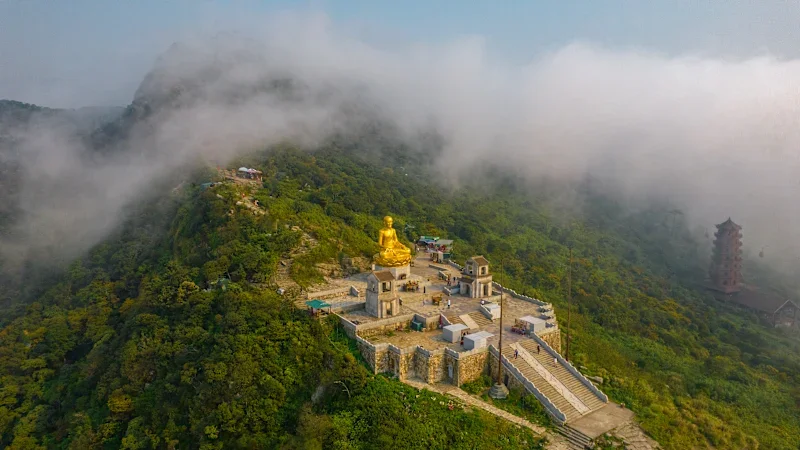
Located in Quang Ninh Province, a three-hour drive from Hanoi, the tranquil forest-swathed peak of Yen Tu, rising to 1068 metres, is considered the birthplace of Vietnamese Zen Buddhism.
Inscribed by UNESCO as a World Heritage cultural site in 2025, this complex of historic temples and pagodas is a popular destination for pilgrims seeking a deeper understanding of, arguably, Vietnam’s most visible organised religion, practised by at least 14 million people.
We meet the master at the foot of the mountain, in the lobby of Legacy Yen Tu MGallery hotel, a creation of wunder-architect Bill Bensley, which conceals five-star opulence behind the rustic facade of a recreated 13th-century monastery.
Sadly, the weather gods are against us, with howling winds and monsoonal rain putting a dampener on our plans to reach the mountainside temples by cable car.
Instead, the master will conduct a private ceremony in Truc Lam Palace, a cavernous reception hall adjoining the hotel that can host up to 2000 devotees. After sounding a gong and chanting, the master asks us to sit cross-legged while he tells the story of the creation of this uniquely Vietnamese sect of Buddhism, dating back to the 13th century.
Born in 1258, King Tran Nhan Tong was the third emperor of the Tran dynasty and a devotee of Buddhism from an early age.
After twice saving Vietnam from the Mongol-led Yuan dynasty and becoming a national hero, the 35-year-old king gave up the throne to become a monk, spending five years studying on the slopes of Yen Tu mountain. Here, he reached enlightenment, founding the Truc Lam school of Vietnamese Buddhism named after the bamboo forest cloaking the slopes.
“Truc Lam is based on Vietnamese traditions, combining Zen Buddhism and other branches of Buddhism with local beliefs,” the master explains. “It was preached in the local language that we use in everyday life so it was easy to understand. That’s how the king taught Buddhism to the people, adapting it to the Vietnamese lifestyle.”
“Like Shakyamuni, who renounced life as crown prince to become the Buddha, so our king gave up a life of luxury to study Buddhism, leaving it all behind to come to this remote area and set an example for the Vietnamese people.”
As we listen to the master, asking questions about the religion, his life as a monk and seek tips on how to meditate – “Our minds are like a monkey’s, never focused, and meditation helps us to become calm” – the wild weather abates, and we learn that the cable car is once again operating.
When our precious time with the monk comes to an end, he invites us to continue our discussion as we walk towards the aerial tramway where he will leave us to continue our exploration of the Yen Tu temples alone.
Rugged up against the chill in a brown beanie, the monk leads us across the picturesque Giai Oan Stream (Stream of Release), a bubbling creek where pilgrims are invited to purify themselves before ascending the sacred mountain.
Here, the emperor’s rock star status was cemented in 1299 when, legend has it, up to 100 of his wives and concubines followed him to Yen Tu in tears, begging him to renounce his plans to abdicate the throne.
Adamant his life would take a religious path, the king refused and asked the women to return to the palace. Distraught, many instead chose to throw themselves into the river, drowning to prove their loyalty.
I’m captivated by this romantic, tragic tale, but the monk admits it’s probably just a story, and that the King was too devout to be swayed. “Every day he practised Buddhism and lived a simple life, he was not interested in beautiful girls,” he laughs. “To say 100 concubines came here, I don’t believe it.”
The legend continues, however, at the Chua Giai Oan (Pagoda of Release), where it is said the king held a ritual ceremony for the wandering souls of the imperial concubines to release them from the repeating cycle of life and death, or samsara.
Reconstructed in 2003, the shrine, surrounded by 100-year-old fruit trees, is also dedicated to the king’s beloved mother, making it a particularly special place for female devotees.
After inviting us to make an offering of incense, the monk leads us once again in prayer before giving his thanks for the opportunity to share his beliefs. “I feel proud to help you understand about this place and Buddhism, and I feel happy today because you have a lot of questions and curiosity,” he says, grasping my hand. “I hope you have the chance to further understand Vietnamese Zen Buddhism as you continue your journey up the mountain.”
I’m a little dubious about his blessings, however, as we make our way up the first stage of the Yen Tu aerial tramway, which assists pilgrims to make the six kilometre trek up 6689 stone steps to the peak of the sacred mountain.
The wind has again picked up, blowing the shuddering, glass-bottomed cable car like a feather, swaying perilously close to the supporting towers protruding from the bamboo forest below. I’m usually not afraid of heights, but after this heart-stopping ride, I’m more than relieved to touch base at the middle station, the gateway to Yen Tu’s centrepiece temple, Hoa Yen Pagoda.
This may be the lazy route up the mountain, but there are still more than 150 steps before reaching the nearly 1000-year-old pagoda surrounded by frangipani trees, located 534 metres above sea level.
There’s then a further 1000 steps from the top cable car station to the misty summit of the mountain and the evocative, lotus-inspired Dong Pagoda, the largest mountain-top temple made from copper in Asia, and a place of special spiritual significance for Buddhists.
It’s a tumultuous path to enlightenment as, once again, the weather gods turn on us.
After exploring the mid-level temples, we discover that the second leg of the cableway has been closed due to the adverse conditions. With limited time, we have no choice but to make our way back down the mountain, the rocky peak just an ethereal, Zen dream lost to gale-force winds.
THE DETAILS
VisitBestPrice Travel’s six-day “One Journey – Two Heritages” tour, includes two nights in Hanoi, three nights at Yen Tu and a Halong Bay cruise. It costs from $1927 a person. For those seeking a deeper spiritual connection at Yen Tu, BestPrice Travel can arrange a local monk to accompany your group during the mountain ascent. Note that the monk does not speak English and an interpreter will join the group. The cost, for up to 20 guests, is around 20 million VND (around $1105). See bestpricetravel.com
The writer travelled as a guest of BestPrice Travel.