The sea ice surrounding Antarctica has contracted sharply this month in what should be its main expansion season and is at its second-lowest point on record for this time of year, satellite data shows.
Climate scientists expect some recovery over the next few weeks because sea ice usually peaks in mid-September before the spring melt, but without rapid, steep growth, the winter peak will be close to and could even break the record low year in 2023.
“We’ve now got less sea ice than we would than we saw in ’24, and less sea ice than we saw in ’25, which were two really low winters, and so the only year that’s had less sea ice than we currently have for this time of year is 2023,” said Dr Ariaan Purich, a climate scientist at Monash University.
The sharp decline in sea ice comes as the world is in the grip of a devastating super El Nino that has fuelled the hottest June on record in western Europe and Sydney, and the equal warmest July on record globally. The past three years have been the warmest on record, and scientists recently sounded the alarm about grasses displacing ice on land across sub-Antarctic islands and parts of the Antarctica peninsula.
Purich said sea ice was important for climate change because the white reflective surface kept the planet cool, and it also provided a physical buffer to protect the ice sheet – frozen fresh water on land that would cause sea levels to rise if it melted into the ocean.
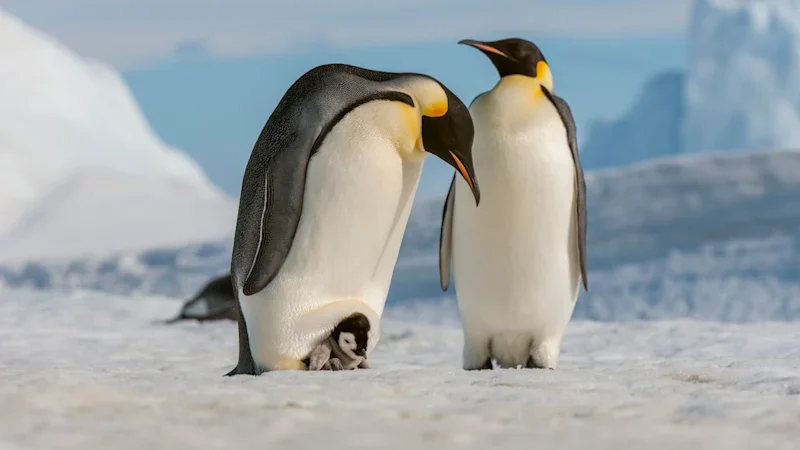
Sea ice was also crucial for the ecosystem, Purich said, firstly because it was a breeding ground for krill – the keystone species of the Southern Ocean food web that provides food for whales, penguins and other animals. Secondly, the stable landfast ice is used by emperor penguins, and when it melts faster than usual in late spring and early summer, it can lead to breeding failure for the iconic, endangered species.
“What happens when the sea ice melts back [too fast] is the penguin chicks that are super-cute and fluffy and not ready to swim either fall into the ocean and drown, or they fall into the ocean, climb back onto the ice and their feathers don’t shed water yet, so they freeze to death,” Purich said. “It’s super-grim, and there are cases around Antarctica where for certain years, the entire penguin chick population doesn’t survive and that’s a breeding failure for that colony.”
So far, the peak of the sea ice extent this year was on August 8 (US time), when it reached 16.314 million square kilometres, data from the US National Snow and Ice Data Centre at the University Colorado shows. Over the next five days, it shrank by 312,000 square kilometres to 16.002 million square kilometres on August 13 and has since mostly plateaued.
With records going back to 1978, the three years with the lowest sea ice are 2023, followed by 2024 and 2025. The near real-time data was sometimes adjusted later, but the changes were usually minor, the scientists said.
The extraordinary sea ice loss in 2023 led to a peak 17.064 million square kilometres on September 9 and 10, a week or two earlier than average. On August 13 of that year, sea ice was 15.094 million square kilometres, but growing.
Dr Will Hobbs, a sea ice researcher at the University of Tasmania, said the drop was “very unusual”. Scientists had been anticipating winter sea ice this year to be lower than normal, he said, but nothing as extreme the past few years. It was tracking that way until early August.
“The big blip that we’re seeing right now is largely due to a big sudden loss in an area called the Amundsen Sea, which is the southeast Pacific sector,” Hobbs said. “That really has very, very suddenly retreated, and it’s a region which historically has been pretty stable in winter and doesn’t vary very much at all. It’s very, very surprising.
“One event is not climate change but when it’s winter after winter after winter, it’s beginning to look a lot like the future.”
The Amundsen Sea is the location of some of the West Antarctic glaciers such as Thwaites and Pine Island that are melting the fastest. Thwaites is known as “the doomsday glacier” because of the speed of the melt.
“If this sea ice doesn’t recover in the next few weeks before it starts melting anyway, as it naturally would, what that would entail is that that ice is going to retreat to the coast relatively quickly this summer, and it means that those ice shelves that are really threatened are going to be more affected by warm water and ocean swells for a longer period,” Hobbs said.
“My hope is that the ice there now hasn’t so much melted but just been pushed up against the coast so it’s super-thick and compacted. If that is the case, then hopefully it will stick around a little longer and take longer to melt.”
Dr Phil Reid, sea ice researcher and climatologist at the Bureau of Meteorology, also agreed the trend was unusual, and said it could be influenced by the current very strong El Nino. When the El Nino Southern Oscillation (ENSO) system was in El Nino or La Nina, it was a “disruptor event” that could change the distribution of cyclones in Antarctica.
“There are cyclones that go around Antarctica that make tropical cyclones look a little bit piddly,” Reid said. “They’re big cyclones, and those sorts of cyclonic events change where sea ice is growing or shrinking.”
It was only possible to get such a steep dip in sea ice decline because it was shrinking in multiple regions, Purich said. Normally, a storm would drive down sea ice in one location, while winds would make it expand elsewhere.
The scientists agreed that warm ocean temperatures were probably contributing as well. If the sea ice was thinner than usual, it would be more susceptible to break up, Purich said.
Purich said it was easy to feel helpless but the extent of future global warming was within humanity’s collective control.
“We will have some amount of warming and further ice loss, no matter what our decisions are, but we can control whether this future sea ice loss is moderate or whether this future sea ice loss is really, really severe by deciding what we choose to emit,” she said.