Sign in. It’s quick, free and it’s up to you.
An account is an optional way to support the work we do. Find out more.
(Seo alt ónár bhfoireann Gaeltachta. Is féidir an bunleagan as Gaeilge a léamh anseo)
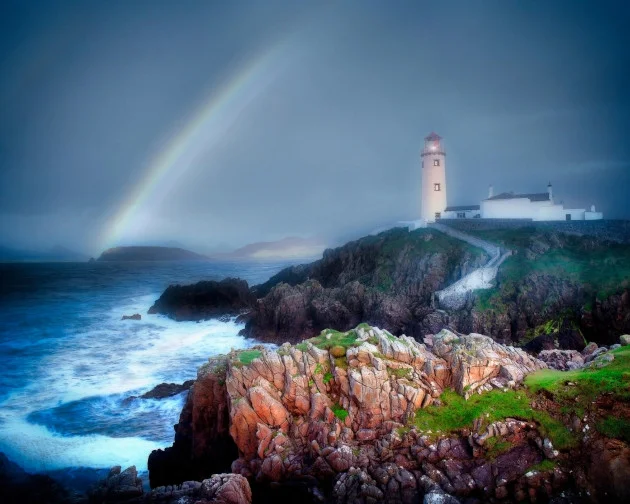
FÁNAD LIGHTHOUSE IN County Donegal is a landmark known across the country and is at the heart of the most northerly Gaeltacht community on the island of Ireland.
When The Journal visited the site at the end of July, it was teeming with people who had come from far and wide to tour the historic building, perched as it is on the cliff’s edge with the waves crashing against the rocks below.
Although it is remote — there is a Donegal saying that something is ‘as far out as Fánad Lighthouse’ — the lighthouse is among the most visited attractions in the county, with around 65,000 people coming to see it every year. The centre’s manager, Eimear Ní Mhathúna, said it has been very busy again this year, busier even than other years.
“It was built in 1817 following the wreck of the Saldanha and it has been operating as a lighthouse ever since,” said Ní Mhathúna.
It has been an automated lighthouse since the last keeper retired in 1983. In 2014, the Commissioners of Irish Lights decided it would be opened to the public, and it has been operating as a visitor centre since 2016, when Ní Mhathúna was appointed as manager after spending the preceding years as director of Cultúrlann McAdam Ó Fíaich in Belfast.
“We are open to the public and the old cottages have been renovated and people can stay in them or they can come for a day visit and get an insight into the life that was here before.”
A busy café has been built and a shop where visitors buy tickets for the lighthouse along with souvenirs.
It is an important centre from the perspective of enterprise and employment in the area. “We have 30 people on our books working for the summer on a seasonal basis and we have five of us working full-time and others on schemes and so on — there are few places in the area that the lighthouse is not having an impact on,” Ní Mhathúna said.
“There are very few families who don’t have some connection with the lighthouse now.”
The lighthouse is a social enterprise, which means any profit goes back into the local community.
The facility has another significance in that it is ‘central’ to the cultural flourishing taking place in the area.
“We are in the Gaeltacht and it is a Gaeltacht that is genuinely struggling due to a lack of Irish-medium education, for example.
We opened as a Gaeltacht project and we have been promoting the language from the start — you’ll see it in the signage and in everything we do here.
“Most of the staff have Irish and are happy to use it and they welcome people coming or placing an order in the café through Irish.”
That is certainly an encouragement to the community in the neighbourhood, where efforts are being made to support Irish in the area.
According to the 2022 Census, the population of Tuaisceart Thír Chonaill — the language planning area in which the Fánad peninsula is located — is 2,716, and 241 or 9% said they speak Irish daily. Tuaisceart Thír Chonaill encompasses areas stretching approximately 60 kilometres from side to side and 50km from top to bottom.
Among the communities there alongside Fánad are Na Dúnaibh, Ros Goill and An Chraoslach, An Tearmann, Gleann Domhain and Gleann Bairr.
It is Michelle Nic Pháidín who is the language planning officer in this extensive area, with much in hand as she supports and works in partnership with the local cooperative, Comhar Fhánada agus Ghleann Bhairr.
“There is a great deal of good work going on in this Language Planning Area in terms of language matters,” said Nic Pháidín.
“We organise festivals and provide Irish classes. We run courses.”
One of their main activities now is providing courses for the parents of school-age children.
It is the case that many people are coming home to Fanad — people who left to find employment and who are now able to return, thanks perhaps to the way remote working took off during the pandemic — and to work and raise their families.
There is growth as a result in attendance at local schools, and to support the parents who are coming home, courses are being run for parents who have limited Irish so they will be able to help their children with homework and so on.
Nic Pháidín said there used to be around 10,000 living in the area before the Great Famine, which struck the Fanad population as hard as it struck the population across the country. That was a major blow to Irish as a community language.
But in recent years, and particularly during the pandemic, more people have moved back home, knowing and recognising that they were able to work from home rather than working in places like Dublin and Dubai.
“When they came back home they had more respect for the culture and there was a desire in them to raise their own children through the medium of Irish, in their own dialect particularly, in an area like Fanad.”
According to Nic Pháidín, the people coming home have good jobs and are contributing greatly to the local community, and that along with the growth in attendance at local schools adds to her hope.
“I would always be optimistic about Fánad as a Gaeltacht and I have more than one reason for that,” she said.
It is a beautiful remote area on the edge of the world, as you might say. It’s special — there are people there and there is music there. There is culture there.
“There are small new businesses there that weren’t there before the pandemic and that is nice to see and, also, they are bringing money into the area and providing employment.”
As we leave Fánad, a local festival is in full swing. Children on the beach are competing in a sandcastle competition, there is music in the pub, the Lighthouse Tavern — more than twenty musicians playing energetically, tunefully and well. You can barely move in the room for the number of people there, enjoying the music, the drinks and the excellent pizza from the food truck outside.
It may be the most northerly Gaeltacht community on the island of Ireland — but it is certainly also the Gaeltacht community closest to heaven on earth.
And perhaps the Lighthouse is also showing the way forward for the future of the Fánad Gaeltacht community, just as it did for sailing ships and vessels on sea voyages around the Donegal coast.
The Journal’s Gaeltacht initiative is supported by the Local Democracy Reporting Scheme.
This article was originally written in the reporter’s native Irish and has been translated to English here. AI was used as part of the translation process before final edits.
To embed this post, copy the code below on your site