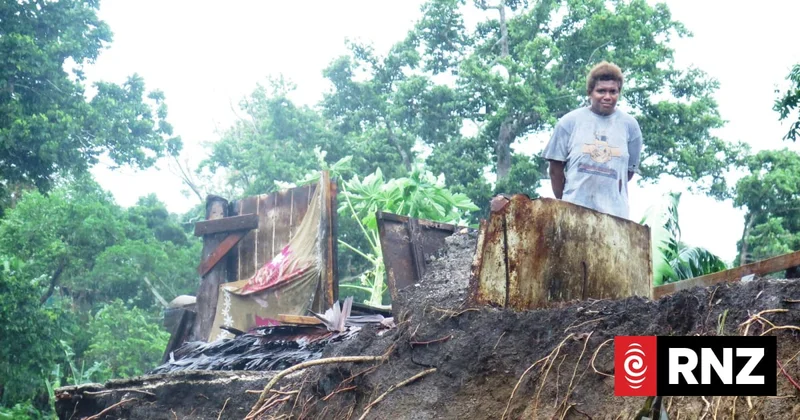
Pacific humanitarian workers face major logistical and access challenges, World Vision says
Access remains the biggest challenge for humanitarian workers in the Pacific Islands region, but humanitarians are not targeted as they are in other parts of the world, according to World Vision.
To mark World Humanitarian Day, World Vision, an international Christian humanitarian and development organisation, is highlighting the unprecedented risks faced by global humanitarian workers in recent times.
There has been a threefold increase in deaths of humanitarian workers over the past three years, with over 1000 deaths - mainly in Gaza, Ukraine, and Sudan.
World Vision said in such parts of the world, humanitarians and medical personnel are targeted by states they are trying to assist.
World Vision's Hanna Taylor-Moller told RNZ Pacific that in the Pacific, humanitarian agencies are not seeing the lawlessness and disregard for international humanitarian law that they were experiencing in other parts of the world.
Different challenges
Taylor-Moller said that there was a different suite of challenges facing humanitarian workers in the Pacific, a region of often remote islands spread across a wide region.
"When we are responding to things like climate-induced or climate-driven cyclones, it's making them worse," she said.
"But because we are responding to a lot of these areas by boat, small planes in the case of Papua New Guinea, access is the biggest challenge we are facing in the Pacific to reach the communities who really need it, who will often be a very small number of people in very very remote locations.
Climate-induced crises in the Pacific, particularly the impact of the El Niño cycle on cyclones and storms, present particular challenges for humanitarian agencies in their efforts to get help to communities.
"When you try and convey to people the work we do, people often like to hear these big numbers of the thousands of people reached, but the reality in the Pacific is that you'll go to huge effort to literally get food, supplies, soap, clean water to quite a small number of families in remote locations," she explained.
Daunting logistics
The logistics can be daunting, as humanitarian agencies set out to get clear information immediately following, for example, a natural disaster.
Taylor-Moller said often the internet or phone connectivity was very low in the Pacific Islands, making it hard to get the details out.
"The first port of call in a in a crisis is to find out what the needs are. And that's the first thing, trying to get people out to an area to assess it, local people who speak the language, who know the terrain, getting to find who's injured, who's in need of shelter, water, supplies, getting that information back - and then getting the necessary supplies out to these remote locations.
She said while humanitarian workers are operating in the Pacific often with a much higher degree of safety compared to what they're seeing in other countries and other responses.
"But the logistics are definitely a challenge. A lot of lot of sea, open water travel. Not as easy with the roads, that is for sure."