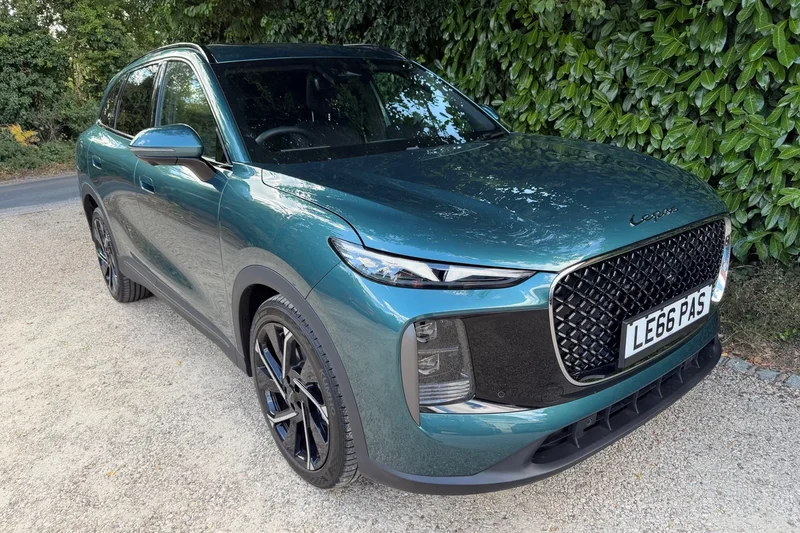
Living with a car for ten days tells you rather more about it than a few hours on a launch route. The initial excitement wears off, the buttons you thought were clever either become genuinely useful or completely forgotten, and you find out how a car fits into normal life rather than how it performs on somebody else’s carefully selected roads. That was especially interesting with the Lepas L8, not only because I had plenty of time to get to know it, but because my 27-year-old daughter, Gemma, drove it a lot, too. She came at it from a rather different perspective and, as it turned out, picked up on quite a few of the same things I did.
There’s another reason the L8 is interesting. Lepas is a completely new name in the UK – part of the Chery group alongside Omoda, Jaecoo and Chery itself – and this is a car that has to persuade people to take notice of it.
It’s a five-seat D-segment SUV, 4,688mm long, and for now it comes solely as a plug-in hybrid, although an electric version is due to follow in 2027. Prices start at £34,900 for the Essence, with the better-equipped Elevate at £37,900. My Elevate came in Expressive Emerald, a £500 option that took its on-the-road price to £38,400.
Before we get anywhere near how it drives, the L8 makes a pretty strong visual introduction. If it had the badge of a Western premium car maker on its nose, I reckon people would be talking rather more excitedly about the styling. There’s certainly a hint of Porsche about it; one friend took a look at the back and immediately said Porsche Cayenne, even pointing out that the style of the Lepas lettering adds to the impression. It’s a good-looking thing, nicely proportioned and rather more restrained than some of the more aggressively styled new SUVs we’ve seen recently.
I’ve seen some of the other cars Lepas has coming, too, and there are some really good-looking models on the way. I’m less convinced by the plan to differentiate the styling of the electric cars, though. I’d rather the company came up with one strong look and stuck to it across the range.
The name itself may take a little more getting used to. Gemma liked the looks almost immediately but wasn’t quite so taken with the word Lepas, even wondering whether the name could put some buyers off. That’s an interesting observation because new brands have enough work to do persuading people away from familiar brands without the name itself becoming part of the debate. What the L8 does have on its side is a specification sheet that makes you wonder how it has all been squeezed into a car costing comfortably less than £40,000.
How we tested
I lived with the Lepas L8 for ten days driving it on UK roads; everything from taking it through in Central London to longer motorway journeys around the M25 and up to the Midlands. I also got my 27-year-old daughter Gemma to drive it extensively and fed in her impressions, while we both assessed all aspects of ownership from practicality to the technology, running costs and how easy the car would be to live with.
Independent rating: 8/10
- Pros:Exceptional value, hugely impressive equipment levels, loads of passenger and boot space, handsome looks, useful electric range, upmarket cabin ambience
- Cons:Steering is far too light, too much road noise, annoying lane centring, ride can get crashy over bigger bumps, some cheaper interior plastics
Lepas L8 specs
- Price:from £34,900
- Engine/Battery size:1.5-litre petrol / 18.4kWh
- Maximum claimed range:537 miles
- Electric-only range:56 miles electric / 745 miles total
- Charging :Up to 40kW – 30 to 80 per cent in 20 minutes
Battery, range, charging, performance and drive
The plug-in hybrid system combines a 1.5-litre turbocharged petrol engine with an electric motor and an 18.4kWh battery. Total system output is 275bhp with 365Nm of torque, which gets the L8 from 0-62mph in a brisk-feeling 7.9 seconds and on to a maximum of 111mph. There’s an official electric range of 56 miles and, with a full battery and the 60-litre fuel tank filled, Lepas claims an overall range of as much as 745 miles. That combination appealed to Gemma in particular; she liked the efficiency of being able to do plenty of everyday journeys electrically while still having the petrol engine sitting there for longer trips – and she didn’t come close to needing to fill up once.
The hybrid system decides for itself how best to use the petrol engine and electric motor, although there are Pure, Eco, Comfort, Sport and Custom modes if you want to get involved. The battery can also be rapid charged (ish!), which isn’t something every plug-in hybrid offers. The maximum DC rate is 40kW and Lepas quotes around 20 minutes to get from 30 to 80 per cent charge. An included Vehicle-to-Load function can charge external devices at up to 6.6kW with a proper 230V three-pin socket in the luggage compartment, while there’s even Vehicle-to-Vehicle for sharing charge with other EVs, too.
Lepas has also made plenty of noise about the L8 being tuned specifically for European roads. Engineers worked on the steering, suspension and body control following testing in Europe and the UK, with MacPherson struts at the front and a multi-link arrangement behind.
Unfortunately, the steering is also my biggest issue with the car, which I felt from the moment I first drove away – it’s just too light. Even switching into Sport doesn’t give me anything like the weight I’d like through the wheel and, although the car goes exactly where you point it, there’s a slight feeling of detachment that means you don’t have quite the sense of control I’d expect in a car that has supposedly had so much attention paid to its European steering calibration.
The interesting bit is that the L8 supports over-the-air updates, so I’d love Lepas to have another look at the steering software set-up. I’m not asking it to turn the L8 into a sports SUV because that would miss the point completely. Just adding a little more weight would make it feel more reassuring and connected from behind the wheel, and add a bit more of a premium feel, too.
Another candidate for software updates is the lane-keep assistance system, which both Gemma and I found a bit over-zealous. I’m more used to these systems interfering too much, particularly on Chinese models, but Gemma found it strange that a supposed safety system would make you feel anything but safe as it pulls you back into lane. Again, an over-the-air update would be welcome here.
Ride comfort is generally okay rather than outstanding. Most of the time it deals reasonably well with the sort of roads we have to put up with in Britain, although bigger bumps can catch it out and make things feel a little crashy. And let’s be honest, finding a big bump on a British road isn’t exactly difficult at the moment.
Refinement was also a little disappointing. Elevate versions get an acoustic laminated windscreen and front windows, and there’s Active Engine Noise Cancellation as well, so I expected the L8 to be quieter than it actually is. Road noise is particularly noticeable and the Kumho tyres on my car seemed to be playing quite a part in it – I suspect a tyre swap would help. When so much else about the L8 is trying to create the impression of a premium SUV, that background roar stands out more than it otherwise might.
Then there’s the sound the car deliberately makes at very low speed when it’s running electrically. You can hear it very clearly from inside and it became something of a talking point during our ten days with the car. I thought it sounded a little like an ice-cream van; Gemma’s description was much better – apparently, it’s the noise fairies would make! I was particularly conscious of it when creeping very slowly past some horses on a country lane because it seemed loud enough to attract their attention. Thankfully they ignored it completely.
Interior, practicality and boot space
The cabin is where the L8 starts making a particularly persuasive case for itself because there is an enormous amount of space. A 2,800mm wheelbase helps provide plenty of room in the back, where Lepas quotes 970mm of rear legroom, and nobody who spent time in the car with me complained about being cramped.
Gemma reckoned it was a decent-sized car without feeling like a particularly huge SUV when she was driving it, which is a useful trick for something that measures 4,688mm from nose to tail. (For context, a full-size Range Rover is 5,052mm long and a Volvo XC60 is 4,708mm). There was plenty of room for Elvis the Labrador in the back, too, which is an equally important part of Gemma’s practicality test, while my larger Goldendoodle, Sky, was also happy in the back.
The boot capacity is a useful 507 litres with the rear seats upright and 1,314 litres once they’re folded. There isn’t masses of hidden space below the boot floor, but there is enough to get a charging cable underneath along with a few other odds and ends, which is really all you need.
Where the L8 really goes to town is on making the cabin feel like somewhere rather special to be sat in. The big panoramic roof brings plenty of light in and the Elevate gets 256-colour ambient lighting, while there are lots of plush materials across the dashboard and the upper sections of the doors. Then you start finding all the toys. Both front seats are electrically adjustable, heated, ventilated and have a massage function, and they’ll recline far enough for you to have a decent lie down while the car’s parked. Even the rear seats recline, so passengers get a little of the lounge treatment as well.
Then there’s the fragrance system, which was one of Gemma’s favourite features. You can choose the fragrance you want and then decide how strongly you want the cabin to smell of it. Add the Nano-Aqua Ion air-purification system and you get a real sense that Lepas has tried to make the L8 feel relaxing rather than simply cramming it with gadgets. After ten days, these weren’t just things I’d tried once for the sake of a review; we actually spent enough time with the car to enjoy them.
Not everything inside feels quite as special as I initially expected, though. The front seats are a little firm for my liking and, more importantly, they could do with offering better basic support. It’s slightly odd to have seats that will heat you, cool you, massage you and virtually turn themselves into beds, yet leave you wishing the fundamental seat shape was a little better.
Quality is similarly mixed. Most of the areas you look at and touch regularly make a good impression, with plenty of plush surfaces around the dashboard and door tops, but there are also some disappointingly cheap-feeling plastics on the doors – and they’re not all hidden away right at the bottom.
Gemma noticed the same thing, describing the L8 as a car that looks and feels premium in most places but reveals the odd little area where it’s clear some money has been saved. That’s fair, although the other part of her verdict is equally important: for this money, she thought the overall package was sensational value and I’d agree.
Technology, stereo and infotainment
The 13.2-inch portrait touchscreen dominates the dashboard and it’s one of the bits of the car both Gemma and I liked. Portrait screens don’t always make the best use of their shape, but this one works especially well, since Apple CarPlay fills the whole display. The Maps app look especially good stretched across the big vertical screen and it gives the interior another little premium touch without making anything unnecessarily complicated.
There is one small quirk when you want to leave CarPlay and return to the Lepas menus: you swipe upwards from the bottom of the display. It takes no time at all to learn, though – since it’s the same home action as on an iPhone – and once you know what to do it really isn’t an issue. The Lepas menu system itself is about par for the course. There’s a fair amount packed into it, as there tends to be in Chery group cars, but I didn’t find it unusually difficult or frustrating to use.
The main screen is backed up by a 10.25-inch digital driver display, while the rest of the connectivity list includes 4G, connected navigation, the “Hello Lepas” voice assistant and both software and firmware updates over the air. There’s a 50W wireless phone charger with active cooling, which should help stop your mobile overheating while it charges, plus USB-A and USB-C ports for passengers in both the front and rear.
Elevate cars also get an eight-speaker Sony audio system in place of the six-speaker set-up in the Essence. It’s reasonably good rather than outstanding, with decent clarity and separation between the different elements of a track. I’d just like a little more bass; it lacks a bit of weight at the bottom end and would benefit from a touch more punch.
The quantity of safety and driver-assistance technology is another reminder of how much equipment Lepas is putting into the car. There are 10 airbags, plus adaptive cruise control, autonomous emergency braking, forward collision warning, lane-departure warning and prevention(which I’ve already mentioned needs a bit of tuning), blind-spot detection, rear cross-traffic alert and braking, traffic-jam assistance and integrated cruise assistance among a long list of systems.
Move up to the Elevate and there’s more assistance when you’re parking, with front and rear sensors, a 540-degree panoramic camera, Advanced Parking Assist and Remote Parking. They’re useful features on a car of this size, although Gemma’s point about the L8 not actually feeling particularly big from behind the wheel is worth repeating. Spending ten days with it rather than simply moving it around a launch-event car park also showed that the technology doesn’t dominate the experience; most of the time it’s simply there doing its job.
Prices and running costs
It’s impossible to talk about the L8 for long without coming back to the price, because the amount of equipment you get is hugely impressive. The Essence starts at £34,900 and already comes with 19-inch alloy wheels, LED lights, a panoramic sunroof, dual-zone climate control, rear air vents, the two digital displays, connected navigation, Apple CarPlay and Android Auto, 50W wireless charging and a long list of safety systems. It’s hardly an entry-level model in the old-fashioned sense.
The Elevate costs £37,900 and moves to 20-inch wheels while adding acoustic laminated front windows, electrically adjustable front seats, four-way powered lumbar adjustment for the driver, heating, ventilation and massage for both front seats, a heated windscreen, hands-free powered tailgate, ambient lighting, the fragrance system, air purification, a rear fold-out table, Sony stereo and the upgraded parking technology. My Expressive Emerald test car came to £38,400.
It was that price versus what you actually get that Gemma kept returning to during her time with the L8. She liked the efficiency of the plug-in hybrid system, thought the car felt properly posh, loved the screen and the styling, and could see the places where money had been saved, but still came away describing it as sensational value. That seems a pretty good summary of the proposition because the L8 isn’t pretending those cheaper bits of plastic aren’t there; it simply surrounds them with an extraordinary amount of equipment and space for the money.
There’s a useful ownership package behind it, too. Lepas says more than 50 UK showrooms had been signed by July 2026, with a target of 60 by the end of the year and 90 by the end of 2027. Owners can also use the wider authorised Omoda, Jaecoo and Chery service network, while routine servicing is listed at one year or 10,000 miles.
The manufacturer warranty lasts seven years or 100,000 miles and the battery gets eight years or 100,000 miles of cover. There’s also a 12-year anti-perforation warranty and 12 months of RAC breakdown cover.
The verdict: Lepas L8
The L8 has loads going for it: space, equipment, electric range, looks and a genuinely posh feel for the money. Many of the bigger issues can easily be improved with an over-the-air software update to improve the steering weight and relax some of the in-car warnings. If Lepas could sort that it could gain another point and be an even more complete PHEV competing for class honours.
Lepas L8 rivals
FAQs
How long does it take to charge?
The Lepas L8 has an 18.4kWh battery and can DC rapid charge at up to 40kW. Lepas says a 30 to 80 per cent charge takes around 20 minutes in suitable conditions. AC charging is also supported.
How much does the Lepas 8 cost - is it worth it?
The Lepas L8 starts at £34,900 for the Essence, with the better-equipped Elevate costing £37,900. My Elevate test car came to £38,400 with its £500 Expressive Emerald paint. The equipment level, passenger space, 56-mile claimed electric range and generally upmarket feel make the price one of the strongest parts of the package, although the light steering, road noise and some cheaper cabin plastics show where compromises have been made.
Does Lepas replace batteries for free?
Lepas covers the L8’s battery for eight years or 100,000 miles, while the car itself gets a seven-year or 100,000-mile manufacturer warranty.
Why trust us
Our team of motoring experts have decades of experience driving, reviewing and reporting on the latest EV cars, and our verdicts are reached with every kind of driver in mind. We thoroughly test drive every car we recommend, so you can be sure our verdicts are honest, unbiased and authentic.