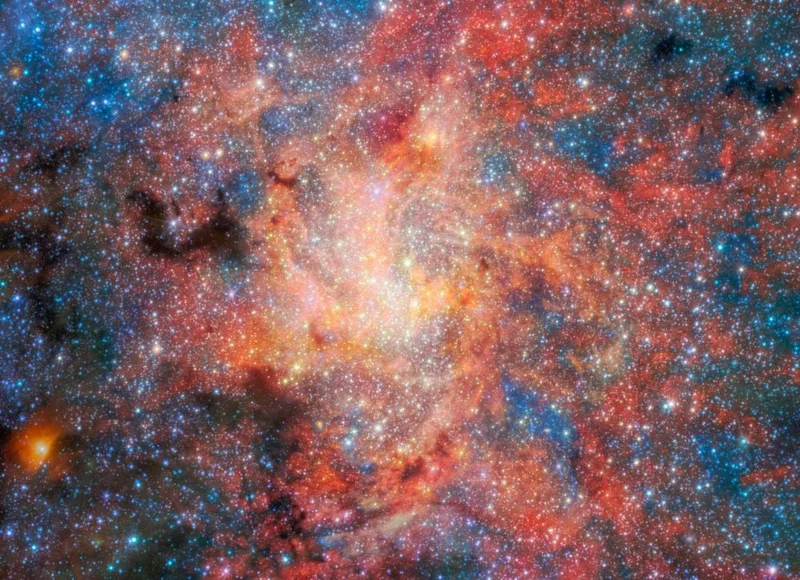
The Milky Way's galactic center is dominated by its supermassive black hole (SMBH) Sagittarius A-star (Sgr. A*). It doesn't just dominate with its massive gravititional pull. It also overpowers the region with radiation that should destroy dust and other molecules.
New research shows that water and dust exist around a star near Sgr. A*. These materials were shed from a star near the SMBH, and they exist there despite the overwhelming radiation coming from the SMBH.
The star is named IRS 3, and it's a highly-evolved AGB star only about 0.55 light years from the massive SMBH. The star has about 6 solar masses and is about 72 million years old. Astronomers are interested in the connection between these stars and the interstellar medium (ISM). AGB stars can lose up to 70% of their mass during this phase, and that material has a powerful effect on the composition of the ISM.
In new research published in Astronomy and Astrophysics, astronomers used the JWST to observe IRS 3 and the area around it. Their work is titled "Dust production in the harsh environment of Sgr A*," and the lead author is Florian PeiÃker. PeiÃker is a post-doctoral researcher in the Institute of Physics at the University of Cologne in Germany.
"Studies of the interstellar medium (ISM) have frequently revealed signatures of the dust produced in the envelopes of asymptotic giant branch (AGB) stars, demonstrating a connection between the dust composition of the ISM and that of AGB stellar envelopes," the researchers write. "Investigating this relationship in the extreme, radiation-dominated environment surrounding Sgr A*, the center of our own galaxy, reveals how such conditions might influence dust composition and the recycling of material in galactic centers."
The Milky Way's galactic center is known for the intense radiation coming from Sgr. A, including powerful x-ray flaring and gamma radiation. The researchers used the JWST's NIRCam to image the region, and its Mid-Infrared Instrument (MIRI) and its medium resolution spectrometer to study IRS3. "We aim to conduct a comprehensive spectral analysis to more tightly constrain the dust composition and line-emitting species within the envelope of IRS 3 in the immediate vicinity of Sgr A," the researchers write.
This is a mid-infrared image of the region around IRS 3 from the research. A yellow à marks the SMBH Sgr A, and IRS 3 is labelled inside its callout box. The distance between Sgr A and IRS 3 is about 0.17 parsecs. "The emission from IRS 3 is dominated by the extended envelope of the AGB star," the authors explain. Image Credit: PeiÃker et al. 2026. A&A.
To their surprise, they found that alumina and amorphous silicates are present in the dust. They also found water, another surprise. "For the first time, we find clear signs of water in the envelope of IRS 3," they write.
âGalactic centres are among the most extreme environments, so understanding whether stars can continue enriching their surroundings there is an important question,â said lead author PeiÃker in a press release. âWith Webb, we can directly observe how stars behave under these conditions and see that dust production remains remarkably resilient.â
Astronomers' interest in IRS 3 goes back decades. It's one of the brightest mid-IR sources in the galactic center, and the researchers describe it as the "most prominent AGB star within the inner parsec of the Milky Way." The star sits inside a massive gaseous cocoon that extends an estimate 10,000 astronomical units. Based on the JWST's spectroscopic data, the star's dusty envelope has a shell-like distribution shaped by a temperature gradient. The temperature changes from approximately 1200 Kelvin close to the star, to about 100 Kelvin in the outer regions.
AGB stars shape the ISM's composition with the types of dust they inject into it. "Analysis of the MIRI MRS spectrum reveals the presence of amorphous silicates, Al2O3, and H2O," the authors write.
But the amount of dust matters, too, and the researchers studied the star's bow shock to determine IRS 3's mass loss rate. They determined that it's shedding about 20 Earth masses per year, or one Earth mass every 18 days. They say that this is "characteristic of the superwind phase of an O-rich AGB star."
This image from the research shows the estimated stand-off distance between the IRS 3 and its bow shock. "The stand-off distance is a measure of the ambient ISM and the ram pressure of the star," the authors explain. Understanding this distance helps the researchers determine the star's mass loss rate. In this image, the green x marks the position of IRS 3 and the green circle marks the apex of the bow shock. Image Credit: PeiÃker et al. 2026. A&A.
âThis discovery was possible because of Webbâs highly capable infrared instruments,â said Macarena Garcia Marin of ESA, a co-author of the study and PI of the MICONIC programme. âThis is the first time a continuous mid-infrared spectrum has been collected for this star, allowing us to detect the features from the silicate dust and uncover the starâs true chemical identity.â
âThe detection of water is especially exciting because it shows that molecular material can survive in an environment dominated by intense radiation,â said Macarena. âThis tells us that even close to a supermassive black hole, stars can continue contributing material back into their surroundings.â