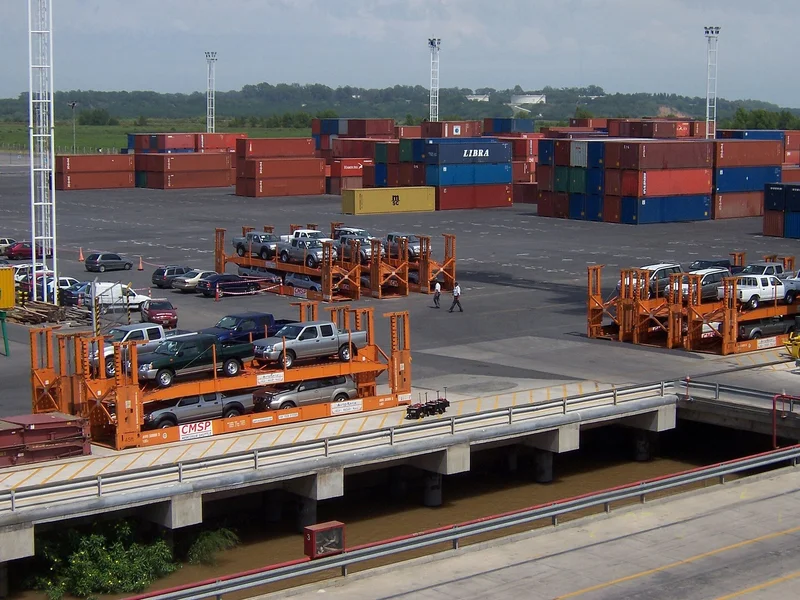
Argentina Imports of Consumer Goods Hit a Record US$5.4 Billion
Argentina · Economy
The number of firms bringing consumer goods into the country has doubled since 2023, and imported pasta is up more than 500%.
Argentina imports of consumer goods reached US$5.36 billion in the first half of 2026. The highest figure on record for any January-June stretch.
That is 34.7% more than the same months of 2023, when the country still rationed access to dollars. A strong peso is doing most of the work.
A Record Half-Year, With a Catch
Argentina imports of consumer goods were measured by CEPA, a Buenos Aires research centre, in a report dated 17 August 2026. It put the first-half total at US$5.36 billion.
That beats the previous first-half record, set in 2018, by 20.7%. The 2018 total was US$4.44 billion.
Still, the catch matters. Compared with the first half of 2025, the increase was only 1.8%.
Why Argentina Imports Are Suddenly Cheap
The short answer is the exchange rate. The official wholesale dollar closed at ARS 1,487.50 on 14 August 2026, its lowest level of the month.
Since April 2025 the peso has floated inside a band set by the central bank. The ceiling sat near ARS 1,860, so the currency was trading about 25% below the level that would trigger intervention.
Meanwhile prices at home kept climbing. Consumer prices rose 2.1% in July and 19.3% over the first seven months of 2026, INDEC reported.
In other words, wages and local costs rose in pesos while the dollar barely moved. As a result, anything priced abroad became relatively cheaper.
The 500% Figure, Explained
The eye-catching number is real, but it is narrower than it sounds. CEPA found imported pasta up 530.8% and fresh or preserved meat up 315.2%.
Both comparisons run from the first half of 2023 to the first half of 2026. That is a three-year gap, not a year-on-year jump.
For instance, the same report puts the whole consumer-goods basket up 34.7% over that stretch. No broad category comes close to 500%.
Which Goods Are Actually Arriving
Household appliances, batteries and lamps led the way, up 109.2% against the first half of 2023. Clothing followed at 86.3%.
Motorcycles, bicycles, yachts and similar transport equipment rose 67.6%. Food products gained 51.9%, while pharmaceuticals added 27%.
Within food, the spread is wide. Oils and fats rose 93.9%, bakery goods 90.1% and chocolate and confectionery 45.4%.
By contrast, one residual food grouping actually fell 13.9%. So the boom is uneven rather than universal.
Thousands of New Importers
Perhaps the bigger structural shift is who is doing the importing. CEPA counted 33,108 new importing firms, roughly double the number active three years earlier.
Clothing saw 3,516 new entrants, a 175% rise. Leather goods added 2,866 firms, up 144%.
Appliances, batteries and lamps drew 2,180 newcomers, a 127% increase. Jewellery, toys and musical instruments added 4,022 firms, up 96%.
Even so, the trade stays concentrated. Ten activities account for 84.7% of all consumer-goods imports, and the top five alone account for 45.5%.
What the Official Trade Data Shows
INDEC’s own trade report tells a calmer story at the aggregate level. In June 2026, total imports came to US$6.86 billion, up 7.3% on a year earlier.
Exports reached US$9.06 billion that month, up 24.5%. That left a surplus of US$2.19 billion, the 31st positive month in a row.
For the first half as a whole, total imports were US$35.53 billion, down 3.9% from 2025. The half-year surplus came to US$13.92 billion.
Because total imports slipped while consumer goods held up, the consumer share climbed. That is why 15.1% is the headline number, not the raw growth rate.
Caputo’s Debt Swap, Dated Precisely
Economy Minister Luis Caputo has run bond conversions this year, though the big one was in June rather than August. Resolution 31/2026 appeared in the Official Gazette on 9 June 2026.
It converted inflation-linked Boncer bonds held by the central bank, series TZX28 and TZXD7, into a basket of dollar bonds. The mix was 66% Bonar AL35 and 34% Bonar AE38.
The operation was executed on 5 June and settled on 8 June. Ambito Financiero put the nominal size at about US$7.5 billion.
Since this was a swap between the Treasury and the central bank, there was no market take-up rate to publish. Analysts read it as a way to build collateral for a repo loan from foreign banks.
A separate exchange offered to private holders was auctioned on 12 June, under Joint Resolution 32/2026. It let owners of the TZX26 and TTJ26 bonds, both maturing 30 June.
Move into new dual-rate bonds due in 2028, 2029 and 2030, for up to ARS 32.5 trillion, near US$21.9 billion. August brought a routine auction instead.
On 12 August the Treasury placed ARS 4.49 trillion, about US$3.0 billion. Against roughly ARS 4.5 trillion falling due, a rollover of 100.26%.
The New Rules on Dollar Loans
The clearest fresh policy is the loosening of dollar credit. Caputo presented the change on 13 August 2026, and decree 736/2026 was published the next day.
The decree rewrote article 23 of a 2002 rule that had ring-fenced banks’ dollar deposits. Before, those deposits could largely only fund exporters and firms with foreign-trade income.
Now banks may also lend to companies that earn no dollars at all. The central bank capped that new lending at 15% of each bank’s dollar deposits.
The guardrails are real. These loans carry a minimum capital requirement equal to 125% of comparable lending.
And count as 1.25 times their value against large-exposure limits. Borrowers must also sell the dollars in the official market and use pesos.
In short, the measure is designed to add dollar supply rather than let firms hoard the currency. An earlier step came in June.
Central bank Communication A 8446, dated 11 June 2026, had already allowed dollar loans to non-exporters backed by an exporting guarantor.
What This Means on the Ground
For shoppers, the effect is visible on shelves and screens. Imported appliances, clothes and packaged food are competing on price in a way they could not three years ago.
For local producers, the same trend cuts the other way. Cheaper foreign goods squeeze margins, particularly in clothing and small appliances.
Yet the aggregate numbers argue against panic. Total Argentina imports fell in the first half, and the country still ran a US$13.92 billion trade surplus.
What to Watch Next
The next INDEC trade report, covering July, was scheduled for 20 August 2026. It will show whether the consumer share keeps rising.
The other thing to track is the peso. If inflation stays near 2% a month while the dollar drifts, imported goods keep getting cheaper in real terms.
Finally, watch how much of that 15% dollar-lending allowance banks actually use. Take-up will say more about confidence than any announcement.
Frequently Asked Questions
Did Argentina’s consumer-goods imports really rise more than 500%?
Not as a whole. One narrow line, pasta, rose 530.8%, and meat rose 315.2%.
How big are Argentina imports of consumer goods right now?
CEPA put consumer-goods imports at US$5.36 billion for January to June 2026. That is a record for any first half, and 20.7% above the previous peak of US$4.44 billion set in 2018.
What did Caputo’s debt swap actually do?
Resolution 31/2026, published on 9 June 2026. Converted inflation-linked Boncer bonds TZX28 and TZXD7 held by the central bank into dollar Bonar bonds, split 66% AL35 and 34% AE38.
What changed for dollar loans in Argentina?
Decree 736/2026, published on 14 August 2026, lets banks use dollar deposits to lend to firms that do not earn foreign currency. The central bank capped this at 15% of each bank’s dollar deposits and set tougher capital rules.
This article was produced by The Rio Times’ automated newsroom system. How we use AI · Report an error