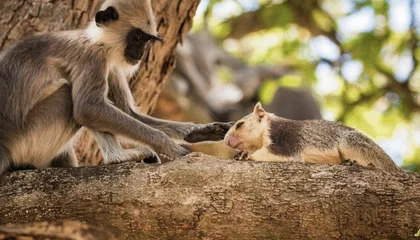
When a mouse wandered into the white-cheeked gibbons’ enclosure in the Shanghai Zoo, the monkeys didn’t try to eat it—or even chase it away. One female primate scooped up the rodent and gently held and caressed it. University of Oxford evolutionary biologist Cyril Grueter watched the interaction, and he was mystified.
“I wasn’t quite sure what I was looking at,” he wrote in an article for the Conversation. “The gibbon treated the tiny rodent with remarkable gentleness. I couldn’t stop wondering why.”
Working with an international group of researchers, Grueter then uncovered more examples of primates interacting closely with other species. A young male bonobo carefully cradled a mongoose pup. Some monkeys climbed onto the backs of pigs; others mounted deer. A tufted gray langur stroked a squirrel. A group of stump-tailed macaques worked together to groom a stray dog.
In all, the team tallied 427 cases from scientific papers, media reports and a global survey of 37 primatologists. The interactions, most of which included play or grooming, occurred both in the wild and in captivity. They involved 88 primate species alongside 127 other species. The researchers published the findings in July in the journal Primates.
The compilation reveals that “this is quite a common behavior,” Grueter tells New Scientist’s Michael Marshall. The new work is only a first step, but it’s starting to fill a void on the subject in the mainstream scientific literature, he adds. “We’re hoping that this study is also a wake-up call for primatologists, or zoologists more generally, to look for similar behaviors in both the wild and in captivity.”
One of Grueter’s favorite encounters occurs in Japan, where macaques have been regularly seen grooming and riding on the backs of sika deer. “It starts with something mundane: Macaques feeding in trees drop fruit and leaves that deer eat, and deer also consume macaque feces around sleeping sites,” Cédric Sueur, an animal behavior researcher at the University of Strasbourg in France, tells Smithsonian magazine. But it doesn’t stop there: “Macaques groom deer and eat their parasites, play with them and ride them.” They even try to mate with the deer, a behavior that might be spread through social transmission among the primates.
Sueur has published studies on the macaques and deer, but he was not involved in the new research. With the team’s assembled anecdotes, he says, “scattered curiosities become a dataset one can interrogate.” But he emphasizes that the observations were not a designed experiment. “The numbers describe where scientists and cameras have been, not how often these behaviors occur,” Sueur says.
Not all interactions documented by the team seemed friendly. Twenty-six of the incidents were deemed “abusive,” though these ranged widely. In one case, a male baboon in Saudi Arabia seemed to have “kidnapped” a domestic puppy, per the paper, and carried it around for long periods. The researchers identified 13 instances where the other animal died from violent handling, including birds, pangolins, primates and a domestic cat. These cases did not necessarily stem from ill will or aggression on the part of the primates—some might have simply been botched attempts at caring for the other creature.
Patterns emerged in how the primates interacted with other species based on their age and sex. Juvenile primates were more likely to engage in play, while females were more likely to groom. Most interactions were initiated by the primates.
These reports may shed light on the evolutionary origins of pet-keeping behavior in humans, the team writes. Of course, these cross-species relationships aren’t the same as humans having a cat or a dog. “The authors say so themselves: Nearly all these interactions are ephemeral, whereas keeping a pet is a durable, caretaking bond,” Sueur says. But the behaviors “may represent some of the evolutionary building blocks from which human-animal companionship eventually emerged,” Grueter adds in a statement.
The findings indicate that “some of the behavioral capacities that make pet-keeping possible (curiosity, tolerance, caregiving and maintaining long-term relationships with another species) did not suddenly appear in humans but have deeper evolutionary roots,” Grueter adds in an email to Defector’s Sabrina Imbler.
Did you know? When did pet-keeping emerge?
Researchers do not know exactly when people started keeping pets, but evidence of domestication reaches to at least 12,000 years ago. A 14,000-year-old grave in Germany preserved a man and woman buried alongside a dog, whose bones showed evidence that it had been cared for.
A few cases, however, showed some longer-term care. A group of black-striped capuchin monkeys seemingly adopted an infant common marmoset in Brazil in 2004. The young monkey received care from two “adoptive ‘mothers,’” per the paper, and tolerance from others in the group, where it remained for at least ten months. A captive western gorilla named Koko showed maternal behaviors—from grooming to cradling and protective posturing—toward a kitten named All Ball in the 1980s. News reports in 2017 described a crested macaque in an Israeli zoo cuddling, grooming and playing with a chicken that wandered into its enclosure.
Next, Sueur says, he would like to see “studies that take the other species’ point of view." He adds: "Almost everything we know is measured from the primate’s side; deer, dogs and pigs are treated as the setting rather than as partners.” If some of these interactions, such as the primates riding the sika deer, are to be seen as shared culture between the species, then they are not one-sided. This kind of relationship, he adds, “only makes sense if you watch both.”