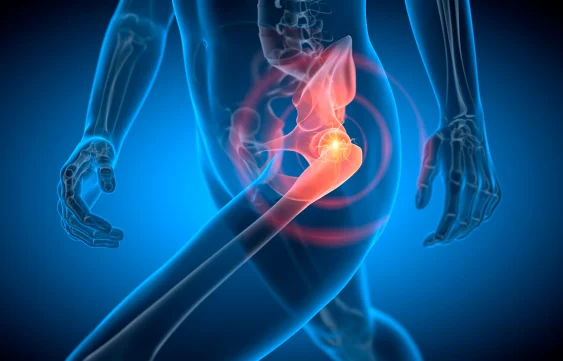
There’s a lot of research on the female pelvis, and for good reason. The so-called “obstetrical dilemma”—why childbirth seems particularly difficult for humans compared to other mammals—involves a lot of questions about evolutionary trade-offs, the development of the upright gait, cranium size, and the female pelvis. The male pelvis, on the other hand, has been relatively overlooked—until now. A new study published in Scientific Reports finds some fascinating evolutionary innovations that are unique to men’s pelvises.
An international team of researchers led by anthropologists from Tel Aviv University carefully analyzed 91 modern human pelvises (63 male, 28 female) and compared them with two complete male Neanderthal pelvises. According to the team, the male modern human pelvis is unique among the three, with hip sockets oriented more toward the front of the pelvis. They concluded this pelvic configuration constitutes an adaptation that benefits human locomotion.
Read more: “How Walking Upright Made Early Humans Smart”
Walking has been described as a series of controlled falls. When you walk, you destabilize your center of gravity, then interrupt an embarrassing trip to the ground by swinging your leg forward to catch yourself, and so on. During these controlled falls, your body drops downward, which both stresses your joints and requires energy to recover from.
Per the team, the unique architecture of the human male pelvis means we do a better job of dealing with both of these issues. Because our legs are positioned slightly more forward, our quads both absorb the shock of stepping and spring our bodies back upward. This more energy efficient gait may give men an advantage over long distances. Because they were constrained by the demands of childbirth, women’s pelvises weren’t able to develop these modifications, researchers say.
Additionally, these new findings could help inform further research with implications that go beyond human evolution. “Understanding the evolution of our walking mechanism can contribute to contemporary research in biomechanics, musculoskeletal medicine, rehabilitation, and injury prevention,” study author Ella Been of Ono Academic College explained in a statement. “The perspective provided by the Neanderthals helps us better understand the modern human body.”
It’s important to stay in touch with your own body—and sometimes it takes a look back at where we’ve been to understand how far we’ve come.
Lead image: peterschreiber.media / Adobe Stock