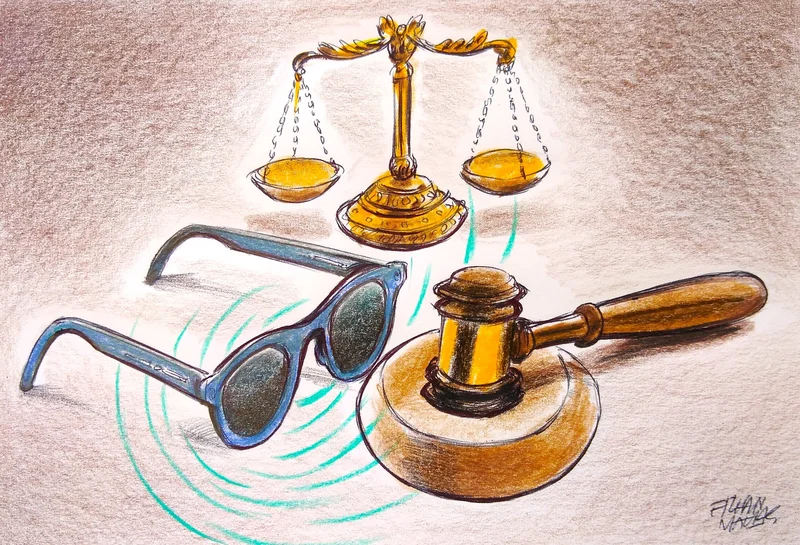
Artificial intelligence is becoming an inseparable part of daily life, quietly shaping how we see, judge and remember the world around us. Yet one layer has always been assumed to remain untouched: the footage of our own faces, homes and conversations. That footage is personal, and no one else has the right to use it for individual or commercial gain. Meta's new generation of AI-powered glasses has reopened this question with unusual urgency, and it is really two debates in one: an ethical debate over consent and dignity, and a legal debate over who, if anyone, is answerable when things go wrong.
The scale of Meta's ambition makes the question hard to avoid. Having invested $80 billion in its latest hardware push, Mark Zuckerberg's company is unlikely to abandon its bet on smart eyewear, devices likened to face-mounted smartphones. More than a decade after Google's first smart glasses failed to find an audience, Meta is betting that a more stylish, functional and affordable product can finally make camera-equipped eyewear as unremarkable as the handheld phone. The new models record video, take photos, identify objects and answer questions through a built-in AI assistant, all without a hand ever leaving one's side.
The ethical case against that ambition starts with a simple asymmetry: the wearer consents to the device, but the people around the wearer do not. A small LED indicates when the camera is recording, but critics argue it is too subtle to give bystanders meaningful notice, and academic surveys of wearable technology have a name for this: Bystander privacy, which is the risk that a device's sensors identify or expose people who never agreed to be filmed.
It is not a new concern. Workplaces banned Google Glass a decade ago for the same always-on-camera reason. What is new is what happens after the recording. Footage can now be transcribed, cross-referenced and linked to identities almost instantly, and the harms that follow are no longer hypothetical.
Image-based sexual abuse and cyberflashing accounted for more than half of an 11% rise in reported sexual offenses in England and Wales in the year to March 2025. In one documented case, footage of someone taken without consent was only removed after the subject paid a fee. Separately, the British lawmaker Jess Asato is suing the AI company xAI after its Grok chatbot produced fake, sexualized images of her.
A quieter ethical question sits beneath these headline harms: researchers note that wearers of such devices rarely own the data generated about them, so even those who freely choose to wear the glasses cede more control than they realize.
None of this makes the ethical debate one-sided, and fairness requires acknowledging the other view. Proponents note that hands-free recording has genuine accessibility value for people with mobility or vision limitations, or for real-time hazard identification. They also argue that adults have some right to choose their own tools, including ones that carry personal risk.
The honest ethical test, as researchers studying wearable adoption put it, is whether the benefits outweigh the costs. The trouble is that with smart glasses, the benefits accrue mostly to the wearer while the costs, such as being filmed, profiled or misidentified, fall on people who were never asked. That asymmetry, more than the technology itself, is what makes this an ethical problem rather than a matter of taste.
The legal debate is, if anything, further behind. The United Kingdom Online Safety Act and the European Union Digital Services Act were built to police platforms and content, not always-on capture devices. Legislators are only belatedly recognizing that they need to anticipate this kind of harm rather than respond to it after the fact. One report from the Social Market Foundation went so far as to call unchecked misinformation a "silent killer of trust."
Europe's General Data Protection Regulation (GDPR) technically already applies to Meta's glasses: its data-protection obligations, including consent and data-minimization requirements, apply to any product that processes personal data, not only to certified medical devices. That is a rule long enforced against health wearables but rarely tested against lifestyle gadgets that capture bystanders' faces.
In the United States, the situation is not better. The comparable health-privacy law, the Health Insurance Portability and Accountability Act (HIPAA), applies only to "covered entities" such as insurers and providers, leaving consumer AI glasses almost entirely outside its scope.
China's newer personal-data law shows the same unresolved core problem from a different angle: it requires "informed consent," but regulators themselves acknowledge the term still lacks a workable definition, precisely the ambiguity the LED-light debate turns on in the U.K.
Underneath these specifics sits one real legal fork in the road: should camera glasses be regulated lightly, as ordinary consumer electronics with a disclosure notice, or strictly, as biometric-capable surveillance devices comparable to the medical wearables that already face certification regimes such as the EU's CE-marking or the U.S. Food and Drug Administration's clearance process?
Regulators have not chosen, and neither have courts settled, who bears liability when harm occurs – the manufacturer that designed a barely visible recording light, the wearer who chose to film, or the platform whose AI processed the result.
Neither debate should end in an outright ban. Some governments already know that blunt instruments exist, from Saudi Arabia's confiscation of the glasses at its borders to Germany's earlier ban on children's smartwatches over hacking risks. But a ban forecloses genuine benefits along with genuine harms.
A narrower, more defensible path already has a template in established data-protection principles: limit collection to a stated purpose, require fresh consent for any secondary use, and be transparent about what is stored.
Japan's requirement that phone cameras make an audible shutter sound shows a low-cost precedent worth borrowing. A similarly unmissable recording signal, paired with real consent defaults for bystanders, would cost manufacturers little.
Meta's glasses are not going away, and the appetite for hands-free AI is only growing. The unresolved question is not whether such devices should exist, but whether the ethical and legal architecture around them keeps pace with what they can now do, or whether, as with Google Glass a decade ago, society is once again asked to decide the rules only after the technology has already normalized the harm.