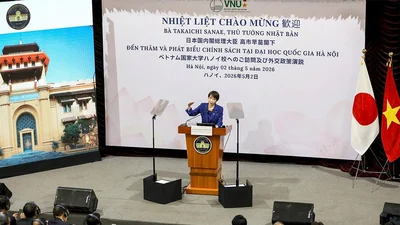
In May this year, the administration of Prime Minister Takaichi Sanae rolled out its vision for an updated Free and Open Indo-Pacific, stressing regional autonomy and resilience in the face of intensifying US-China tensions and instability in the Middle East. A noted authority on international security assesses the strengths and limitations of FOIP 3.0.
FOIP at Ten and Japan’s Diplomatic Push
The Free and Open Indo-Pacific is the most successful regional foreign-policy concept to come out of Japan in the post–Cold War era. Proposed by the second administration of Prime Minister Abe Shinzō in 2016 and elaborated by Prime Minister Kishida Fumio in 2023, FOIP treats the Indian and Pacific oceans, Asia, and Africa as a single strategic space and envisions an overarching regional order based on the rule of law, freedom of navigation, free trade, connectivity, and maritime security.
A central aim of FOIP was to expand the institutional, economic, and security options for the region’s countries to prevent the US-China rivalry from depriving them of freedom to maneuver. Japan’s FOIP concept moved away from the logic of drawing sharp lines between opposing blocs and instead conceived the Indo-Pacific as an “open order.”
In May 2026, with the initiative approaching its tenth anniversary, the administration of Prime Minister Takaichi Sanae issued a series of policy statements on the topic in three separate venues. On May 2, in a foreign-policy speech at Vietnam National University, Hanoi, Takaichi announced an “evolved,” or updated, version of FOIP. On May 3, while visiting Kenya—where Abe had officially unveiled the original initiative a decade earlier—Minister for Foreign Affairs Motegi Toshimitsu spoke on the theme of “Japan-Africa Relations and the Free and Open Indo-Pacific.” Finally, on May 31, at the Shangri-La Dialogue in Singapore, Minister of Defense Koizumi Shinjirō delivered a speech linking the updated FOIP to concrete joint security measures, including the buildup of defense capabilities, joint military exercises, intelligence sharing, cooperation on military equipment and technology, and defense-industry collaboration. Taken together, these three speeches position the updated FOIP as a coordinated diplomatic effort linking Japan’s engagement with Southeast Asia and Africa to a broader agenda of security cooperation.
A closer reading of Takaichi’s May 2 speech, together with materials distributed by the Ministry of Foreign Affairs, leaves little doubt as to the Japanese government’s intentions. While adhering to FOIP’s core principles of freedom, openness, diversity, inclusivity, and the rule of law, Takaichi’s plan stresses the need to adapt to new global and regional realities: intensifying geopolitical competition, accelerating technological innovation, and the rise of the Global South. To this end, it seeks to strengthen the autonomy of Indo-Pacific countries—their ability to determine their own future amid complex ties of interdependence—and their resilience—the capacity to withstand crises and coercion—in the economic, social, and security realms. This is the gist of Takaichi’s FOIP 3.0.
How the Energy Crisis Is Reshaping FOIP
Implicit in Takaichi’s speech was the larger goal of transforming FOIP from an abstract geopolitical concept into a policy framework shaping regional industries and everyday life. She conveyed both the depth and fragility of the region’s supply chains and economic interdependence, citing concrete examples: made-in-Vietnam consumer electronics that depend on Japanese companies for their core components; the training of semiconductor engineers at Vietnam Japan University; Japan’s role in the development of the Vietnam National Space Center and Vietnam’s earth observation satellite LOTUSat-1; and bilateral cooperation on rare-earth supply chains. As all of this suggests, FOIP is at once a geopolitical vision drawn across the maritime map and an increasingly concrete policy framework linking industrial parks, universities, satellite systems, semiconductors, ports, data centers, and more.
In this context, the government’s April 15 launch of POWERR Asia (Partnership on Wide Energy and Resources Resilience Asia)—a response to the crisis in the Strait of Hormuz—was a milestone of great significance. The initiative aims to build a comprehensive energy program that combines fuel procurement (supported by the Japan Bank for International Cooperation, Nippon Export and Investment Insurance, and the Japan International Cooperation Agency) with a regionwide stockpiling and release system and medium- and long-term structural measures encompassing energy conservation and the development and deployment of biofuels, next-generation solar energy, nuclear power, and liquefied natural gas. This is a bold attempt to expand the purview of FOIP from discussions about sea-lane defense to coordinated crisis-management policies aimed at protecting energy supplies and the region’s industrial base.
As we have seen over the past few months, when the supply of oil from the Persian Gulf is interrupted, the impact extends far beyond fuel shortages. Disruption in the supply of naphtha affects the production of a wide range of plastics and other petroleum-derived products, including critical medical supplies, as well as manufacturing more broadly. Takaichi’s updated FOIP seeks to frame this chain of vulnerabilities as a challenge for the regional order.
Supplies of critical minerals and pharmaceuticals are similarly vulnerable. In response, Japan has embarked on such policy initiatives as the Japan-Australia rare-earth project in Malaysia, programs for the recovery of critical minerals from discarded home appliances and automobiles in ASEAN countries, and diversification of pharmaceutical supply chains. These measures are best understood as practical preparations to prevent excessive dependence from becoming a source of political leverage.
The fact is that zero dependence is not a realistic option for Asia’s economies. What we need instead is a system that combines alternative sources, stockpiling, financial assistance, technological cooperation, and rule-making, so as to preserve multiple options for the region’s countries, even in the event of a crisis.
Implementing FOIP in AI, Rules, and Security
Policies governing artificial intelligence and data should also be understood in the context of regional autonomy and resilience. The FOIP Digital Corridor Concept calls for the regional development of infrastructure essential for the era of AI and data, including data centers, undersea cables, open RAN, satellite communications, and all-optical networks. In addition, it offers support for the development of native-language AI, industry-specific foundational models, and advanced AI talent development. As such, it goes beyond the construction of communication networks to address core issues affecting local communities.
Whose data should flow, and under what rules? What kinds of AI models should be adopted to support public administration, industry, disaster response, and education?
In the age of AI, national sovereignty will be shaped not only by military power but also by access to computing resources and data, standards, talent, and the capacity to shape norms. The FOIP Digital Corridor should be conceived as a public good designed to prevent countries in the region from becoming overly dependent on a closed technological sphere or surveillance-oriented infrastructure.
In terms of building a regional economic order, the focus of FOIP 3.0 should be the expansion and upgrade of the Comprehensive and Progressive Agreement for Trans-Pacific Partnership, or CPTPP (the successor to the US-supported Trans-Pacific Partnership). With the formation of a regional order in mind, Japan is spearheading an effort to extend high-standard free-trade rulemaking into the era of economic security. This emphasis is seen in Japan’s efforts to advance accession processes involving the Philippines, Indonesia, and the United Arab Emirates and in its focus on such issues as governance of e-commerce, measures for supply-chain resilience, and policies to combat market-distorting practices and economic coercion.
The withdrawal of the United States from the TPP in 2017, under President Donald Trump, was a blow to the entire concept of a rules-based free-trade regime. But by steadfastly maintaining the original agreement’s high standards, Japan has preserved vital options for the region going forward. The spirit of FOIP lies in the creation of institutional scaffolding that preserves options for individual countries during crises that threaten the international order.
The Takaichi administration also hopes to leverage Japan’s extensive policy experience to boost regional security. The idea is to enhance the capabilities of Japan’s regional partners through capacity-building in maritime law enforcement and maritime domain awareness (MDA), cybersecurity cooperation, Official Security Assistance (OSA), defense equipment transfers, and support for port and airport infrastructure. The Japan Coast Guard’s accumulated expertise—including maritime surveillance systems, the Coast Guard Capacity-Building Support Unit, and MDA using satellite data and information-analysis technologies—provides a foundation for regional countries to better safeguard their own waters. OSA also supports the sovereign capacity of regional partners through the provision of coastal surveillance radar, patrol boats, and unmanned aerial vehicles.
The Regional-Order Vision FOIP 3.0 Needs
Some in Japan have criticized FOIP 3.0 as lacking in specifics, but as the foregoing indicates, this assessment falls wide of the mark. In fact, the plan is remarkable for its wealth of detail. It creates an overarching policy framework that encompasses energy, critical minerals, AI and data, free trade, and maritime security, building on previous contributions via official development assistance, other official flows (OOF), private capital, coast guard cooperation, defense cooperation, and trade rulemaking. Takaichi’s FOIP 3.0 represents the intersection of the connectivity assistance introduced under Abe, the inclusivity stressed by Kishida, and today’s economic-security emphasis.
It is important to note, moreover, that the constituent policies are designed to reinforce one another. Preparing for an energy crisis also strengthens critical-mineral and manufacturing supply chains. Data infrastructure and communications networks, in turn, enable AI talent development and industrial upgrading. Rigorous rulemaking within the CPTPP enhances institutional resistance to economic coercion. Strengthening MDA and maritime law-enforcement capabilities helps ensure the safety of the maritime traffic on which regional supply chains depend. When coherent policies are situated within a compelling strategic narrative, their combined effect can exceed that of the individual measures. Herein lies the potential of Takaichi’s FOIP 3.0.
What remains lacking, in my view, is an overarching vision of the regional order these policies are intended to support. Abe’s FOIP gave Japanese diplomacy a new geographical imagination, linking the Indian and Pacific oceans and connecting Asia with Africa. Kishida’s FOIP injected ideas of inclusivity and co-creation through watchwords like Our FOIP, Equal Partnership, and People-Centeredness. What, then, should Takaichi’s FOIP—FOIP 3.0—seek to articulate? The answer, I believe, is a vision of regional order grounded in autonomy and resilience.
The central question is what “strategic autonomy” means in Asia. In Europe, strategic autonomy has often been discussed in terms of maintaining a degree of distance from the United States while strengthening Europe’s own regional capabilities. For many Asian countries, autonomy has different political implications. For these countries, expanding national capabilities and options helps sustain US engagement, avoid excessive dependence on China, and preserve relations with Beijing. Asian autonomy is the foundation needed to make alliances and partnerships sustainable. Takaichi’s FOIP 3.0 should be structured around this central understanding.
Takaichi has presented the initiative as an “updated FOIP,” a phrase that implies a linear extension of the blueprint drawn a decade ago. Yet the strategic environment has evolved in ways that the original blueprint could not fully anticipate. US–China rivalry has hardened; the energy crisis has exposed the fragility of Asia’s industrial base; AI and data are reshaping the meaning of sovereignty; and the United States has become more selective and transactional in shaping the international order. FOIP 3.0 therefore requires conceptual integration alongside policy expansion—a clear organizing idea that gives coherence to its policies and articulates the regional order they are intended to build.
At the heart of FOIP should be a commitment to expanding the choices available to countries across the region and strengthening their capacity to exercise them. Those choices must remain viable even in the face of coercion or crisis. This requires institutional foundations spanning energy, digital connectivity, trade, and maritime security. If Takaichi’s FOIP can integrate these elements into a coherent vision of regional order, FOIP—the most successful regional concept to emerge from post–Cold War Japanese diplomacy—can advance into a compelling framework for order in an increasingly turbulent world.
(Originally published in Japanese on July 6, 2026. Banner photo: Prime Minister Takaichi Sanae delivering her foreign-policy speech at Vietnam National University in Hanoi, May 2, 2026. © AFP/Jiji.)