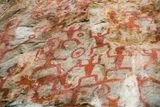
Paintings of blood-red squatting humans, various animals, daggers, and musical instruments have covered a 160-mile stretch of rock along the Zuojiang River in southern China for more than 2,000 years. Although the Huashan paintings are not the oldest human-made rock art, they have puzzled scientists because they have survived the valley’s extreme weather conditions.
Frequent monsoon rains, humidity, and extreme temperatures should have caused weathering, but researchers from Shandong University in China may have now cracked the secret recipe that preserved the rock art for millennia. As described in their study, published in the Journal of Archaeological Science, the artists combined lime and blood into a mortar, which they mixed with the pigment that made the documentation of their lives so durable.
The protein profile of the blood preserved in the rock fragments revealed another detail about the humans who immortalized their culture on the walls of the river valley. The researchers suggest that some of the blood may have come from women during childbirth or shortly afterward, which fits historical records describing the local community as a matriarchal hunter-gatherer society that worshipped female fertility.
Lime and Blood Binder Preserved Red Pigment for Millennia
The research team collected fallen rock art fragments from three sites in the Huashan rock art belt and used a variety of spectroscopic methods, which examine how matter interacts with light to identify the composition of objects, as explained by the National Institute of Standards and Technology.
The pigment that gives the art its vibrant color originated from red clay deposits. But instead of applying the pigment directly to the rock, the artists combined it with a mortar made of lime, calcium phosphate, and blood, the researchers found. By reacting with carbon dioxide from the air and the blood proteins added to the mixture, the pigment is encapsulated by biomineralized calcium carbonate, a compound that also forms eggshells.
According to the researchers, this stable organic-inorganic binder demonstrates the creators' ability to invent a complex technological process using resources from their environment, enabling the Huashan rock art to survive for thousands of years despite challenging conditions.
Read More: A Cave So Dangerous to Reach, It Preserved 179 Ritual Objects for More Than 1,100 Years
The Artists May Have Belonged to a Matriarchal Hunter-Gatherer Society
Humans' need to document their lives with natural materials is displayed in almost every corner and timeline of our planet. While prehistoric art mostly survived by chance, often preserved in caves undisturbed by wind, rain, and sunlight, the Huashan rock art belt runs just beside the Zuojiang River in the Guangxi Zhuang Autonomous Region of China and comprises over 80 sites directly exposed to the elements.
The paintings, which span tens of thousands of square meters, have been on the UNESCO World Heritage List since 2016 and may have been created by the Luoyue people. According to recorded history, the Han Chinese described them as a matriarchal society, without a traditional concept of marriage, relying on relationships built solely on personal preference.
The Han descriptions and interpretations of the art describe the Luoyue as a hunter-gatherer community that relied on fishing and early farming.
Blood May Come from Childbirth
Although the blood in the mortar wasn't added for its coloring properties, its origins reflect how the creators' community was centered on female reproduction. Based on proteomic tests, the researchers suggest that some of the blood may have come from women giving birth.
Besides its practical role in binding the paint, the blood may also have had a symbolic role and been included in rituals, as described by Archaeology News.
Uncovering the composition of the paint used in the Huashan rock art gives researchers a better idea of the innovations of late hunter-gatherer communities, relying on experimentation with materials and collaboration to access the steep cliffs that visitors marvel at to this day.
Read More: Ancient DNA Reveals Migrant Women Helped Some European Hunter-Gatherers Adopt Farming
Article Sources
Our writers at Discovermagazine.com use peer-reviewed studies and high-quality sources for our articles, and our editors review for scientific accuracy and editorial standards. Review the sources used below for this article:
- This article references information from a study published in the Journal of Archaeological Science: Blood-induced biomineralized calcium carbonate used for binding in the Huashan rock art of Guangxi, Southern China
- This article references information from NIST: Spectroscopy: A Measurement Powerhouse
- This article references information from Archaeology News: Blood may have helped ancient Chinese rock art survive for 2,000 years