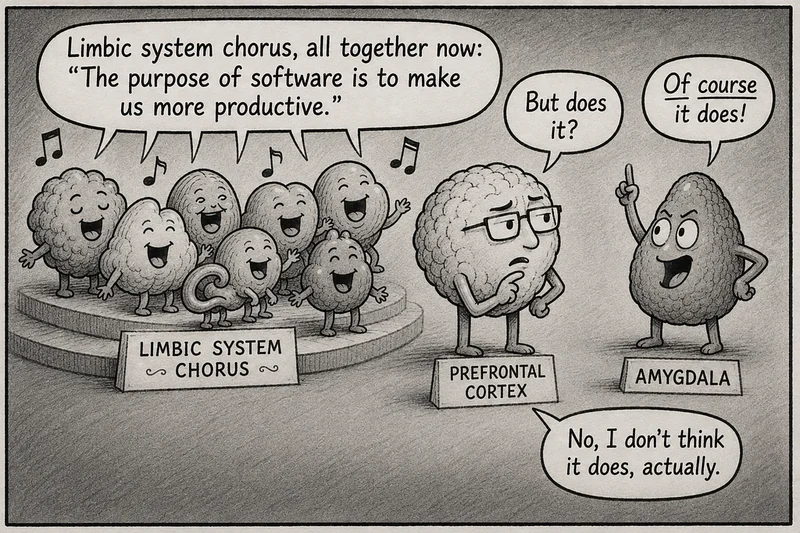
Practical and existential questions for IT Design and Development.I first asked myself this question for a bit of a laugh. This was at the dawn of 2023, during the rise of the LLM. Doomsayers and prophets alike said AI will allow us to produce so much more, so much more quickly.But I had to ask… so much more of what, and to what end? The answer is not superficial.This question has been at times haunting and at times obsessing me for years. Now that software can use software for us, what exactly was the point of us using it in the first place? AI will be a force multiplier, undoubtedly, but what is it multiplying? What is software for and what will it mean for the world when we have exponentially more of it?Here’s the first clue: producing does not equal productivity, not in the technical sense.I had a deeply unsettling hunch and needed to piece together my thoughts before I could share it. I traveled from slushy Danish winters to the equatorial highlands of Kenya, from humid-AF Tokyo to ever-so-sunny Spain — no, not to look for answers, that was just part of a fairly generic midlife crisis — and three years appears to have been the gestation period for this theory. Now that some early evidence supports the theory, I’m compelled to complete it, imperfectly but as well as I can.You’re not going to like the conclusions. I have little in here for the AI optimists nor for the anti-AI anarchists, and not much to please anyone in between. The best I can hope for is that you’ll read my questions and hypotheses and vehemently disagree… and that you’ll have a theory why you disagree.I’ll come back to this in the end, if there’s one exegesis to take from this text, it’s a plea to use your own mind.Software has not made us more productiveI’ve been accused, fairly, of taking the long and winding road in stating my thesis, a Shyamalan-esque approach to nonfiction. (Exhibit A: the first 300 words of this article). Ok, that’s my apology and now I’ll get to the point.So what is the purpose of software? The two words that leap to mind are efficiency and productivity. Or, efficiency that leads to productivity. This was my initial thought; it’s nearly everyone’s initial thought. It’s so often repeated that we take it for granted.Yet, the facts of our economic growth prove this is not true.Here’s how my internal dialogue went:Limbic system chorus, all together now: “The purpose of software is to make us more productive.”Prefrontal cortex: “But does it?”Amygdala: “Of course it does!”Prefrontal cortex: “No, I don’t think it does, actually.”ChatGPT generated this “newspaper style cartoon” in seconds. This would have taken me hours to draw, and first I would have needed to learn to draw. That’s productivity growth, right?We can condense the ensuing three years of internal debate into this handy table of contents (spoilerish, skip ahead if you really like Shyamalan):The Naivety → The Function → The Origins → The Evolution → The Law → The ReckoningPart 1 — Software has not made us more productive, aka The NaivetyWhile computing power has increased 1 trillion times (10¹²) since 1971, productivity growth has declined to less than half of mid-1900s levels.Part 2 — The Function, The role of software in societyThe purpose of software is not to increase productivity but to increase the density of information in any unit of digital output.Part 3 — The Origins, A brief history of softwareA look at both a history of the inventions and a history of the applications, and the causal links between the two.Part 4 — The Evolution, How markets mimic biologyDifferentiating between teleonomy vs. teleology: Natural ecosystems explain the past, present, and future.Part 5 — The Law, The physics of dissipative structuresSoftware — like a whirlpool, a flame, or a living cell — survives only through continuous energy consumption, and collapses the moment the flow stops.Part 6 — The Reckoning, How the World Will Adapt to AIAI will not change the purpose of software or its relationship with productivity. AI will be a General Purpose Technology in every sense but purpose… Yet, this time it is different.The logic of each point follows the previous. First we need to convince you that productivity gains from software are a myth.This fear (should we call it a fear? Maybe queasiness) surfaced nearly 40 years ago. The economist and Nobel Laureate Robert Solow wrote, “You can see the computer age everywhere but in the productivity statistics.”That was 1987. A decade later productivity growth was increasing; economists and technologists breathed a sigh of relief. There’s often a “productivity lag” between the invention of a disruptive technology and its effective use. Surely this was why it took a few decades for growth to materialize?Alas, though the brief burst of the late 90s brought us nearly to previous levels of growth, it fizzled out just as quickly. We’re now back to flirting with century lows of productivity growth.Let’s look at the data to debunk our collective misconception.Productivity in the Age of InformationPaul Krugman, another Nobel winner, wrote in his NYT column in March 2023, “Like previous leaps in technology, [AI] will make the economy more productive.” He also concluded that, thanks to LLMs, “the longer-run prospects for economic growth do look better now.”Krugman seems to be a proponent of the productivity lag theory. Still, he gently cautioned restraint in projecting any rapid acceleration of economic growth.The title of that column sums it up, A.I. May Change Everything, but Probably Not Too Quickly. He suggested that “ChatGPT and whatever follows are probably an economic story for the 2030s, not for the next few years.”To support his points, he presented a chart of productivity growth over the last 120 years. This chart measures the annual rate of non-farm labor productivity growth over the previous 10 years.https://www.nytimes.com/2023/03/31/opinion/ai-chatgpt-jobs-economy.htmlLabor productivity growth from 1920–1970, aside from the Great Depression, was mostly well above 2%. Since the invention of the microprocessor in 1971 it has been mostly below 2%.The annotations on the chart are Krugman’s. In his words, “for at least two decades after Moore’s Law kicked in, America, far from experiencing a productivity boom, suffered from a protracted productivity slowdown.”The long post-WWII boom marked with a “?” is suggested to be the result of an “age of continuity” during which we got better at using technologies that had been around for a while, like the internal combustion engine.The economist Robert J. Gordon identified five “Great Inventions” from 1870 to 1970: electricity, urban sanitation, chemicals and pharmaceuticals, the internal combustion engine, and modern communication. He proposed that this 100 years of transformational General Purpose Technologies (GPTs — no relation to ChatGPT) was a one-off phase, never to return.Krugman leans techno-optimist, but despite his compliment sandwich approach, some folks got mad at Paul for his column. (That seems to be what happens when you present an opinion with a logical argument.) They didn’t like that he questioned the productivity gains of IT, even with a semi-favorable conclusion.But then again, you can’t blame them. When you ask questions — questions about someone’s raison d’être (I believe that’s French for “raisin of existence”), it really shrivels some grapes.People put a lot of stock in the work they do. We all do. When I do the math to estimate I’ve spent forty thousand hours professionally engaged with technology — a quarter of my 4,000 weeks on this blue dot — asking why can get a bit uncomfortable.So Krugman was compelled to write a follow up, The Internet Was an Economic Disappointment, to present more data to the gnostics.The Information Age has been an economic disappointmentI’m taking things a step further than Krugman. We can rely on the same foundational data, though.In his follow up piece, he looked at data from the US Bureau of Labor Statistics on labor productivity and Total Factor Productivity. Total Factor Productivity, incidentally, is a measure created by our pal Solow. It includes the impact of capital and worker knowledge as well as hours of labor; it’s a preferred way to measure the effect of technological progress.As Krugman explains, “A truly fundamental technological innovation should cause sustained growth in both these measures, especially total factor productivity.” In the chart below he switches to a forward looking measurement, growth over the 25 years following the dates on the chart. This way we can attempt to identify inflection points and their causes.https://www.nytimes.com/2023/04/04/opinion/internet-economy.htmlWe’ve got one bump that lines up with the end of the dot com “boom” 25 years later. Other than that, the Information Age looks pretty flat.To be ultra-explicit here and avoid fights I’m not looking for (there are plenty I am looking for), what we’re talking about is a deceleration of productivity growth, not the absence of growth.But why stop there, has software helped any other macro KPIs?SPX/GDP, TradingView, captured Jul 2026This chart is a plot of the ratio of the S&P 500 to GDP, which conveniently ignores inflation. While it’s not apples-to-apples — stock prices bundle profits, expectations, and multiples — the direction is what counts. S&P 500 growth is three and a half times the overall economy since those measurements began; all of that advantage and then some accumulated since 1980. Corporate profits’ share of GDP has roughly doubled since the 1980s, and those profits have concentrated in the largest firms. The market is pricing what we’ll attempt to explain in Part 4 on the competitive benefits of information technology.Software may have helped the big guys get bigger but it has not made us more productive.Macro nits to pickIn case you’re already seething, let me take a moment to assure you that I’m not anti-technology. I use software and AI all day every day. I don’t propose that we throw away our phones and go live in a commune. I’m as excited as the next person about what new wonders we’ll create.I’m just trying to get to the bottom of what technology is doing for us — or to us — in aggregate.I enjoy technology, you enjoy technology — surely this is an intangible benefit we should consider. Has quality of life increased since the semiconductor was invented? We have Spotify, Netflix, LLMs, and very large TVs. Still, for the previous century we had vinyl, cinemas, Encyclopedia Britannica, and… cinemas.It’s hard to argue that indoor plumbing, medical sanitation, and washing machines didn’t cause a greater increase in quality of life.In an effort to leave no stone unturned, I jotted a list of possible “purposes” of software:Do things quicker, easierRemove physical thingsNew capabilities that we couldn’t do beforeLevel the playing field of abilitySurface information that would otherwise be difficult to find and coordinateSolving problems?Improved analytics/mathematical capabilitiesEntertainment & games (potentially a counterweight to productivity… look at hours worked)Digitizing the analog — preventing data lossAll of these avenues led to dead ends. Not just dead ends but depressing one-line obituaries. “He was an honest man, and well liked by his peers.”Any of the above can be considered benefits, but none an end in and of themselves. Much of it can be distilled to an abstraction of data and a facility for the average person to corral that data. We’ll come back to this.You may have seen my note to self in the list above. I needed to consider productivity per person, or even per hour.Here’s a log chart of real (inflation adjusted) gross domestic product per person in the US.https://fred.stlouisfed.org/graph/?g=1XTkCIs it slightly concave, or is it slightly convex?How about hours worked?https://ourworldindata.org/grapher/annual-working-hours-per-worker?country=~USAFrom the early 1950s at more than 2,000 hours, we reduced annual working hours to 1,771 by 1982. Relative to that year, things have stayed fairly consistent:Year — Hours — % relative to 19822000 — 1,845 — 104.2%2009 — 1,730 — 97.7%2017 — 1,757 — 99.2%2021 — 1,820 — 102.8%Anecdotally, I have to put an asterisk next to the hours-worked* data. In the mid-90s (incidentally, the growth years) and prior, when knowledge workers left work they were done with work. Previous generations clocked out. Now information workers are generally expected to be on call every waking hour.I would be hard pressed to find anyone working in IT today who doesn’t reopen their laptop after dinner to wrap up some work. Virtually every hour we feel compelled to keep an eye on work email and, god help us, Slack.On a true per capita, per hour basis, we may be the least productive we have ever been.Punchcard perceptionsWe’re not working more or fewer hours as a result of IT. It might be more informative to reflect on how we feel about the hours we work.There’s an interesting train of thought to follow: Why do we work fewer hours (as measured) in software-heavy knowledge work than we used to doing more manual labor? Maybe we reach our limits with mental effort sooner than we would exerting physical effort?This is evidenced by psychological survey data. The American Psychological Association found that 77% of workers felt stressed at work within the last month, 57% reported negative impacts of work-related stress. Gallup found that globally 41% of employees experienced a lot of stress the previous day (2024 report). 22% of US employees rate their level of burnout as high or very high.Is “moderate burnout” acceptable? Another 35% of employees fall in that column.In Gordon’s book, The Rise and Fall of American Growth (2016), he argued that inventions that lead to major productivity gains fundamentally change the nature of the workplace — how businesses operate and how employees execute their work. But with information technology nothing has changed except for increased stress.Sure, we got cubicles and then the walls of the cubicles came down, we got sent to work from home and then we got called back to the office. Now cubicles are trending again, but through it all we’re still desk jockeys.Meet the new boss, same as the old boss.The Productivity Paradox, RevisitedInspired by Robert Solow’s quip about productivity statistics, the term “Productivity Paradox” was named in 1993 by Erik Brynjolfsson, now a teacher and director at Stanford.The paradox is said to have disappeared due to the renewed growth we observed in the late 90s, but… I don’t think it ever left. (I also don’t think it’s a paradox at all). It’s still considered controversial to suggest that Information Technology doesn’t deliver the same productivity gains as other General Purpose Technologies like the steam engine and electricity.Gordon himself acknowledged that productivity growth could have been even worse if somehow software never came to be, but this counterfactual is unknowable. It’s also a bit like giving the little league kids a trophy for showing up — sub-1% TFP growth is no triumph.One Good Decade, 1995–2004Before we transport ourselves back in time — à la Bill & Ted — to the 90s, let’s acknowledge the “mismeasurement hypothesis.”Some commentators suggest that the modern slowdown in productivity is an illusion caused by old data collection methods that ignore the value of free digital goods. Chad Syverson, an economics professor at the University of Chicago, published a thorough rebuttal showing that the slowdown is too large and too synchronized across regions — regardless of their IT consumption — to be explained by digital surplus.The hard data only supports a brief surge in productivity in the late 90s. Krugman called it an “IT Boom.” It’s commonly accepted that IT gets the credit: Federal Reserve economists Stephen Oliner and Daniel Sichel took the Solow growth-accounting approach and showed that IT capital expenditures and faster computer production were responsible for two-thirds of the growth surge in the 90s. This analysis was published in 2000.This aligns with other IT-productivity proponents who state that much of our ongoing productivity growth is in the IT industry.But here’s the problem with that: This is like saying that the greatest benefit of electricity would go to utility companies, or that the breadwinner of internal combustion would be Ford… The whole point of a “general purpose” technology is that it enhances the productivity of many industries, not just its own.The Federal Reserve analysis is an accounting, not a statement of causality. As the famous Moe Abramovitz quip goes, TFP is a “measure of our ignorance about the causes of economic growth.” And as Oliner & Sichel themselves wrote, the neoclassical “framework provides a superficial explanation of growth.” They went on in their 2000 paper to project that the productivity boost would persist, yet we know it died in 2004 even as IT investment continued to grow.The Cost DiseaseSpeaking of accounting, there’s another rival analysis to explain the slowdown in growth over the last half century.It started with a string quartet.Photo by Larisa Birta on UnsplashIn 1966, two Williams, Baumol and Bowen, published Performing Arts: The Economic Dilemma. Their original observation was that a Beethoven string quartet requires exactly four musicians and takes exactly as many minutes to perform as it did in 1826. Productivity, in the economic sense, cannot rise without destroying (or changing) that product.Still, the musicians need their wages to rise along with wages economy-wide or they’ll quit the violin for a job in manufacturing or information technology. The relative cost of the quartet rises forever as other sectors get more efficient and offer higher wages.This was dubbed the “cost disease,” a strong term, perhaps, but we can guess poor Baumol bemoaned the rising cost of attending the opera. In any profession where human time and attention are the output — a therapy session, a professor’s lecture, a doctor’s exam, a legal consultation — output per hour is capped, wages rise anyway, and the sector’s prices inflate relative to everything else that doesn’t have a capped output.The “disease” isn’t a dysfunction; it’s just math. These sectors became known as Baumol sectors; we’ll keep coming back to these throughout our exploration.In 2006, another William, this one with the surname Nordhaus, published Baumol’s Diseases: A Macroeconomic Perspective for the National Bureau of Economic Research. Looking at the previous half century of industry data, he confirmed Baumol’s prediction that “technologically stagnant sectors experience above average cost and price increases, take a rising share of national output, and slow aggregate productivity growth.” Share of GDP shifts to lower growth sectors.Again this is an accounting, not an explanation of why. It’s also essentially the inverse of the argument that IT does produce productivity growth because the IT industry is growing. Importantly, Baumol sectors got the greatest IT investment (Brookings economists Bosworth & Triplett showed that IT investment goes overwhelmingly to services), which should have resulted in productivity growth, not stagnation, if that was the net effect we expected of IT.We also have the brief “IT Boom” as evidence that services can register productivity gains with the right blend of circumstances, even if IT itself is not the main ingredient.Reversion to the MeanKrugman asked the question too. Why did the “IT Boom” that sorta kinda peaked at previously sustained growth levels only last for a decade? What’s the non-superficial layer, what’s the behavioral variable that explains why the boom lived no longer than a beloved family dog?A hypothesis: Based on the timing, this boom coincided with the phase of early majority users of the internet (borrowing the framework from Geoffrey Moore’s Crossing the Chasm). And why did it only last a decade? Dare I say it, maybe… Google?What if, what if, ALL productivity booms are the result of a ménage à trois of access to information, the ability to comprehend that information, and the opportunity for curiosity.What if the printing press gave us the Renaissance; electrification took us off factory floors and put us in offices; the G.I. Bill gave a generation access to education; and for a brief honeymoon AOL and Yahoo! let us browse the internet.Then Google got really good at giving us exactly what we were looking for. The insidious thing here is that the easier it is to find the information you’re looking for, the less you discover along the way. This could have massive implications for the long-run results of LLMs.By contrast, the greatest opportunity cost to human potential is that which detracts from curiosity. We went from read to browse (hypertext! links to more information, like synapses in the brain) to search to chat, and next is delegate.Browse was the pinnacle (and still can be, for those whose favorite internet experience is Wikipedia), and since then what we are witnessing is a disengagement curve.I looked for macro evidence to support this hypothesis but it doesn’t cleanly exist. I’ll leave it as is, bounded by italics, to live on as a mere curiosity.Another coincidence of timing — the World Trade Organization (WTO) opened for business in 1995. Trade openness doesn’t impact the economy immediately, but one thing that does is credit, the fourth element. King and Levine in 1993, “Finance and Growth: Schumpeter Might Be Right,” and Rajan and Zingales in 1998, “Financial Dependence and Growth,” build this case.The mid-late 90s credit story in the US was Riegle-Neal (1994) opening interstate banking, real rates falling through the decade, retail brokerage and the IPO window opening (bubble acknowledged), and venture funding growing an order of magnitude. This is supporting evidence, not a different theory. Money meets minds.Efficiencies of information tasks do not lead to productivity, but capital efficiencies do. Oddly enough it may be a sort of information inefficiency that does correlate with productivity growth.Efficiency vs. Productivity, the Semantic DivideI’ve tossed out these words repeatedly — efficiency and productivity, without giving them their due attention.Efficiency is time per task. Micro, measurable, tangible, real. Efficiency is the thing that software empirically delivers. We experience it all day every day, which is why we instinctively overestimate its impact on…Productivity is value output per hour. Macro, intangible (in our lived experience). What economists measure. The thing that hasn’t budged through fifty years of Information Technology.It feels logical to connect the two and, in fact, smart people frequently do despite the lack of evidence.To grab one of a million such statements, here’s pundit Scott Galloway talking about A New AI World, “Starting in the 1980s personal computers put technology that had cost tens of millions 20 years earlier on nearly every person’s desk. The gains in productivity, globally, have been substantial.” (My emphasis).But, not so. Are you with me on this now?We now have technology and business luminaries predicting historically unprecedented growth rates thanks to AI. Dario Amodei (Anthropic) envisions a “dream scenario… would be 20% annual GDP growth rate in the developing world,” and touted 10–20% at home. Masayoshi Son expects AI revenue to reach 20% of global GDP by 2040. Marc Andreessen offered the possibility that “productivity growth is about to go through the roof.”Gross Domestic Product deserves a clarification too: this is all final goods and services produced in a country. Productivity growth is a primary driver of GDP growth. These terms can be misleading to us laypeople. “Product” is value-added output.Here’s a simple illustrative example: If the world’s pencil powerhouse nation produces 1 billion pencils, but then an AI pencil machine is able to produce 2 billion at the same cost, and sell each of them for half the price, this nation’s GDP will not have changed. Productivity and Product are not measures of cumulative products created, but rather the economic value of those products.Another example, informally called the “Excel Shock,” gives us a chiaroscuro foreshadowing of what’s to come.When digital spreadsheets dropped in the late 70s and 80s many expected accounting and finance jobs to be eliminated. What used to require an army of junior automatons could now be done in minutes with Lotus 1–2–3 or Excel. What actually happened instead was an explosion of financial analysis, modeling, forecasting, and reporting. Finance jobs expanded and up-leveled, but meanwhile the lack of macro productivity gains during this period was one of the more visible paradoxical surprises to economists.Producing more does not mean growth. AI will produce more — we see that already, but will producing more lead to greater Product and Productivity growth? The instinctive hunch we feel is that the answer should be yes, but this treatise seeks to prove that the answer will be no.It’s not just productivity growth that has been the subject of sensational predictions, there’s also the drastic reduction in work — the promised utopia.Where did the [predictions of] good times go?In 1930, John Maynard Keynes famously speculated that within a century technology would enable us to work 15 hour weeks. 2030 is right around the corner…In 1956 Nixon anticipated a four-day work week. Larry Page, belatedly, predicted the reduced work week in 2014 (maybe he Googled it?).What do we think of Jamie Dimon predicting a three-and-a-half-day work week? Lame one-upsmanship. He put it rather eloquently, “literally they’ll probably be working three and a half days a week.” He also said AI is a “living breathing thing,” so… yeah, can I apply to be the CEO of Chase?The fallacies driving these poor predictions are the same ones that support our conviction that software makes us more productive. But it doesn’t.And yet this is unsettling. These are brilliant and/or highly competent thinkers and leaders and they’re wildly wrong, going on a century now. I find it unsettling.Cognitive dissonanceWe experience the efficiency of using software and we can recognize that each new generation of computers and software is a leap forward in power and efficiency. Surely this should let us increase productivity?Gordon Moore’s prediction — the number of transistors on a microchip would double every two years — was remarkably accurate. Two to the Nth power is quite powerful.Here are some data points on the number of transistors on a microchip:1965: ~64 transistors1971 (Intel 4004): 2,300 transistors1982 (Intel 80286): 134,000 transistors1993 (Intel Pentium): 3.1 million transistors2006 (Intel Core 2 Duo): 291 million transistors2018 (AMD Ryzen 7 2700X): 4.8 billion transistors2023 (Apple M2 Ultra): 134 billion transistorsTotal increase since 1965: Over 2 billion (~2.1x10⁹) times more transistors per chip.We’ve made use of those chips to increase computing power even faster.1971 (Intel 4004): ~1 kFLOPS (floating point emulated in software)1982 (Intel 80286 + 80287 coprocessor): ~50 kFLOPS1993 (Intel Pentium): ~75 MFLOPS2006 (Intel Core 2 Duo): ~15 GFLOPS2018 (NVIDIA V100, as the frontier moved from CPU to GPU): ~125 TFLOPS2023 (NVIDIA H100): ~2,000 TFLOPS (2 petaFLOPS at the low precision AI runs on)Total increase since 1971: Over 1 trillion times (10¹²) increase in computing power.Let’s visualize this on a logarithmic scale:Chart generated by Claude based on publicly available data points. (Purists might note that I’m comparing 64-bit to 8-bit and CPUs to GPUs. Fair, but the frontier moved and we’re looking at the frontier.)If we looked at this without the log scale we’d be looking at a 90 degree angle with a corner radius. Let’s appreciate for a moment that the y-axis goes to 10-to-the-15th. We should be wizards by now.What gives?The AuditWe’ve got a trillion-fold increase in input, accelerating every day. We’ve got measurable, observed, felt efficiency gains. We’ve got flat hours (and worse mornings). And yet we have decelerating output growth. The books still balance to near zero.Where did that trillion-fold increase in computational power go, in the macroeconomics? Something absorbed the dividend.We’ve looked at the defenses and the apologists and the just-wait-any-day-now crowd. I’m not buying their argument that the gains just haven’t landed on the books yet.Software does not — and here I’ll add the uncomfortable part — will not lead to productivity growth. If you stay with us through the end of this treatise, we’ll argue why this will hold with AI and even AGI.For forty years we’ve called it a paradox, as if the books simply failed to balance. But the paradox isn’t a paradox, we’ve just been looking in the wrong direction. The books always balance. If a trillion fold increase in computation didn’t buy us productivity, it bought something else — something that compounds, something that shows up as more windows, more tabs, more systems, more steps between us and done. There’s a word for it, and it isn’t ‘growth.’Friends, Medium’s algorithm won’t necessarily surface subsequent parts of this treatise for you. I’ll do my best to make each part a standalone article, but if you do want to read the whole thing there are a couple actions that might help: Save Part 1 and check back (I’ll add links to each part after publication) or Follow with email notifications on.What is the purpose of software was originally published in UX Collective on Medium, where people are continuing the conversation by highlighting and responding to this story.
What is the purpose of software