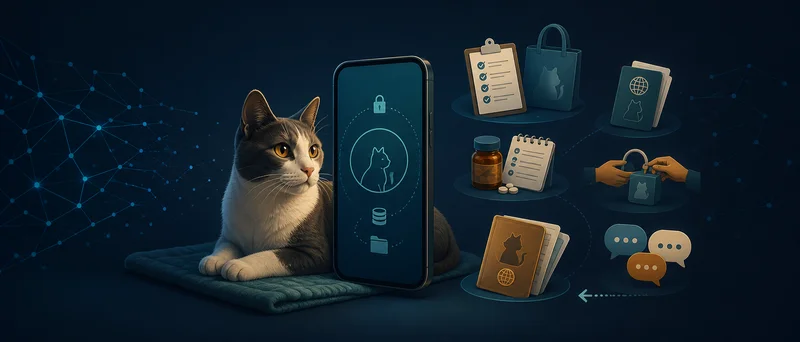
Building software for cat care creates an unusual design problem. People want structure, reminders, and useful records, but the app must never pretend to replace a veterinarian. They may need to capture subtle changes in behavior, prepare for an appointment, brief a sitter, or find essential information during an emergency. At the same time, those records can contain sensitive details about routines, medication history, and household life.
CatPulse grew from that tension.
I wanted to build an Android app that could help people organize everyday cat care without requiring an account, an internet connection, or the surrender of personal data to a remote service. The result is CatPulse, a published Google Play app that works offline, stores user data in a local database on the device, supports 19 languages, and includes right to left interface support for Arabic.
The premise sounds simple. Keep cat care information on the phone and make it useful. In practice, every word, screen, and feature had to answer a harder question. How can an app support responsible observation and preparation without crossing into diagnosis or treatment?
Privacy as a Product Decision
Many applications treat account creation as the natural starting point. CatPulse takes a different position. It works without an account and does not depend on connectivity for its core use.
That choice matters because cat care is often documented in small, ordinary moments. A change in appetite. A medication entry. A task that needs to be completed. A note that may become relevant before a veterinary visit. Requiring a remote account for these activities would introduce friction and create a broader data relationship than the product needs.
CatPulse stores user data in a local database on the device. This makes the privacy model concrete. The app does not need an online identity merely to help someone maintain a care record.
Offline operation is also about reliability. Internet access should not determine whether someone can retrieve a cat’s emergency information, review medication history, or prepare a handoff for a sitter. A care tool should remain useful in the situations for which it was installed.
This does not mean that local storage solves every privacy problem automatically. Device access and responsible handling still matter. It means the application begins from data minimization. If a task can be completed locally, CatPulse is designed to complete it locally.
Designing Around Observation, Not Diagnosis
The most important boundary in CatPulse is clinical.
CatPulse does not diagnose conditions. It does not calculate medication doses. It does not recommend treatment. Those are not missing features waiting to be added. They are deliberate limits.
The app instead focuses on activities that can support better communication and more organized care. Users can record health observations, maintain medication history, manage care tasks, and prepare summaries for veterinary appointments. The purpose is to help someone remember what happened and present relevant information more clearly.
This distinction influenced the language throughout the app. A care interface can become unsafe when neutral observations are quietly converted into medical conclusions. A change in behavior may deserve attention, but the software should not infer a diagnosis from it. A medication record may help a veterinarian understand prior care, but the app should not use that record to generate dosing instructions.
CatPulse therefore operates as a structured memory and preparation layer. It helps users capture information, preserve context, and communicate more effectively. Clinical judgment remains with qualified veterinary professionals.
The content approach draws on guidance from the American Association of Feline Practitioners, the American Animal Hospital Association, the World Small Animal Veterinary Association, and Cat Friendly Homes. These sources informed the general orientation toward responsible observation, feline-friendly care, veterinary preparation, and clear safety boundaries. CatPulse does not present itself as a substitute for those organizations, their guidance, or professional veterinary assessment.
Building for the Moments Between Appointments
Cat care does not happen only inside a clinic. Most of it occurs between appointments, when owners are observing routines, administering previously prescribed medication, completing care tasks, and deciding what information may be worth discussing with a veterinarian.
That is why CatPulse includes several connected forms of record-keeping.
Health observations provide a place to capture changes and relevant details. Medication history helps preserve a chronological record without turning the app into a prescribing tool. Care tasks help users organize recurring responsibilities. Veterinary preparation summaries bring selected information together so that an appointment can begin with better context.
The goal is not to create more data for its own sake. The goal is to reduce the chance that useful information disappears into memory, scattered notes, or hurried conversations.
A veterinary visit can be stressful. It is easy to forget when a change began, whether it was consistent, or what happened after a previous intervention. Structured preparation cannot replace an examination, but it can improve the quality of the information available during one.
Care Has More Than One Caregiver
Another design challenge appears when responsibility moves from one person to another.
A sitter may need feeding information, routine details, task instructions, medication history, and emergency context. The owner knows these details because they live with the cat. The sitter does not. A useful handoff must close that information gap without assuming that the temporary caregiver has veterinary expertise.
CatPulse includes a sitter handoff feature for this purpose. It gives users a structured way to prepare practical care information for another person.
This feature reflects a broader principle behind the app. Good care software should support coordination, not only individual record-keeping. The value of information increases when it can be organized for the person who needs it in the relevant context.
The same principle applies to the emergency passport and lost cat passport. These features are designed around moments when rapid access to clear information matters. In an emergency, people should not have to reconstruct essential details from memory. If a cat is lost, information intended to support identification and communication should already be organized.
These passports do not make medical decisions and do not guarantee an outcome. They provide structure for situations in which confusion and time pressure can make even basic information difficult to assemble.
Why 80 Breed Profiles Are Not a Diagnostic System
CatPulse includes 80 cat breed profiles. Breed information is useful because people often want to understand the history, characteristics, and care context associated with a cat.
It is also an area where software can overstate certainty.
A breed profile should not be treated as a prediction about an individual animal. Cats vary within breeds, mixed ancestry may be uncertain, and health concerns require individual veterinary evaluation. CatPulse keeps breed information within an educational context rather than converting it into automated risk scoring or diagnosis.
This boundary is part of the product’s larger philosophy. Reference content can support curiosity and preparation. It should not create false confidence.
Internationalization Is a Care Feature
CatPulse supports 19 languages. Arabic also receives right-to-left interface support.
Localization was not a decorative layer added after the core product. Care information must be understandable to be useful. An interface can contain the correct concepts and still fail if its language feels inaccessible or its layout becomes confusing.
Supporting multiple languages creates more than a translation problem. Labels must remain clear at different lengths. Navigation must continue to make sense. Safety boundaries must retain their meaning. Terms that appear simple in English may require different phrasing elsewhere to remain precise and natural.
Right-to-left support makes the structural nature of localization especially visible. Arabic does not only require translated strings. Direction affects reading order, alignment, and the overall logic of the interface. Supporting it means treating directionality as part of the user experience.
The underlying product principle is straightforward. A person should not receive a weaker care experience because their preferred language is not English.
Multilingual design also adds responsibility. A sentence about observation, medication history, or veterinary attention cannot become more prescriptive through careless translation. The non diagnostic boundary has to survive across languages, not merely appear in one disclaimer.
The Technical Value of Staying Local
From a product engineering perspective, offline first design changes what counts as success.
The app must deliver its core value from data available on the device. A network failure cannot become a failure of the care record. Account recovery cannot be assumed as the mechanism behind every interaction. The local database is not a temporary cache for a remote source of truth. It is where the user’s CatPulse data is stored.
That model reduces some forms of dependency, but it also demands discipline. Features must be designed around the actual local experience. Empty states, record organization, editing, and retrieval all matter because there is no remote service waiting to compensate for a confusing flow.
Local-first software also forces a useful question during product development. Does this feature genuinely help the user care for the cat, or does it exist mainly to expand the system?
For CatPulse, the answer repeatedly favored focused tools. Record an observation. Preserve medication history. Organize a task. Prepare for the veterinarian. Hand care information to a sitter. Keep emergency or lost cat information accessible. Learn from a breed profile without mistaking it for an assessment.
Building in Public Through Shipaton
CatPulse was developed as part of RevenueCat Shipaton 2026.
A build-in-public event creates a useful form of pressure. The idea has to become a real product that people can find and install. Broad intentions must become concrete interface decisions. Safety boundaries must appear in the product itself. Privacy claims must match how the app actually works.
For me, Shipaton was not only about adding features. It was a reason to make the product’s commitments legible.
CatPulse is private by design because it works without an account and keeps user data in a local database on the device. It is offline because core care information should remain available without connectivity. It is multilingual because accessibility is not limited to one language. It is deliberately non diagnostic because responsible software should know which decisions belong to veterinary professionals.
Publishing the app on Google Play turned those commitments into something testable by actual use. The store listing is not the end of development. It is the point at which the product has to stand behind what it says it is.
What I Learned From the Boundaries
The clearest lesson from CatPulse is that constraints can create a stronger product.
Refusing to diagnose narrowed the feature space, but made the app’s purpose clearer. Avoiding dose calculations removed an unsafe shortcut. Working without accounts reduced data collection and friction. Offline operation kept attention on the essential local experience. Supporting 19 languages exposed assumptions that an English only interface would have hidden.
The most valuable product question was not, “What else can the app predict?”
It was, “What information can the user organize more responsibly?”
That question led to a tool centered on observation, history, preparation, handoff, and access. It also created a line that CatPulse can defend. The app supports care organization. It does not practice veterinary medicine.
I think that distinction will become increasingly important as consumer software gains more automated capabilities. Technical possibility is not the same as product justification. In health-adjacent contexts, restraint is part of engineering quality.
CatPulse is my attempt to apply that principle to everyday cat care. It is an offline Android app, available in 19 languages, with practical tools for the ordinary moments, transitions, and emergencies that shape life with a cat.
Disclaimer: CatPulse was developed as part of RevenueCat Shipaton 2026. It is an informational and organizational tool. It does not diagnose, calculate medication doses, or recommend treatment. User data is stored locally on the device. CatPulse draws on general guidance from AAFP, AAHA, WSAVA, and Cat Friendly Homes, but it is not affiliated with or endorsed by those organizations.