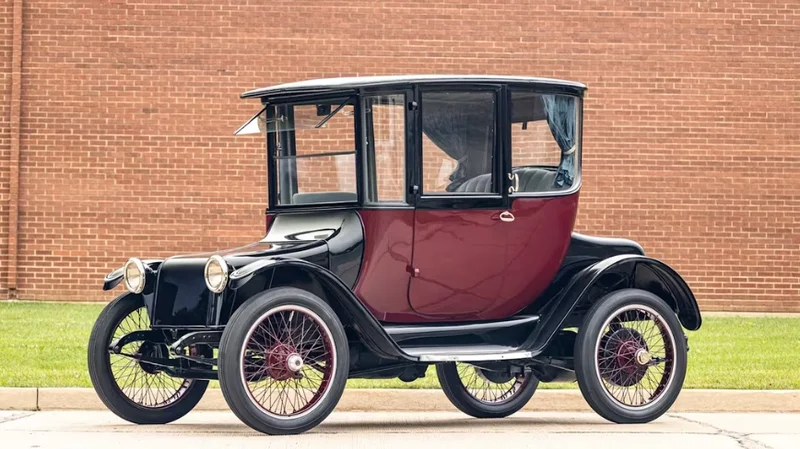
A 1918 Detroit Electric Model 75B went under the hammer at Monterey Car Week claiming an original 80 miles of range, against the 73 miles the first Nissan Leaf was rated for. The format died because of the electric starter and a price five times a Model T, not because of range.
A 1918 Detroit Electric went under the hammer at Monterey Car Week claiming 80 miles of range. The first Nissan Leaf, sold in 2011, was rated by the EPA at 73.
The comparison needs handling. The 80 miles was an advertising figure for a car that topped out at 20 mph, the Leaf’s 73 came from a regulated test cycle, and this particular Model 75B has since been refitted with modern batteries.
The original engineering was not a novelty. Forty-two lead-acid batteries, 21 at the front and 21 at the rear, fed a single 4.28 horsepower motor mounted under the floor and driving a rear differential, according to the auction listing.
There is no steering wheel. A long lever steered the car and a short one set the speed, and both folded out of the way when it was parked.
Detroit Electric was a real manufacturer with a real order book. The Anderson Electric Car Company built roughly 13,000 cars between 1907 and 1939, selling 1,000 to 2,000 a year at its peak, to buyers including Thomas Edison, John D. Rockefeller Jr and Clara Ford.
The cars occasionally beat their own marketing. One test vehicle covered 211.3 miles on a single charge, a figure a modern city car would be content with, and a reminder that range matters less than buyers assume.
What finished them was not distance. Cadillac fitted an electric self-starter in 1912, removing the crank handle, which had been the main practical argument for buying electric in the first place.
Price did the rest. A Model 75 listed at $2,175 in 1918, when a Model T touring car cost $450 and a runabout $435, so the electric was roughly five times the money.
Cheap petrol and a cheaper rival, in other words, rather than any failure of the technology. It is the same question TNW was still asking a century later, when electric cars were not yet normal.
Detroit Electric shipped its last car on 23 February 1939. It kept building electric cars for 27 years after the starter motor was supposed to have killed them, which says something about how slowly a market actually turns over.
The modern version of the equation is visible now. US EV prices rose for the first time this year as incentives fell away, and cost is again deciding more than any specification on the sheet.
Get the TNW newsletter
Get the most important tech news in your inbox each week.