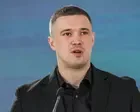
Ukraine’s recently dismissed former defence minister Mykhailo Fedorov has called for a wartime presidential election in the most direct political challenge to Volodymyr Zelenskyy since the start of Russia’s full-scale invasion in 2022.
The politician, whose abrupt sacking last month triggered a wave of protests, said that Ukraine had to “restore a full democratic process even amid a prolonged war” in a video address released online late on Tuesday evening.
“Democracy cannot be held hostage by Russia. We are fighting precisely because we want to remain a free European state,” Fedorov said in his nine-minute speech.
Though he did not mention Zelenskyy by name, Fedorov implied the current president presided over a poorly functioning state that was struggling to tackle corruption despite the national emergency.
“People cannot endlessly live in a state where they do not understand why certain decisions are made. Why some reforms move forward while others are blocked,” Fedorov said, arguing that Ukraine could fight a war and hold a national poll.
“It is particularly dangerous when society develops the feeling that the main criterion for an appointment is not professionalism, results or the ability to transform the country, but personal loyalty to the system,” he said.
Elections have been suspended in Ukraine since martial law was imposed at the start of the full-scale invasion by Russia. Zelenskyy’s five-year term ended in May 2024 but there has been little desire in Ukraine to hold a contest while war continues.
The US president, Donald Trump, has previously demanded that Ukraine hold an election, though his once-fraught relationship with Zelenskyy has gradually improved over the past year as Kyiv has shown it can hold its own on the battlefield.
Fedorov, 35, was Ukraine’s digital minister from 2019 until January, fronting the country’s wartime adoption of drones, before briefly serving in what was considered to be a successful stint as defence minister until July.
But he was suddenly dropped by Zelenskyy in a government reshuffle after a falling out with military commander Gen Oleksandr Syrskyi. Street protests followed, leading to the sacking of Syrskyi, but there was no sign Fedorov would be reinstated.
On Tuesday Zelenskyy formally nominated Yevhen Khmara, the acting defence minister, to take the post permanently. Khmara’s nomination has to be confirmed by Ukraine’s parliament, and a vote is expected to take place on Wednesday.
Artem Bronzhukov, a Ukrainian political analyst, questioned whether it would be practical to hold elections given that Russian bombing was continuing. “Today there is no clear understanding of how to ensure people’s safety in the context of a full-scale war,” he said.
There was, he added, “a fairly deep-rooted view within Ukrainian society” that elections are necessary but only after the hot phase of the war ends – and that the country remained “a warring democracy – confirmed precisely by the protests taking place after Fedorov’s resignation from the government”.
Protests had been taking place nightly in a square below the presidential office in the heart of Kyiv, but the numbers attending had been dwindling. However, the campaign was relaunched in a special rally on Sunday night that attracted about 2,000 people with regular chants of “Fedorov, Fedorov, Fedorov …”
Polling conducted at the turn of the month reported the ex-minister would come third in the first round of a presidential election with 13.1%, behind Zelenskyy on 22.3% and the former head of the armed forces, who is now Ukraine’s ambassador to the UK, Valerii Zaluzhnyi, on 21.4%.
The same polling, conducted by the Socis Centre for Social Research, also concluded that Zelenskyy would then be defeated in the run-off election by both Fedorov and Zaluzhnyi. Ukraine uses a two-stage voting system.
If Ukraine were to hold an election, it would have to contend with the fact that millions have been exiled and displaced since the start of the war, and that more than 1 million are serving in the armed forces, many on the frontline. About a fifth of the country’s territory is also under Russian occupation.