Sign in. It’s quick, free and it’s up to you.
An account is an optional way to support the work we do. Find out more.
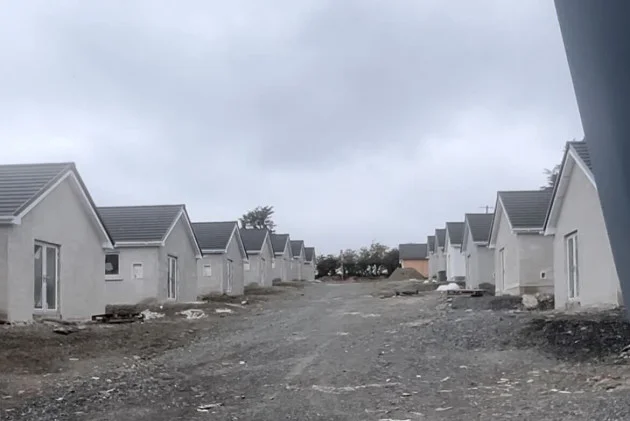
LOCALS IN A remote community on the Dublin-Wicklow border have given a broad welcome to a court order that will see 29 modular homes erected last year demolished in the coming days.
The works took residents by surprise when they began without planning permission on the site at Chianti Park, Raheen in August last year, kicking off a planning and court battle by locals and South Dublin County Council.
While the developer and site owners had argued that the works were simply renovations of a prior, vacant caravan park, the High Court dismissed this as a “particularly egregious case” as far as planning disputes go.
An offer was made to hand over the homes for free to the council, but this was rejected, and the decision has been backed by politicians and residents as a non-starter.
Grace O’Neill, whose father John was one of the objectors who successfully appealed the building of the homes at Chianti Park, Raheen, told The Journal that “you can’t have one rule for some and not others”.
She said locals in the area had been hit with multiple obstacles when trying to attain planning permission to build family homes in this scenic part of the country.
“There’s three generations of our family in my our house because we can’t get planning permission for a home – and then someone comes along and builds more than 20 without any planning. That’s just wrong,” O’Neill said.
The stand-off in this rural area, near the village of Brittas, is set to come to an end with the removal of the modular homes, but questions remain over the future plans for the site.
Unlike in the case of the Co Meath mansion that was razed earlier this year after being built illegally some 20 years earlier, Chianti Park faces dismantlement before anyone had been able to move into any of the homes.
When The Journal visited Chianti Park this week, we found the road-side entrance to the homes sealed off ahead of demolition, although they could be viewed from different points of the site.
South Dublin County Council and the O’Neill family objected to the modular homes after works got underway last year by developer Paddy Byrne’s Branach Developments.
This led the case to appear before the courts, as Branach Developments and the site owners, Mullnassa Limited and Threshford Limited, sought to continue the works.
In June, after the builders appealed a circuit court decision to knock the homes, the High Court eventually ruled the homes would need to be demolished.
In the ruling, as reported by the Irish Times, Judge Richard Humphreys said that the developers had shown “almost unbelievable chutzpah” in building the homes.
He further criticised the developers for continuing construction of the site “in the teeth of interventions” from the local authority and residents.
Instead, they had “stood on the accelerator through those flashing red lights, in the hope of creating a fait accompli before they were brought to a halt” by authorities.
An unusual feature of Chianti Park is that, aside from hosting a trailer park of caravans for several years, it is also neighboured by a long-established cluster of mobile homes and chalets at a site called Hillsbrook.
Hillsbrook, which was first established in the 1960s, is now home to around 10 families, who are a mix of Irish, Eastern European and other nationalities.
“This would not be a romantic TikTok video,” one resident said of the scrapped plans to move new people in, arguing that the hilltop community faces all four seasons of Irish weather, including tough winds and heavy snow.
It was outlined that while people who have been living long-term in Hillsbrook are comfortable with the “off-the-grid” way of life there, it may not be as suitable for people on the housing waiting list in south Dublin who may require or expect more local services.
Each resident spoke on condition of anonymity.
Several people The Journal spoke to expressed a strong belief that the new Chianti Park homes may well have been used for the government’s International Protection Accommodation Services (Ipas) to house asylum seekers.
In a statement to local politicians last year, this claim was strongly rejected as “entirely false” by Branach Developments.
The developer said that the current works were focused solely on replacing outdated mobile and chalet units with “modern, A-rated modular homes for existing residents and future private renters” instead.
A number of residents pointed to company filings, also seen by The Journal, showing that the site owners – Richie and David McDermott of Mullnassa Limited and Threshford Limited – both hold directorships at companies that house people at Ipas accommodation.
Branach developer Byrne told The Journal that as the “land has been in use as residential for 60 years”, he personally believes the site owners should have been allowed to apply for retention planning permission from the council.
If that were to be refused, then Byrne accepted that the owners should “proceed as per the High Court judgement” in June deciding for demolishment.
When contacted, the McDermotts – who own the site through Mullnassa Limited and Threshford Limited – did not respond in time for publication.
The McDermotts have told the Irish Times that they would be complying with the order from the courts, but that they had also offered the modular homes to South Dublin County Council free of charge following the court case.
The local council has not commented on the case publicly following the court case’s completion.
One woman said that she wants to help homeless people and asylum seekers but questioned the suitability of the area.
“I want to help, but to help people we have to know how to help – because if we moved people in here, then they would be happy for the first month but they would be crying for every month after, about the standards, about the location,” this woman told us.
“By adding almost 30 houses over there you’re adding new problems to here,” she said.
Despite the strong denials of any Ipas plans, one Hillsbrook resident said they “didn’t want a repeat of Citywest”, when a riot took place after an alleged sexual assault of a 10-year-old girl at the grounds of the accommodation centre.
One family living in a mobile home expressed frustration at the works that had taken place for the modular homes, as they had occurred with little notice and had seen the removal of some trees at the site.
“When January and February come around, those trees were like the first barrier for everyone living here,” this person said.
In his court ruling, Humphreys said the works had been done in a “highly sensitive setting” that is zoned “high-amenity Dublin mountains” in the South Dublin County Development Plan.
Grace O’Neill, whose father was a key objector to the homes, said that “even if it wasn’t Ipas, it’s not right to try and land people up here” without proper planning procedures, given what she described as a lack of local services.
Mayor of South Dublin council Francis Timmons told The Journal that while it is “regrettable” that any housing has to be removed, a “clear message must be sent out” that planning rules are there to be followed.
“I’m glad that planning enforcement followed up on my many representations on this matter,” Timmons said, adding that it would be “grossly unfair” if the site owners were allowed to retain the homes.
To embed this post, copy the code below on your site