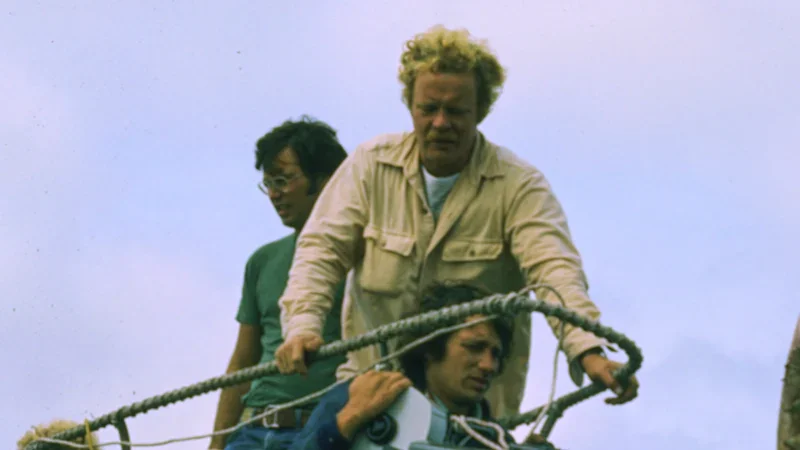
Steven Spielberg was only 27 when he directed Jaws, but the film redefined the creature feature the same way his E.T. later made aliens cuddly and Jurassic Park rekindled our love of dinosaurs. Those movies dazzled viewers by pushing the limits of technology, but Jaws was most notable for what it didn’t show. The shark at its centre was a mess.
The 1200-kilogram leviathan’s mechanical malfunctions were notorious. Spielberg insisted on filming in open water, and the behemoth’s behaviour in the brine was so poor that the director had to invent a slew of film techniques covering up for the absence.
Those menacing point-of-view shots of swimmers’ legs? The victims yanked beneath the waves by an invisible terror? The two notes signalling the shark’s approach? They’re why the film is so chilling, despite how rarely we glimpse the misbehaving animatronic monstrosity the crew affectionately dubbed Bruce.
The Shark is Broken is a play that dramatises the production’s off-screen challenges, as experienced by the fractious, larger-than-life personalities of its three leads. There’s Richard Dreyfuss, the New Hollywood young buck desperate to prove his chops. Roy Scheider is the perma-tanned hot-shot fresh off Oscar-bait such as Klute and The French Connection. And then there’s the legendary Robert Shaw, the British actor who’d played everything from Bond villain to Henry VIII.
The shark in Jaws is what literary types call a structuring absence: you don’t see much of the big fish, but its presence looms large. The structuring absence of The Shark is Broken might well be Robert Shaw himself. The play is the brainchild of his son, actor and writer Ian Shaw. Writing a play about his father – and sometimes playing the role – meant grappling with the man who died of a heart attack when his son was only eight.
For most of his career, Ian avoided mention of his famous father. Nepo babies in showbiz are nothing new – even Aeschylus and Euripides had kids who followed in their footsteps – but the younger Shaw had built his career on his own terms long before The Shark is Broken was a glimmer in his eye.
That seed was planted after he met Richard Dreyfuss in Birmingham. The veteran actor was directing a production of Hamlet when Ian introduced himself as the son of his Jaws co-star. The meeting didn’t go well. “He looked like he’d seen the ghost of Hamlet’s father and sort of crumpled and sat down. I thought: ‘Well, I’ve blown this.’”
The younger Shaw had forgotten the lessons he had absorbed from Carl Gottlieb’s famous book The Jaws Log, which describes a volatile off-screen relationship between Dreyfuss and Ian’s father during filming. The rivalry among the Jaws cast was long a sore point for Dreyfuss, who claims that reports of his bratty behaviour are overblown. He and the playwright met again at the US premiere of The Shark is Broken.
Ian Shaw recalled: “I’d loved the film so much and watched it so many times, and the chemistry was so good that I sort of assumed that they were basically friends. It became clear that there was something quite deep going on for Richard and so I walked away, and that gave fuel to the thoughts in my head that there was a very interesting backstory here.”
He quickly shelved the idea, though. “I thought it would be in poor taste, actually… I loved my father dearly and didn’t want to do him a disservice. I thought it was potentially going to be a car crash and terribly embarrassing and my family would be upset.”
There was plenty of family to take offence: Robert Shaw had 10 children from three marriages. But after friends convinced him that it was at least worth plumbing the depths of Hollywood’s first legitimate blockbuster, he and co-writer Joseph Nixon knuckled down. When the first draft was complete, they knew they had something on the hook.
“But I thought we had something that would be popular on a small scale. We were going to tour it around the UK, taking it to 80-seat venues, putting it in the back of a van.”
They arrived at the Edinburgh Fringe Festival with a production as scrappy as the fishing trawler in which the action plays out. The actor performing as Roy Scheider was also the show’s designer, and the three cast members would build the set themselves in the scant minutes before the show began. They’d brought another play by Damon Runyon to the festival to perform on alternate nights.
It wasn’t long before the Runyon play was thrown overboard. “Word of mouth got out that [The Shark is Broken] was a good show. People wanted to see this and they couldn’t get tickets. We were sold out and lots of wonderful producers were coming to see it. I was slightly dumbfounded because the Edinburgh Festival is a tricky place. Normally you’re struggling, you’re dragging people off the streets to come and see your show.”
The message was clear: you’re gonna need a bigger theatre.
Soon enough the play was booked for a lengthy West End run. A Broadway season followed.
Critics have praised the play’s humour. “We were very conscious of the source material. Jaws is a very funny film. The headline is that it’s a horror film or a thriller. But it’s very funny, and funnier as the years go by,” says Shaw.
But Jaws is also a film that takes frequent handbrake turns. One moment you’re in a monster movie, the next a satire of small towns and small minds, and then a rollicking caper on the high seas. “What I love about the movie is the way that you don’t quite know what’s going to happen next,” says Shaw. “It feels like it shifts tone very sharply, and so we wanted to emulate that in the play.”
Getting into the heads of its three characters meant devouring every documentary and interview that Shaw and Nixon could find. “Some of [the dialogue] is what they actually said. And then you fill in the blanks. You try to guess what they might have said from how they felt.”
Shaw isn’t playing his father in the Australian tour, yet the script is a reckoning between a child and the parent who was torn away too early. One critic has written that Shaw “simultaneously summons his father, redeems him, equals him, and merges with him, as we in the audience bear silent witness to a kind of sacrament”.
When creating The Shark is Broken, Shaw realised that “there are pieces of your father within you, and you’re sifting through that. There are times where you’re not in alignment, but there are times where you’re very strongly in alignment.”
Facing the ghost of his father eventually allowed him to find a more universal side to his story. “What we were writing about was fathers and sons. It wasn’t just me and my dad. In some strange way, it was about all of us and all of our fathers.”
The Shark is Broken is at Sydney’s Foundry Theatre from August 28 and Melbourne’s Athenaeum Theatre from October 15.