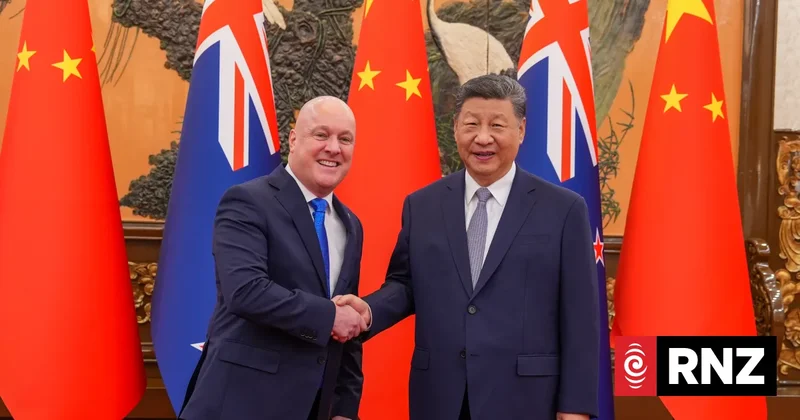
This year's security threat report names China to an unusual extent, leaving questions around whether the wording might provoke our 'complicated, but important' trading partner
The NZSIS 2026 Security Threat Environment report didn't hold back about intensified threats to the country's security, naming interference in our elections, efforts to get hold of critical assets - including high-tech secrets from the space sector - targeting of our diaspora community groups, and homegrown threats and violence from extremists.
Something else it named? China.
In the past, such reports have tread a delicate diplomatic balance, wary of offending our notoriously tetchy trade partner and avoiding singling out any one particular nation - but the language this year has been specific.
The report talked about the People's Republic of China being the only country detected conducting espionage at scale, China trying to get information about our critical assets that "cannot be described as benign" and a Communist Party research institution called the Purple Mountain Observatory, saying it had tried to use trickery to get satellites up and running here.
The spy agency was able to disrupt its attempts, but the threat report said it wasn't the first attempt and was unlikely to be the last.
"This was a really clear and solid example of one of the ways that China is trying to get critical infrastructure in our part of the world," says Anna Fifield, former Washington Post Beijing bureau chief, and now The Detail's Saturday host specialising in geo-politics.
"We hear a lot about how they are trying to repress diaspora communities, trying to influence certain elections, but this was a really concrete example of how a Chinese state-affiliated research institute had used a cover story to try to trick a New Zealand company into letting them install ground-based space infrastructure, which is basically radar or antenna like that from which they can monitor activity in space."
On The Detail today, Fifield talks about the balancing act in such reports, when it comes to warning Kiwi companies about what's going on, without offending the Chinese, our largest trading partner.
"The SIS was really clear in its report to say 'this should not deter companies'. Most of the business we do with China is all above board, but they are warning companies, New Zealand institutions, universities that work in these sensitive areas where dual-use technology could be in place just to be aware, on the alert about this and to go to them with any questions.
"I think it's about raising awareness that not all Chinese activity is benign. If China comes back and tries to do this in another way, hopefully they will catch it earlier."
Fifield also says these SIS threat reports have become progressively more direct in calling out China by name.
"It's quite a sharp change for New Zealand and it's one that Australia hasn't made. Their equivalent security threat assessment report does not name China by name, it just refers to 'foreign actors' or 'third countries'... so it is unusual, but I think it really re-inforces the threat that our officials, our spooks, see from China... trying to take advantage of our naivety, take advantage of our good trading relationship with them and use that for their purposes.
"In this kind of situation, they will deny all knowledge usually, and say that China abides by rules and international law, and expects everybody else to do the same. I certainly don't think that China is going to 'fess up to this, but it will be on their radar - no pun intended!"
So far, in reaction to the SIS report, the Chinese embassy in Wellington has said it "fabricates and hypes", and has even suggested that the report itself may well be the result of foreign interference - "part of a new round of attacks, smears and vilification of China orchestrated by certain international forces".
The Chinese state-affiliated Global Times reported that China "firmly rejected and condemned" the report, "stressing that the report is rife with Cold War thinking and contains unfounded accusations against China".
The article also quotes an academic who called it 'compensatory hawkishness', with the goal of proving New Zealand's reliability as a Five Eyes ally.
Fifield says we may not have heard the last of this from Beijing and there's always the chance of trade retaliation.
"China makes a habit of using its economic power as political leverage, there is always the chance they will do that with New Zealand. Luckily we have avoided that so far, but our exporters are certainly alert to the risk of that and trying to factor that in.
"I think even our big exporters know that there are going to be times when Chinese behaviour is so egregious that our government will have to issue statements in this way about it.
"If it wants to be angry about something, it will find the weakest of excuses, so from our perspective, we need to continue to say what we need to say in order to protect our national security."
The report follows an amendment to the Outer Space and High-altitude Activities Act, which Parliament hurried through last July, requiring registration for ground-based space infrastructure.
Also today, The Detail talks to Jason Young, the director of the New Zealand Contemporary Chinese Research Centre at the Victoria University of Wellington - he's an expert in Chinese politics and international relations.
He says the language in the SIS report was very general about the various risks New Zealanders face, but some of the case studies point specifically to China.
"There is a balance between acknowledging that the risk is not purely from one country, and also wanting to protect our diplomatic interests and trading interests," he says. "At the same time, I think it's important that New Zealanders are aware of where particular risks may come from."
Young says, given our burgeoning tech and space industries, which inherently have dual uses when it comes to defence and security, New Zealand businesses must do their due diligence to ensure risks don't eventuate. They should still act on their commercial interests, but be aware of what's going on.
"There's really no excuses, considering the information that's been put out over the last decade from the New Zealand agencies about the types of the things that they need to do in terms of managing risks."
Young says it's important also to focus on developing productive relationships with countries like China.
"I always like to say, when I'm talking about the more sensitive and challenging areas of the relationship with China, that it's always important to put in the perspective that, yes, we have these issues and these challenges, but when you look at the relationship as a whole, there's a whole bunch of really good news stories, there's a very important trade relationship, there's very strong institutionalised diplomatic links with China.
"Which is not saying to dismiss the issues and the challenges, but rather to put it in the perspective of a very complicated and significant and important relationship for New Zealand to manage."
You can also get in touch with us by emailing thedetail@rnz.co.nz