By Kang Yoon-seung
SEOUL, Aug. 19 (Yonhap) -- South Korea's economy is expected to grow 3.2 percent in 2026, a state-run think tank said Wednesday, revising up its previous forecast of 2.5 percent amid stronger-than-expected global demand driven by the artificial intelligence (AI) boom.
The Korea Development Institute (KDI) said the revision came as global demand for semiconductor products remained stronger than expected, leading to increased exports and facility investment, which are expected to eventually boost private consumption in 2027.
Accordingly, the KDI also projected economic growth of 2.2 percent for 2027, up 0.5 percentage point from its previous outlook.
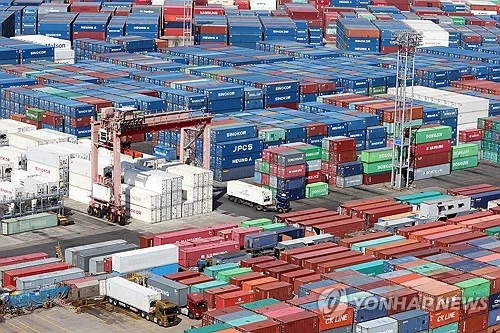
The think tank added that South Korean export volumes are expected to grow 8.7 percent and 5 percent in 2026 and 2027, respectively, despite U.S. tariff measures and geopolitical uncertainties in the Middle East, as AI-related investment around the globe is expected to offset such hurdles.
The KDI, meanwhile, assessed that South Korea is currently enjoying a surge in exports and facility investment amid the AI boom.
"Exports of computers, electronics and optical instruments continue to grow at a sharp pace, with the current account posting an unprecedented surplus," the KDI said in its report.
"Facility investment is expanding, led by chip-related segments," it added, noting that construction investment, in contrast, remains sluggish due to a slump in the housing market outside the greater Seoul area.
Global credit appraiser Moody's Ratings, meanwhile, also reportedly revised up the growth forecast for Asia's No. 4 economy to 3.5 percent, rising from the previous projection of 2.5 percent suggested in May, in its periodic review.
The KDI, however, warned that changes in the semiconductor industry cycle may increase economic volatility, given the South Korean economy's heavy reliance on global chip demand.
"Growth may slow rapidly should global AI investment contract due to concerns over profitability or South Korean chipmakers' global market shares decline amid heightened competition with producers from other countries," the think tank said.
The KDI, on the other hand, said growth may exceed expectations if South Korean companies expand their semiconductor production capacity at a faster-than-expected pace.
Other potential risks include uncertainties surrounding U.S. tariff policies and geopolitical tensions in the Middle East that could disrupt raw material supplies, it added.
colin@yna.co.kr
(END)
- BTS' V reveals hearing loss, Jungkook performs through shin injury on world tour
- N. Korea silent on Lee's proposal for dialogue to officially end Korean War
- (2nd LD) Lee proposes dialogue with N. Korea to officially end Korean War, halt Pyongyang's nuclear program
- Ha Young says 'sincerely sorry' over great-grandfather's pro-Japanese past
-
Incheon airport ranks world's No. 1 in int'l passenger traffic in first half
-
BTS' V reveals hearing loss, Jungkook performs through shin injury on world tour
- N. Korea silent on Lee's proposal for dialogue to officially end Korean War
- Trump signs memo permitting foreign shipbuilders to build up to 2 U.S. ships in their shipyards
- (LEAD) Lee reiterates support for four-year, two-term presidential system
-
(2nd LD) Lee proposes dialogue with N. Korea to officially end Korean War, halt Pyongyang's nuclear program
-
Death penalty sought for woman accused of killing 2 men with laced drinks
- (2nd LD) Lee reaffirms push to retake wartime operational control of troops during his term
- (LEAD) Trump says N. Korea's Kim has responded to his dialogue overture
- (LEAD) Seoul in close consultation with U.S. over combined military exercises: security adviser
- (LEAD) USFK commander visits defense ministry after Trump's order to reduce joint exercise with S. Korea