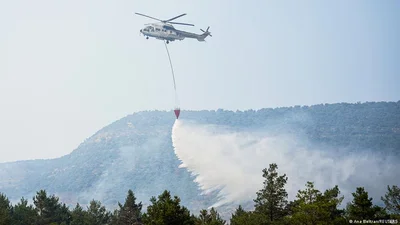
Hundreds of firefighters and soldiers were battling a massive wildfire northeast of Madrid on Tuesday that has been raging since last week.
Authorities say the blaze, which broke out on Thursday in Guadalajara province about 100 kilometers (60 miles) north of Spain's capital, is one of the most difficult they have faced and is considered the most significant wildfire to affect the country this year.
What do we know about the fire north of Madrid?
"It is the most complex of those that have been tackled in recent years in Spain," Castilla-La Mancha regional president Emiliano Garcia-Page told reporters.
The fire has been raging in an area just 100 kilometers from MadridImage: Ana Beltran/REUTERS
Garcia-Page added that more than 600 firefighters and nearly 50 aircraft and helicopters had "practically stopped" the blaze from spreading toward the provincial capital of Soria, but that it was not yet under control.
"We can now see light at the end of the tunnel," he said.
The blaze has forced some 1,200 people to evacuate from their homes across the region of Castilla-La Mancha, while at least 30,000 hectares (74,000 acres) of land have been burnt, officials said.
The fire has been so difficult to bring under control because the area is made up of scrubland and has been under prolonged, severe drought conditions. High winds have also complicated the situation.
At least 30,000 hectares have been destroyedImage: Nacho Valverde/Europa Press/IMAGO
Spain's risk of more fires 'remains high'
Spain on Tuesday entered the third heatwave of the summer so far, with temperatures expected to soar above 40 degrees Celsius (104 Fahrenheit) in much of the country, hindering firefighting efforts.
According to Spain's national weather agency AEMET, the heatwave is expected to only last about three days.
Spain is still reeling from one of the deadliest wildfires in modern times that killed 13 people and destroyed 7,000 hectares in southern Almeria province earlier this month.
According to the European Forest Fire Information System (EFFIS), wildfires have destroyed over 115,000 hectares of land in Spain this year.
"We are going through particularly complex weeks, and the risk of fires remains extremely high," government spokeswoman Elma Saiz told a press conference.
Last year, the EFFIS said more than 393,000 hectares were destroyed by wildfires, the most in Spain's history.
Spain has been fighting multiple fires in recent weeks and is already in its third heatwave this yearImage: Ricardo Rubio/Europa Press/IMAGO
France also battling major fires
In southwestern France, two firefighters were killed near an airport in Gironde, Interior Minister Laurent Nunez said Tuesday.
On Monday, firefighters tackled a fire at a Roma camp on the outskirts of Nantes in western France.
Around 200 people were evacuated after the blaze, which began after a car caught fire, spread to nearby woodland and to caravans belonging to people living in the settlement.
Human-driven global heating is making heatwaves longer, more intense and more frequent, most scientists say, which creates dry conditions that increase the likelihood of destructive wildfires.
Why forest fires are becoming more frequent around the world
[](https://hlsvod.dw.com/i/Events/mp4/pp/pp20210820_gesamtHD_,sd,hd,.mp4.csmil/master.m3u8)
Edited by: Wesley Dockery
Don't let the algorithm hide the news. If you rely on our team for trusted reporting, please take a moment to select us as your Preferred Source on Google by clicking here and hitting the "star" or "preferred" button, so you'll always see our verified news first.