- Witchland by Marion Gibson (Simon & Schuster £22, 320pp)
In 1650, a pretty young woman was hauled into Newcastle’s medieval main square to be examined by the Witch Pricker. Newly arrived from over the Scottish border, the Pricker’s job was to decide whether the unfortunate girl really was, as her neighbours claimed, a witch.
His ‘examination’ involved poking her upper thigh with a sharp bodkin: if she winced from pain and bled from the scratch then she was innocent.
Inevitably, a crowd had gathered to see the Witch Pricker fling the woman’s skirt over her head, leaving her naked from the waist down. On pricking her – and everyone was aware of the lascivious innuendo – the man announced loudly that she had not bled. She was a witch and would have to die.
The name of both the woman and man have been lost to history, but the incident goes to the heart of the misogyny, paranoia and sectarian violence that stalked England during the witch-crazed 1640s. Hundreds of women, nearly always poor and often single, were accused of signing a pact with the Devil.
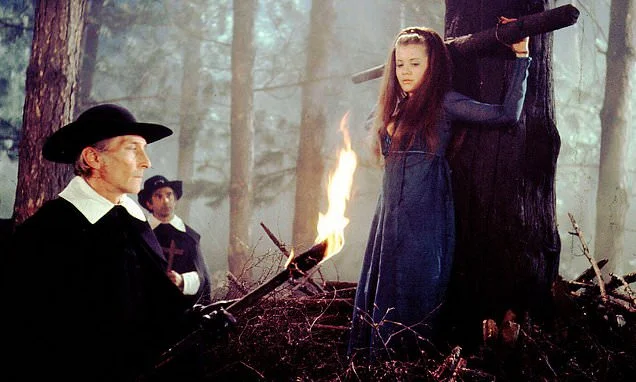
Matthew Hopkins: Witchfinder General
Having sold their soul to the Evil One in return for sex, money or just a piece of cheese, they agreed to kill their neighbours’ children, spoil their crops or burn down their houses.
The nameless Newcastle woman was lucky. The regional military governor had become suspicious about the Witch Pricker’s motives: the scoundrel was paid 20 shillings for every witch he caught and clearly enjoyed any excuse to lift the skirts of pretty young women.
Lieutenant-Colonel Hobson insisted on the test being done again.
This time, the young woman bled and the Witch Pricker was forced to admit that ‘she was not the child of the Devil’. All the same, 15 people, including one man, failed the test and were hanged on a site near to what is now Newcastle United’s stadium.
Marion Gibson is a leading historian of witchcraft and in this terrifying but compulsive book she spells out how, in a superstitious age without much scientific know-how, it was possible to believe that everyday disasters really did have a satanic cause.
When Essex wheelwright Thomas Hart was devastated by the death of his prize sow in 1641, his automatic assumption was that it was the work of the town’s curmudgeon, a widow called Anne West. Later, and far more ominously, Hart accused West of causing his wife Prudence to miscarry in church.
Likewise, wealthy Great Yarmouth hosier Henry Moulton claimed that Elizabeth Bradwell had ‘bewitched’ his baby son for 18 months, almost to the point of death. The reason? Earlier, he had refused to give Bradwell any extra knitting work.
A nd in Cornwall, Joan Pitt was suspicious when, while walking in daylight, she fell and hurt her leg.
The only explanation was that Ann Jefferies, her servant who sometimes admitted to talking to ‘fairies’, had put a curse on her. West and Bradwell eventually confessed to being in league with the Devil and were hanged, while Jefferies was confined in Bodmin Jail.
Execution by hanging of four 'witches' in Edinburgh, Scotland 1678
Today, we might put the ‘witch craze’ down to group hysteria. Gibson explains that the Civil War in England had turned everyone paranoid. While the people who followed the king – Royalists – were favourable to the lax old religious order which took a tolerant view of local superstitions, the new Puritans insisted on a strict interpretation of the Bible.
These two world views were bound to collide, and it is no coincidence the areas of England where the Roundheads were winning were also places that experienced the greatest witch panics: East Anglia especially, but also Lancashire and Newcastle. Wartime conditions meant jury trials were suspended in favour of local big-wigs deciding cases according to regional prejudices.
East Anglia was undoubtedly the worst. In 1644, a young Essex clergyman’s son called Matthew Hopkins appointed himself Witchfinder General and offered, for a hefty fee, to visit local communities and flush out any witches.
According to his famous book The Discovery Of Witches (1647), he was looking for several tell-tale signs. First was the all-important pact: the suspect had to admit that she had signed an agreement, preferably in blood, with the Devil in return for getting her heart’s desire.
E xamples include Rebecca West’s yearning for ‘a proper young man’ – a nice-looking husband who would look after her financially; Helen Clarke, who dreamt of killing pigs; and Elizabeth Goodwin, who just wanted cheese.
If the suspect refused to confess her pact with the Evil One, then Hopkins had ways of making her talk. She would be kept awake for days at a time, forced to walk around her cell by guards working in shifts.
In South Leith in Scotland, Margaret Thomsone walked for 26 days straight with ‘men daily and nightly attending upon her’.
Next came the humiliating physical search for the extra teats with which a witch would feed her familiar or evil spirit – anything from an imp to a bear the size of a rabbit.
The ‘searchers’ were looking for a pile, wart or mouth ulcer that might pass as an extra nipple. And then there was the ‘pricking’, Scottish-style. If a suspect had a numb spot on her body which didn’t bleed, it was proof that demonic suckling had taken place.
After days of this torture, it is no surprise that many poor souls started to say anything to get the pain to stop. Some of the women were clearly psychotic, others may have been suffering from postnatal depression, a few were mentally disabled.
Mary Scutton, who had recently given birth, talked of three imps whom she suckled with her blood three times a day, Bess Clarke confessed to having a ‘familiar’ that looked like a greyhound called Vinegar Tom, and Jane Wallis said creatures called ‘Grizzel’ and ‘Greedigut’ had brought her money.
More prosaically, Margaret Wyard admitted to having caused a blight to fall on the cornfield of wealthy local gentleman William Mase.
All four were condemned to death.
Even though the witch trials were nearly 400 years ago, Gibson is adamant that we must not get complacent that such things could never happen to us.
She even finds a woman called ‘Marion Gibson’ in Scotland who was hanged as a witch, which she takes as a reminder of how easy it would be for any of us to find ourselves at the mercy of hysterical groupthink. After all, we talk glibly today of ‘witch-hunts’ stirred up by social media.
I finished this wonderful book feeling less like a voyeur of historic pain and more like someone who has received a timely reminder about the life-and-death importance of never allowing yourself to get caught up in the latest criminal conspiracy.