Tamil NaduChief Minister C. Joseph Vijay, in his maiden Independence Day address, gave a call to the people to develop “zero tolerance” for corruption.
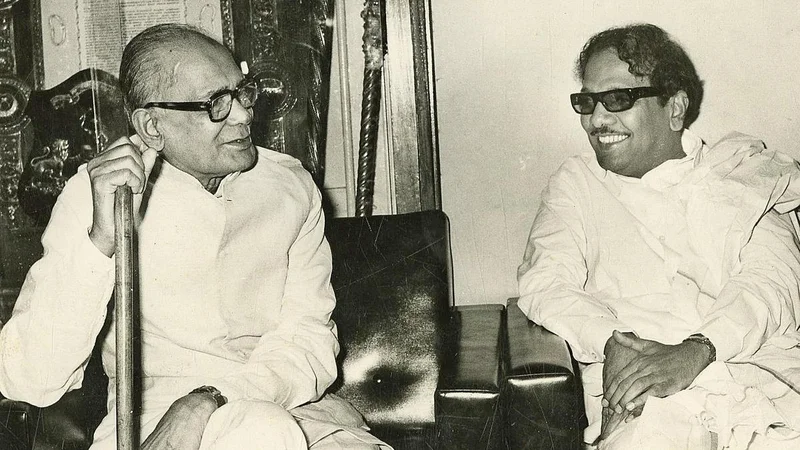
Corruption, as an issue at different levels of the administration, had been talked about for years. Parasakthi, a 1952 Tamil film directed by Krishnan-Panju with the 24-year-old ‘Sivaji’ V.C. Ganesan in the lead and written by M. Karunanidhi, who subsequently became Chief Minister and the Dravida Munnetra Kazhagam (DMK)’s longest-serving president, had portrayed the Congress government as “feckless,” in the words of U.N. diplomat-turned-political writer R. Kannan. The film shot Ganesan and Karunanidhi, who was then 28, into fame, paving the way for the growth of the DMK.
In 1957, the Estimates Committee, comprising MLAs, discussed corruption in government hospitals and called for the formation of a sub-committee to go into the issue. In fact, the then Director of Medical Services had responded by saying that the Government General Hospital in Chennai [now named after former Prime Minister Rajiv Gandhi] be covered initially.
Five years later, in July 1962, Finance Minister M. Bhaktavatsalam explained the steps taken by the government to put down corruption. One and a half years later, Bhaktavatsalam, who had, by then, became the Chief Minister, expressed concern over corruption in local bodies and proposed a vigilance body to tackle the problem. In August 1966, his Ministry faced a no-confidence motion in the Assembly with the then Leader of Opposition V.R. Nedunchezhian of the DMK levelling charges of “corruption, favouritism and nepotism.”
However, it was after the DMK captured power in 1967 that the issue of corruption acquired greater proportion. Veteran Tamil writer and once a bitter critic of Karunanidhi and the DMK, Jayakanthan, as quoted by Dr. Kannan in his biography of the DMK founder C.N. Annadurai, commented in 1975 that “in the city [Chennai] corporation, controlled by the DMK, corruption had come to be acknowledged as an ethic in itself.” The DMK regime, headed by Karunanidhi, created a record of sorts when it was dismissed by the Union government in January 1976 for having indulged in “maladministration, corruption, and misuse of power for achieving partisan ends.”
Sarkaria Commission
In a proclamation issued on the night of January 31, 1976, the then President, Fakhruddin Ali Ahmed, on the advice of the Union Cabinet led by Prime Minister Indira Gandhi, dissolved the Tamil Nadu Legislative Assembly, apart from imposing the President’s rule in the State. The Centre also constituted a commission of inquiry, headed by Supreme Court judge R.S. Sarkaria, to probe the charges.
It was a culmination of a series of exciting events, centred around corruption charges against the DMK regime, for over five years. The State witnessed a high-pitched political campaign involving national leaders, including Sarvodaya leader Jayaprakash Narayan and Union Home Minister Uma Shankar Dikshit. It was during this period that Karunanidhi’s long-standing colleague and the DMK treasurer, M.G. Ramachandran (MGR), exited from the party in October 1972 on the issue of corruption. About one and a half years later, another colleague of Karunanidhi and Harijan [the term used in the 1970s to denote Scheduled Castes] Welfare Minister Sathyavani Muthu turned his strong critic and dropped from the Cabinet, even though her departure was not exactly for corruption charges.
Seven months before MGR’s departure from the party, Karunanidhi, who had completed three years in office as Chief Minister, made an offer in the Legislative Council, during his reply to the eight-day discussion on the Budget, to step down from office if specific charges of corruption or irregularities made against him were proved, The Hindu, reported on March 12, 1972. He added that even if his son was involved in corrupt practices, he was prepared to punish him. He did not want to hold a brief for anybody who was guilty of corruption.
Months after the AIADMK’s formation, the DMK government came up with a legislative measure — Tamil Nadu Public Men (Criminal Misconduct) Bill — which received the assent of President V.V. Giri in January 1974. During the debate on the Bill, Karunanidhi asserted that there was no need to link the Bill to the recent events when the Opposition had brought forward charges of corruption against the DMK Ministry, stated The Hindu on April 7, 1973. The Ministry was “not afraid” to face those charges. Such instances of levelling charges against Ministries and Ministers was nothing new as, in the past, even the Councils of Ministers led by Rajaji, K. Kamaraj and Bhaktavatsalam faced similar charges. Karunanidhi also took the stand that frivolous allegations were being made against the DMK Ministry “out of jealousy” as the Opposition could not tolerate the State being ruled by men from lower strata of society.
Jayaprakash Narayan’s re-entry
When the political discourse in Tamil Nadu took place on corruption, the rest of the country was rocked by students’ agitations in Gujarat first and Bihar later. The Congress leader, Chimanbhai Patel, who became Chief Minister in July 1973, was the target of attack of students, who launched the Nav Nirman movement. The students’ movement got a boost when Jayaprakash Narayan, who had begun carrying on an anti-corruption struggle after ending his retirement from politics, had supported it. Patel had to go in February 1974. A month later, Jayaprakash Narayan, who had emphasised on the idea of probity in public life, turned his focus to his home State of Bihar where students were agitated about the “excesses” of the Abdul Ghafoor-led Congress government. Eventually, Ghafoor resigned in April 1975.
In July 1974, the Union Minister Dikshit, who was the father-in-law of Delhi’s former Chief Minister Shiela Dikshit, became a subject of heated discussion in Tamil Nadu because of his observation that in the State, “the corruption is maximum in the country,” this newspaper wrote on July 16, 1974.
Addressing participants of a training camp of the Congress in Jaipur, the Home Minister commented that the agitation being led in Bihar by the Sarvodaya leader was “motivated by his opposition” to Prime Minister Indira Gandhi rather than by his proclaimed objective of rooting out corruption. If that was not so, Mr. Dikshit added, “he (Jayaprakash Narayan) should have chosen (for agitation) Tamil Nadu.” When Karunanidhi took strong exception to Dikshit’s statement, the latter, in a telegram to the former, blamed the press for creating misunderstanding over his remark.
‘Maximum corruption’
Even though the Home Minister did not pursue his debate with Jayaprakash Narayan over the issue of corruption, MGR, the chief of the All India Anna Dravida Munnetra Kazhagam (AIADMK), found it odd about the Sarvodaya leader warming up towards the Tamil Nadu Chief Minister. In a 12-page letter, MGR pointed out to Jayaprakash Narayan that he had gone about “shouting from housetops” against corruption and spoken of a “total revolution.” Yet, he had chosen to take a “totally different attitude to the corrupt government” in Tamil Nadu because Karunanidhi happened to be a friend of his (Jayaprakash Narayan), The Hindu on May 3, 1975, quoted AIADMK founder as having stated.
Ten days later, Jayaprakash Narayan told a press conference in Calicut (now Kozhikode) that he had not given any “clean chit” to Karunanidhi. At the same time, he had neither the time nor the necessary qualification to undertake the work of going into allegations against Karunanidhi and his Ministers. He gave a brief account of his talks with the Tamil Nadu Chief Minister in New Delhi and Chennai in this regard, according to this newspaper on May 14, 1975.
Eight months later, the discourse on corruption in the State went to the next stage with the removal of the DMK regime.
Published - August 19, 2026 07:00 am IST