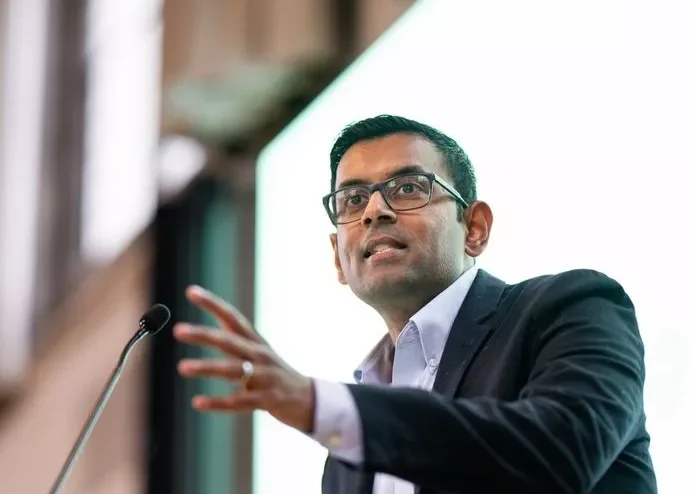
Arvind Narayanan has spent years puncturing Silicon Valley’s grandest claims about artificial intelligence. The Princeton computer-science professor co-wrote AI Snake Oil, a book that challenges the notion that algorithms can reliably predict who will be a good employee, which patients will get sick, or who might commit crimes. He has also pushed back on the idea that generative AI is about to eliminate vast swaths of white-collar work, calling work something like a “sandwich” whose bun is growing even as the meat shrinks.
But Narayanan does not dismiss the public’s mounting hostility toward AI. He thinks the backlash is real, understandable—and far more complicated than any one thing. It’s a coalition of different fears, he said: “many different kinds of anxieties have all kind of pushed together into one sort of generalized opposition to AI.”
What looks like AI phobia, he argued, is really a collection of anxieties about fear of job loss; distrust of powerful technology companies; anger over the influence of billionaires; concern about environmental costs; unease over the technology’s social effects; and, for younger people, uncertainty over what skills they need to retain in a labor market increasingly built around AI.
Snake oil, redefined
Narayanan’s critique is not that generative AI is useless, or that workers should refuse to use it—and he stressed that his “snake oil” criticism largely does not extend to generative AI. He said he views AI as a potentially transformative technology that knowledge workers can already use to research, challenge assumptions, analyze data, and build software. His warning targets a different class of AI claims: systems marketed as capable of making high-stakes predictions about people.
Hospitals, insurers, human-resources departments, and criminal-justice systems have all adopted or considered machine-learning systems meant to forecast future behavior or outcomes. Narayanan is skeptical of those applications because the future is inherently hard to predict—and because dubious forecasts can drive consequential decisions about hiring, coverage, bail, or policing.
“Generative AI, we do criticize for some of the hype that attaches to it,” he said. “But we’re also very clear that this is a technology that is very useful for every knowledge worker.”
The ‘moral crumple zone’
Narayanan has argued with his sandwich metaphor that the near-term workplace consequence may be more complicated than AI just eliminating jobs: AI can expand the layers of checking, supervision, and verification required to use it responsibly. In adversarial fields such as law, for instance, one side’s AI-enabled productivity can compel the other side to match it, so the total volume of work keeps expanding rather than shrinking.
The bigger risk, he said, may be a workplace in which people still have jobs but are relegated to what he called “janitorial work” — his phrase, but he acknowledged that others had circled the same idea with different words. Monitoring systems perform much of the intellectual labor while workers absorb the blame when something goes wrong.
He also invoked a second term for that arrangement: the “moral crumple zone,” a phrase more widely used in AI-ethics circles. Just as crumple zones in cars absorb impact to protect the vehicle, the person nominally in charge becomes the one punished for the failure of an automated system they lack the visibility or authority to truly control.
“It’s not inevitable,” Narayanan said of that outcome. “There are many design choices throughout the AI pipeline.”
Why programmers and artists see it differently
That prospect helps explain why opposition to AI cannot be reduced to generic anxiety about change, Narayanan said. The same technology can empower one profession and alienate another.
Software developers can work with AI interactively—asking it to find bugs, testing its output, and incorporating suggestions throughout a project. The human stays in the loop. Narayanan calls this a “growth cycle,” as opposed to a “dependence spiral,” in which users delegate mundane tasks but retain the expertise to evaluate the system and do the essential thinking themselves.
For artists, the experience is often starkly different. A prompt produces a finished image, creating the impression that the system has skipped over the human creative process rather than supporting it. “There are genuine reasons, based on the way that AI has been designed, that different professions understandably have very different reactions,” Narayanan said.
Students caught in a bind
AI also poses a distinct problem for the students Narayanan teaches, both undergraduate and graduate. They are expected to become fluent in tools they’ll encounter in the workplace, particularly in computing and other knowledge-intensive fields. But leaning too heavily on AI can deprive them of the foundational skills needed to judge whether a system’s output is actually right.
“They’re in a bind,” Narayanan said. “To what extent should you be using AI versus resisting it to build up your own skills?”
That conflict is especially acute because faculty haven’t settled on an answer — and Narayanan said faculty are often “clueless” and lack “bravery” on the subject. Universities are still working out what a healthy integration of AI into instruction looks like, he added, and that uncertainty itself breeds anxiety among students who feel they have little choice but to adapt.
An optimist, not a booster
Narayanan’s diagnosis isn’t a case for resignation. He described himself as an optimist — not the kind of techno-optimist who believes innovation naturally produces good outcomes if critics and regulators simply get out of the way, but one whose optimism is contingent on people continuing to push back.
“I think tech has generally in the past led to good outcomes,” he said, “but only because there were a lot of people worrying about what could go wrong and because we were able to regulate things in time.”
He has a preferred analogy for where this ends up: AI is going to do for cognitive work what cranes did for physical work. We still build skyscrapers; we just don’t carry the steel ourselves. We could have built autonomous cranes if we wanted to, he said, but we decided that was too dangerous. The person operating the crane still decides where the beam goes.
“It’s never too late,” he said when asked whether AI phobia has hardened into something irreversible. “I think some negative impacts have already materialized, but even those can be reversed.”
The skill he isn’t naming
A less flattering theory, however, is buried in Narayanan’s own case study. He is a tenured computer scientist who has spent decades training himself to break problems into parts, evaluate evidence, and think rigorously before ever touching a keyboard. That is precisely the muscle that he says AI rewards rather than replaces: he uses it “to go deeper,” not “to go faster,” because he knows how to do everything himself. But many of his students—and many professionals in the workforce—can’t go deeper with these tools yet.
When his own children, ages 4 and 7, wanted to learn a new topic, he didn’t need a course or a consultant. He built them a custom app in 15 minutes—one of roughly 50 he has made for them, including a phonics tool that helped his son start reading at age three—because he already understood what good pedagogy looked like and simply used AI to execute it faster. He argued for a world where every parent can design AI-powered tools that help their children learn new things, suited to each parent and each child’s particular style. “That’s a whole big part of my life now,” he said, “and I myself use AI heavily for learning, and every day I come into work feeling like I have superpowers that even the projects that, you know, many of the projects that I’m doing today would have been hard to even conceive of five years ago.”
This is a rare skill set, Narayanan acknowledged. Most people, including plenty of comfortable, credentialed professionals, do not have it. And that may be the least discussed driver of AI phobia: not fear of the technology itself, but a quiet suspicion that the technology will entrench intellectual inequality — because many people do not know how to think the right way to use the tool. Narayanan effectively agreed with this when pressed. It’s not that people fear thinking machines. It’s that AI exposes, in real time, who already knows how to think.
Still, Narayanan insisted that real progress is being dismissed. “I think it’s tragic to me that that story of how it’s giving us superpowers is being missed in all the narratives that are going around.”
For this story, Fortune journalists used generative AI as a research tool. An editor verified the accuracy of the information before publishing.
breaks the traditional barrier between audience and newsroom. The show transforms
Fortune DailyFortune’s trusted reporting into actionable, conversational, and entertaining insights for an emerging class of business leaders.
Watch here.