South Africa Invites Chinese Tyre Companies to Build US$123 Million Plant
South Africa · TRADE
What South Africa is offering Chinese tyre companies
On Tuesday 18 August 2026, News24 reported that Eastern Cape Premier Oscar Mabuyane had confirmed “advanced discussions” with Chinese tyre companies and Chinese carmakers about building factories in his province.
The pitch is simple. Make the tyres here, and you can sell them across South Africa and its neighbours without paying import duties. In return the province offers serviced industrial land, deep-water port access and renewable power.
That is a big shift. For four years South Africa has been trying to keep Chinese tyres out. Now it is trying to bring the companies that make them in.
The story did not begin on 18 August, though. The concrete project became public earlier, on 30 July 2026, when the Nelson Mandela Bay Municipality announced talks with the Coega Development Corporation and China’s Sailun Group.
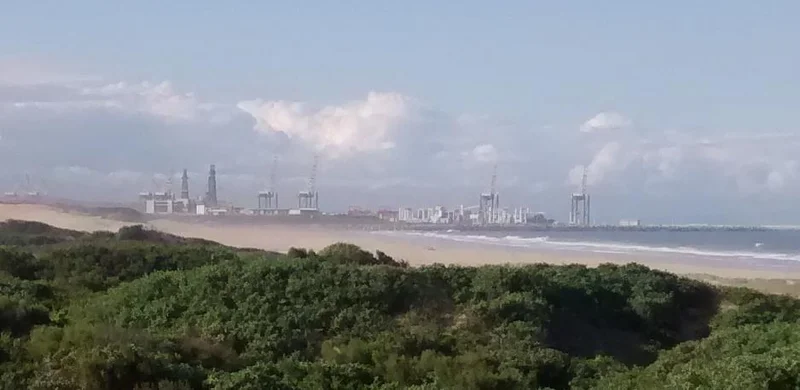
A US$123 million tyre plant at Coega
On Monday 3 August 2026, the government news service SAnews reported that Nelson Mandela Bay Executive Mayor Babalwa Lobishe had reaffirmed the metro’s commitment to landing a proposed R2-billion investment by Sailun Group at the Coega Special Economic Zone. At about R16.22 to the dollar in mid-August 2026, that is roughly US$123 million.
The plan on the table is a 20-hectare factory with an estimated 100,000 square metres of production space, its own renewable energy generation, battery storage and treated industrial return-effluent water.
In its first phase the plant would make one million passenger car tyres and 300,000 truck and bus tyres a year, with room to grow. It would create about 200 direct jobs at the start, rising to about 800 permanent jobs, and more than 1,200 indirect jobs in construction, logistics and supply.
Sailun is still running feasibility studies. It turned to Coega after delays hit an earlier proposed site elsewhere in South Africa, and the municipality says the company likes the location, the logistics, the availability of industrial land, the renewable energy options and the direct access to the Port of Ngqura. Output would serve the Southern African Customs Union and the wider sub-Saharan market.
Sailun is not new to Africa. It already makes tyres in Egypt’s Suez Canal Economic Zone, and in June 2026 it announced a further US$1.14 billion expansion there.
The hole Goodyear left in Kariega
The reason the Eastern Cape is shopping in China is that it lost its own tyre plant. On Thursday 5 June 2025, Goodyear managers told staff at a five-minute meeting in Despatch, near Kariega in the Eastern Cape, that the company would stop making tyres in South Africa. In total 907 jobs went; only about two dozen sales and administration roles stayed.
Production at the Kariega plant, which opened in 1947, stopped for good on Friday 15 August 2025 after 78 years, with 35 workers kept on briefly for maintenance.
After talks led by the National Union of Metalworkers of South Africa and Solidarity, each worker received a lump sum of R100,000 (about US$5,700 at the time) plus four weeks’ pay for every year worked. The company’s opening offer had been R10,000 and two weeks.
In January 2026 Goodyear South Africa appointed property agents to sell the Kariega industrial asset. Three tyre factories are left in the country — Bridgestone, Continental and Sumitomo Rubber, which makes Dunlop — together producing more than seven million tyres a year and employing around 5,000 people.
Why local tyre makers are not complaining
At first glance it looks odd for South African manufacturers to cheer the arrival of a Chinese rival. It is less odd once you look at what the industry has actually been fighting about.
The South African Tyre Manufacturers Conference (SATMC), whose managing executive is Nduduzo Chala and whose chairperson since June 2025 is Jacques Rikhotso, has never argued against foreign ownership. Its own members are Japanese, German and American groups. Its argument is about where tyres are made and at what price.
Imports took just over 60 percent of the South African market in 2025, when about 12.5 million tyres were sold, according to industry figures attributed to SATMC. A factory built inside the customs union pays local wages, local taxes and local electricity bills, and competes under the same rules as everyone else.
That is why News24 reported that local industry was applauding the move. Chinese tyre companies producing in Gqeberha are a very different proposition from Chinese tyre companies shipping containers into Durban.
The duties that are still in place
None of this cancels the trade fight. The International Trade Administration Commission of South Africa (ITAC) opened its dumping investigation on 31 January 2022 after an application from SATMC. A provisional duty of 38.33 percent ran from 9 September 2022 to 8 March 2023.
On 28 July 2023, then trade minister Ebrahim Patel approved definitive anti-dumping duties of 7.18 percent to 43.6 percent on car, bus and lorry tyres from China, for five years to July 2028. Exporters that did not cooperate with the investigation pay a residual rate of 41.47 percent.
ITAC then went after “country hopping”. It opened an anti-circumvention investigation on 20 September 2024 into tyres routed through Cambodia, Thailand and Vietnam. Its preliminary report calculated dumping margins of 27.98 percent for Cambodia, 50.52 percent for Thailand and 78.90 percent for Vietnam over the period from 1 November 2022 to 31 May 2024, and the South African Revenue Service gazetted a provisional payment of 41.47 percent on 30 May 2025.
That case ended in March 2026 when the statutory 18-month deadline ran out. It was a procedural collapse, not a clean bill of health for the importers.
The minister of trade, industry and competition is now Parks Tau, who has spent 2026 pressing Chinese investors to manufacture in South Africa rather than simply export to it — part of the wider contest described in Africa: The New Scramble.
What to watch next
Sailun has not taken a final investment decision, and no construction date has been announced. The feasibility study is the first thing to watch.
The second is money: what the national trade department (the dtic), the Coega Development Corporation and the metro are willing to put on the table in incentives, power and land.
The third is the calendar. The duties on Chinese tyres expire in July 2028 unless they are reviewed, which gives any investor a clear window to think about.
And the fourth is whether Sailun stays alone. If one Chinese producer builds at Coega, the pressure on the others to follow it into the customs union rises sharply.
Frequently Asked Questions
Which Chinese tyre company wants to build a plant in South Africa?
Sailun Group, based in Qingdao, is running feasibility studies on a tyre manufacturing and recycling hub at the Coega Special Economic Zone in Nelson Mandela Bay, valued at about R2 billion, or roughly US$123 million.
Why is South Africa courting Chinese tyre companies now?
Goodyear stopped making tyres at Kariega on 15 August 2025 after 78 years, cutting 907 jobs. The Eastern Cape is trying to replace that lost manufacturing capacity, and Premier Oscar Mabuyane said on 18 August 2026 that talks with Chinese tyre and vehicle makers were advanced.
Do the anti-dumping duties on Chinese tyres still apply?
Yes. Definitive duties of 7.18 percent to 43.6 percent took effect on 28 July 2023 and run for five years to July 2028, with a residual rate of 41.47 percent for exporters that did not cooperate with the investigation.
Sources
This article was produced by The Rio Times’ automated newsroom system. How we use AI · Report an error
LatAm Markets: Live Signals → — real-time movers, turnover leaders and FX across Latin America.