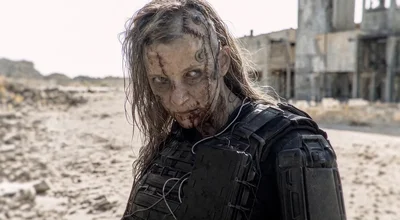
On Monday, District 9 and Gran Turismo director Neill Blomkamp unveiled his latest project: a 13-minute sci-fi short titled Nightborne that’s loosely based on Peter Watts’ 2014 novel Echopraxia. The short comes from Blomkamp’s new AI startup / production company, Barley Studios, and features characters whose voices and faces are modeled after human actors. But every single one of Nightborne’s shots was made with ByteDance’s Seedance 2.0 text-to-video generator.
In an X post about the short, Blomkamp described it as a “test start” meant to demonstrate what generative AI is capable of, and he said that he wants “to tackle a full feature in this format” at some point in the future. Blomkamp seems to think that Nightborne is a strong proof of concept that might get people intrigued to see what he prompts next. But as polished as the “film” might be compared to most of the AI-generated videos floating around the internet today, it still bears many of the hallmarks we associate with slop. And even though a team of real people was involved in the project’s production, Nightborne is such a terrible watch that one would be hard-pressed to call it the future of moviemaking.
Set against the backdrop of a military conflict between the US and Syria, Nightborne tells the story of an American pilot who sustains life-threatening injuries when her helicopter is shot down. Though most of the pilot’s body is badly injured, she’s still technically alive and her head is intact. Those things make her the ideal candidate for Project Nightborne — a governmental program that turns brain-dead soldiers into remote controlled, weaponized zombies. And because the military has an endless supply of bodies at its disposal, the pilot is one of many uniformed ghouls being trained for war in secret.
Like basically every other AI-generated film that has come before it, Nightborne is really a collection of very short video clips that have been edited together to tell a simple story. Nightborne frequently cuts from shots of its zombified main character to documentary-style interviews with people involved in Project Nightborne. These cuts give the film — which was edited by Austyn Daines — a way to obfuscate the fact that Seedance 2.0 is only capable of generating a few seconds of video footage at a time. And the way the film’s dialogue is mixed almost (but not quite) makes it seem like you’re listening to real people speaking.
Blomkamp’s creative voice feels almost nonexistent
When you really take a good look at Nightborne’s visuals and listen closely to its audio, it’s easy to pick up on how much gen AI is in the mix. Signs in the background are often written in complete gibberish, and characters deliver their lines with unusual emphases that make them come across like people who don’t actually know what they’re saying. According to Blomkamp, “real concept artists” contributed work to the project, and 32 human actors agreed to have their likenesses used on-screen. But that human input doesn’t seem like it’s anywhere near enough to keep Nightborne from feeling more like machine-made content than a piece of art.
Aside from it coming from the same director who dreamt up Alive in Joburg — an imaginative exercise in using VFX to explore ideas about apartheid-era bigotry — there’s nothing remarkable about Nightborne. Blomkamp’s creative voice feels almost nonexistent as the short’s story unfolds, and if Seedance 2.0 wasn’t part of the equation, people probably wouldn’t be talking about it.
Though Seedance 2.0 can clearly churn out videos of people emoting, Nightborne highlights how the model still doesn’t have any sort of real understanding of the minute details that make human performances feel organic and truly alive. Whatever emotive nuance you might see in the short is really just a reflection of the videos Seedance 2.0 has been trained on, and not exactly something that it can take credit for.
Aside from zombies, Nightborne doesn’t have all that much in common with its source material. But it’s a lot like Jia Zhangke’s Jia Zhangke’s Dance short and Ruairí Robinson’s viral AI video depicting Tom Cruise and Brad Pitt fighting — both of which were created with Seedance 2.0. Each of these projects has demonstrated that traditional filmmakers tend to know how to downplay gen AI’s technical limitations, but their skills can only do so much to offset the technology’s innate weaknesses.
Though text-to-video models may be getting more sophisticated, they haven’t advanced enough to produce finished works that audiences are excited to see. Nightborne’s announcement was almost immediately met with a wave of backlash from people who saw the film as a sign of Blomkamp being washed. And while Blomkamp might have thought that Nightborne would generate some positive buzz for himself, it seems much more like he’s wandered into an unfortunate situation similar to the one Darren Aronofsky created with his terrible AI series about the Revolutionary War.
The most interesting thing about Nightborne is the way its story can be interpreted as commentary on the technology that was used to make it. Project Nightborne is all about individuals in positions of power repurposing dead people’s bodies without their consent in order to generate labor on the cheap. Generative AI isn’t as (immediately or obviously) destructive as killer zombie soldiers, but those pushing for the technology’s use are driven by a desire that’s similar to the one motivating Nightborne’s villains.
Follow topics and authors from this story to see more like this in your personalized homepage feed and to receive email updates.
- Charles Pulliam-Moore
- AI
- Analysis
- Entertainment
- Film
- Report