But on June 2, after combing a dark expanse of the seafloor with an autonomous underwater vehicle, which resembles a torpedo and is equipped with sophisticated sonar and cameras, the breakthrough came, according to an exploration team.
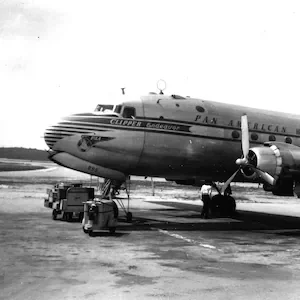
There, 600m beneath the surface and about 8km offshore, white letters spelled PAA against a blue backdrop of the winged globe logo of Pan American World Airways, the same one that the explorers said had appeared on the plane’s nose.
They were also able to make out the letters VOR in “Endeavor”. The rest of the word was caked over with debris from the elements and time.
“When those first photos came in, it was a shock,” Josh Gates, the host of Expedition Unknown on the Discovery Channel, who was involved in the project, said in an interview. “It took my breath away because it was really beyond what I imagined we might see. You know, the aircraft is so intact, and to see that aluminium, which doesn’t corrode, you know, gleaming up at us from the bottom was just staggering.”
An image of the nose section of the Clipper Endeavor with the visible PAA logo in the Atlantic Ocean. Photo / AirSea Heritage Foundation and Deep Sea Vision via The New York Times
Pan Am Flight 526A, nicknamed the Easter Special, was heading to New York’s Idlewild Airport (now Kennedy International) on Good Friday when two of its four engines failed, according to the pilot’s testimony before a civil aeronautics board. The pilot, John C. Burn, turned back toward San Juan, but the plane was quickly losing altitude over the ocean, forcing the crew to dump fuel and attempt an emergency water landing.
Many passengers refused to follow the captain’s orders to abandon the aircraft once it splashed down, staying buckled in their seats, the pilot told the board, adding that he had forcibly thrown some people into the water.
A language barrier also hampered the evacuation of the plane, according to historical accounts of survivors, who said that rough seas and the threat of sharks in the water prompted some passengers to remain inside the cabin. Many of the victims drowned.
Safety briefings before takeoff and landing had not yet been required at the time of the accident, which became an impetus for new instructions about what passengers should do in the event of an emergency.
“It is an accident that fundamentally reshaped aviation as we know it,” Gates said.
Diana Lachatanere, 80, said Monday that she was 5 years old when her father, Romulo Lachatanere, a hospital pharmacist and a photographer, died in the accident. He was returning to his home in Washington Heights, she said.
“It’s still emotional,” said Lachatanere, a retired archivist and former assistant director of the Schomburg Centre for Research in Black Culture at the New York Public Library.
She said she was not aware that there had been a search for the wreckage.
“There’s no body,” she said. “It just makes me sad just because I’m thinking about him.”
The flight’s captain had been involved in another high-profile aviation disaster in 1943, when he was a crew member on the Yankee Clipper, a Pan Am seaplane that crashed near Lisbon, Portugal. After that accident, he helped save actor and singer Jane Froman, who was seriously injured in the crash and was travelling to Europe to entertain troops with a USO tour. They were married.
Finding the wreckage of the Clipper Endeavor had become a preoccupation for the past seven years for Russ Matthews, the president and a co-founder of the nonprofit Air/Sea Heritage Foundation, who played a central role in the project.
In an interview, Matthews said the water where the plane sank was too deep for divers to reach the wreckage.
Harsh weather added to the challenge, according to Matthews, who said the coronavirus pandemic had delayed the search.
“We had to wait a couple of years to get our shot,” he said.
In late spring, Matthews learned that the Fugro Brasilis, a survey ship, would be passing through the 21sq km area that was the focus of the search for the Clipper Endeavour.
Aboard the vessel was an autonomous underwater vehicle, which is named Miss Millie and costs US$10 million to US$12 million ($17m - $20m). The torpedo-shaped probe can reach depths of 6065m.
Matthews raced to the ship, with Gates, who watched as the probe was lowered off a sled on the ship’s stern into the water. Hard drives are housed inside a crushproof container inside the vehicle, which conducted a series of nearly 30 passes over the search area.
“We did run directly over a shipwreck that nobody knew was there,” Matthews said. “And it was like, well, that’s interesting, but, like, we’re looking for a plane, so let’s keep going.”
On the 13th pass, something else caught their attention: it resembled the tail section of a plane. A few hundred feet away from that appeared to be a fuselage, warranting a closer inspection of high-resolution photos of the wreckage.
The landing gear was visible. So were the windows of the main cabin.
“It’s a way to connect the present to the past,” Matthews said. “It’s the closest I will ever come to time travel.”
The group on the ship called Tony Romeo, CEO of Eco Minerals, an exploration company involved in the project, to report their find.
“I was very elated,” said Romeo, for whom the connection to Pan Am had special meaning. “My father was a Pan Am pilot.”
More than 350,000 photographs were taken of the wreckage, which was not disturbed, according to the exploration team, which said there were no plans to recover any remains from the site. (Thirty-nine bodies were never recovered, they noted.)
“That is the only grave marker they are likely to ever have,” Matthews said.
This article originally appeared in The New York Times.
Written by: Neil Vigdor
©2026 THE NEW YORK TIMES