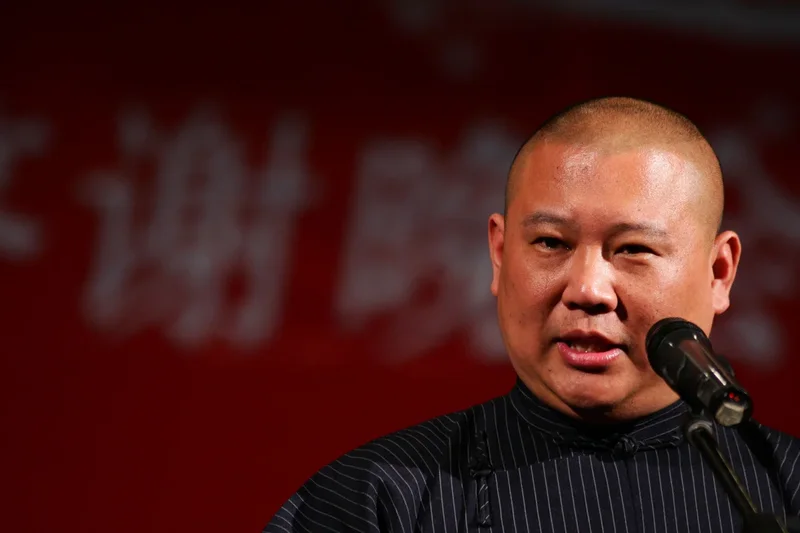
Chinese comedy star Guo Degang is under investigation for allegedly changing the lyrics of a famous revolutionary song during a performance in Wuhan.
Guo altered a line in the Chinese song “Playing My Beloved Pipa” during a show on 24 July, replacing a reference to Weishan Lake with the Forbidden City, according to The Paper.
The Wuhan municipal bureau of culture and tourism opened an investigation on 11 August, saying the improvised section wasn’t included in the material submitted for approval. The performance itself was legally approved.
According to the bureau, the change was suspected of violating the Regulations on the Administration of Commercial Performances.
Guo, 53, is one of China’s best-known comedians and a leading figure in the revival of Xiangsheng or crosstalk, a traditional form of comic performance built around dialogue, wordplay, and storytelling.
He founded the Deyun Society, which helped bring the art form back to mainstream audiences and even took it to the international stage.
What sounds like a throwaway comic alteration by Guo carries significance in China, where the song occupies a distinctly patriotic place.
“Playing My Beloved Pipa” comes from the 1956 film Railway Guerrilla and celebrates communist guerrillas fighting Japanese forces during the Sino-Japanese war. In 2019, it was among 100 songs chosen by the ruling Communist Party’s publicity department to mark the 70th anniversary of the founding of the People’s Republic of China.
The original line describes the sun setting in the west before declaring that all is quiet on Weishan Lake. Guo instead sang that all was quiet in the Forbidden City. He even added comic lines like “I am Buddha, I am Tathagata, Mommy, Mommy, please”, and, according to the local outlet Sina, performed the song in a deliberately comic style.
The performance led to a complaint accusing Guo of having “not only distorted and vulgarised a classic revolutionary work, but also violated public morals and accepted standards of conduct”, CNN reported.
The Wuhan culture and tourism bureau confirmed that its investigation into Guo was still underway.
For almost 500 years, the Forbidden City, a vast palace complex in central Beijing, was home to emperors and the centre of imperial government, with the palace itself designed to embody the authority of the ruler. Although the monarchy ended over a century ago, the Forbidden City came to stay as one of the most powerful symbols of political rule in China.
That makes the altered lyric, in which the sun is setting in the west and the Forbidden City is “quiet”, more loaded than the original, fuelling speculation the line is a metaphor for the decline of political power.
However, authorities insisted their case against Guo was about the improvised section being absent from the material submitted for approval.
In China, commercial performances are subject to prior approval from cultural authorities, with organisers required to submit details of the programme and supporting audio or visual material.
Any change to the information submitted can require the performance to be approved all over again.
Guo had already found himself on the wrong side of China’s cultural gatekeepers once before. In 2010, one of his pupils assaulted a Beijing Television cameraman who had gone to Guo’s home to report on an alleged dispute over an extension to the property.
Guo attacked the media over the incident, drawing a response from the state broadcaster CCTV, which condemned the comedian without naming him and described the behaviour at the centre of the row as vulgar and ugly, according to China Daily.
The controversy came as the Communist Party was mounting its campaign against the so-called “three vulgarities”: yongsu, or vulgar culture; disu, meaning lowbrow or crude culture; and meisu, referring to culture pandering to popular tastes. Guo’s crosstalk, which often dealt with sex, corruption and social problems, became caught up in the campaign.
The fallout saw Deyun Society suspend its regular performances at four Beijing venues and carry out an internal “rectification”. Moreover, major Beijing shops removed Guo’s books and audio recordings while TV stations took programmes featuring him off air.
Guo’s case echoes the crackdown that followed a joke by stand-up comedian Li Haoshi in 2023. During a Beijing performance, Li compared his two dogs’ behaviour to a slogan used by president Xi Jinping to praise the People’s Liberation Army.
Beijing police opened an investigation into Li for allegedly insulting the army, while the city’s culture authorities fined his comedy company £1.4m, confiscated a further £148,000, and suspended it from performing indefinitely after finding that the material had violated regulations.