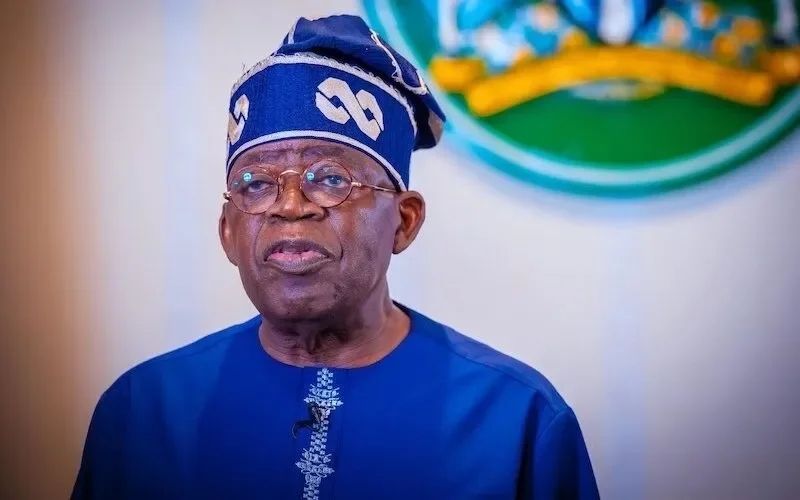
President Bola Tinubu has joined a request by the US Department of Justice for a 10-day extension to respond to a court order over the release of records linking him to alleged drug trafficking.
Von Batten-Montague-York, a Washington-based lobbying firm employed by former Vice President Atiku Abubakar, disclosed this in a post on Tuesday.
It stated that the US Justice Department “initiated action in federal court” requesting an additional 10 days.
However, the US District Court in Columbia denied the request and granted the department only four additional days, noting that it must release records by 21 August.
| | |
|---|
Hours later, the lobbying group shared a picture of a notice showing that the president’s legal team joined the Justice Department in requesting additional days.
In the notice of rejoinder filed with the US District Court, Mr Tinubu’s legal team sought to align his response schedule with the defendants’.
“Intervenor joins Defendants’ motion for a 10-day extension of time to file response to the motion for summary judgment (DE 92), in as much as Intervenor requests that the responses remain on the same schedule,” it read.
However, the district judge, Beryl Howell, declined to grant the full 10-day extension, according to Atiku’s lobbying firm. Instead, the district judge kept 21 August as the deadline for the US government and President Tinubu to respond.
The lobbying firm described Mr Tinubu’s request as an attempt to use delay to exert political influence in Washington.
It argued that Mr Tinubu “wanted to use any delay to call upon his friends in DC to argue that the release of these files would harm US-Nigeria relations” and undermine his ability to work with the US to combat “terrorism and the killing of Christians in Northern Nigeria.”
“We believe that any U.S. government personnel who improperly attempt to interfere with the judicial or FOIA process on behalf of #Nigerian President #Tinubu to prevent the lawful release of these records should be exposed and fired,” it said.
The case against Tinubu
The district court ordered US law enforcement agencies to release confidential information involving Mr Tinubu’s alleged involvement in drug trafficking during a “purported federal investigation in the 1990s” in April 2025. That investigation had led to Mr Tinubu forfeiting some money to the US government in a civil case.
The distict court’s order came about two years after an American, Aaron Greenspan, had filed a suit under the Freedom of Information Act (FOIA) against the Executive Office for US Attorneys, Department of State, Federal Bureau of Investigation(FBI), Internal Revenue Service (IRS), Drug Enforcement Administration (DEA), and the Central Intelligence Agency (CIA) seeking information about a joint investigation into a Chicago heroin ring that operated in the 1990s.
PREMIUM TIMES reported that the American sought criminal investigative records about four named individuals “allegedly associated with the drug ring: Bola Ahmed Tinubu, Lee Andrew Edwards, Mueez Abegboyega Akande, and Abiodun Agbele.”
This was during the 2023 election period, which saw Mr Tinubu emerge as president.
The issue featured prominently at the Presidential Election Petition Court when his opponents, Atiku Abubakar and Peter Obi, challenged the president’s eligibility to contest Nigeria’s presidency. But the election court, in a unanimous decision, dismissed the suits, affirming Mr Tinubu’s election.
This paper also reported that the agencies also issued “Glomar responses”, refusing to confirm or deny whether the requested records exist. Mr Greenspan contested those responses at the Department of Justice’s Office of Information Policy (“OIP”).
He accused the law enforcement agencies of violating the FOIA by failing to release within the statutory time “documents relating to purported federal investigations into” Mr Tinubu and one Abiodun Agbele.
But the OIP affirmed the agencies’ refusal.
Three days later, he filed an emergency motion seeking a hearing to compel the US agencies to produce records but was also denied.
Then, in 2025, Judge Howell ruled partly in favour of Mr Greenspan’s case.
The judge noted that the ‘Glomar’ responses asserted by the FBI and DEA are “improper and must be lifted.” He said the FBI and DEA failed to show that they properly invoked FOIA.
Mr Howell said since it was acknowledged that Mr Tinubu was a subject of an investigation involving both the FBI and DEA, “the claim that the Glomar responses were necessary to protect this information from public disclosure is at this point neither logical nor plausible.”