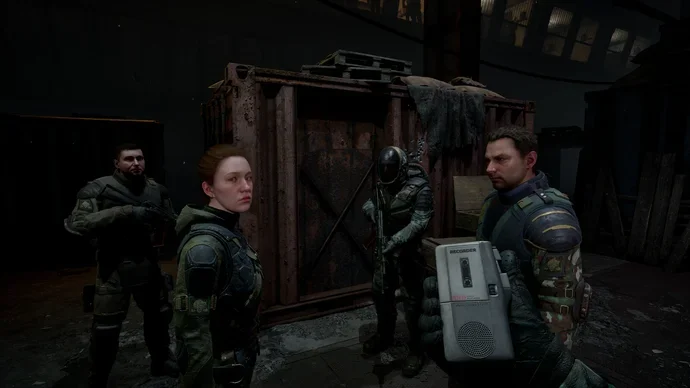
Like the technical fix-uppery of the 2.0 update it’s launching alongside, STALKER 2: Heart of Chornobyl’s Cost of Hope expansion arrives with a determinedly furrowed brow; that kind of enthusiastic, if just slightly contrite, look of someone hellbent on righting their own past wrongs.
Of course, most of the open-world shooter’s past crimes are long absolved, if not forgiven immediately on the grounds that they were committed amid an actual war. But Cost of Hope does serve as a second chance for this bleak, beautiful, tense, thrilling, imperfectly brilliant game to address certain omissions it made back in 2024 – even if some of these restorations gleam brighter than others.
It returns us, for instance, to the Chornobyl Nuclear Power Plant (CNPP), the forbidden ground zero at the heart of STALKER’s mutant-infested, anomaly-ridden vision of Ukraine's Exclusion Zone. Well-trodden ground for the series’ prior instalments, yes, but also such a pivotal locale for this forsaken patch of roasted earth that it was always strange how the base game never ventured near it. Cost of Hope’s central story also revolves around the rivalry between Zone-hating militiamen Duty and pseudo-anarchists Freedom, another Zone staple that STALKER 2 sidelined in favour of its own younger, sexier factions.
Is this pandering? It doesn’t feel like it. Some returning characters may earn an excited finger-point from Call of Pripyat veterans but they’re typically introduced with a locally appropriate sternness, rather than the smug needle drop of a Marvel post-credits. And Cost of Hope’s added map regions, where you’ll be spending the bulk of its wandering and fighting, are all fine pieces of world design work, regardless of whether you already know what a Myklukha is.
The first of these, the Iron Forest, takes an isolated anomaly from a previous game and expands it into an unsettlingly hostile, sometimes downright ghostly tract of twisted metal and electrical deathtraps. Thick fog seems to choke this place more often than anywhere else in the Zone, while lingering radio signals carry the dead’s last words on the air. It’s awful here, and I love it.
The CNPP doesn’t disappoint either. While the story flow takes you on a grim sightseeing tour through the megalophobia-inducing sarcophagus and the gnarled remains of reactor number four, the whole area is worth exploring. It’s a solemn sprawl of towering industrial tombs - perhaps not as dangerous neighbouring Pripyat, but with longer stretches of silence to truly drink in the tragedy of it.
Best of all is the lost town of Lymansk, which without wanting to spoil too much, is essentially Ravenholm if Remedy Entertainment built it. Trading off the free-roamability of the other new locations for a more focused dive into survival horror, Lymansk has a disregard for the laws of physics that even the main Zone doesn’t muster. Cost of Hope then asks you to traverse its impossible suburbs in the dark, while striking all your light sources with electronic impotence. It’s unlike anything else in the game, let alone this expansion, and yet creeping through it with dwindling ammo and a broken torch feels like STALKER 2 at its weird, unforgiving best.
Part of that is also down to how the Lymansk section departs from the far, far more common mission loop of hoofing it to some crumbling Soviet facility, blasting all the men/mutants inside, and leaving. Cost of Hope trusts in the process too, and repeatedly. Although, it does at least throw in a few higher-concept shootouts: a battle around an out-of-control centrifuge, a tricky ascension up a silo while a mutant has a telekinetic tantrum in the middle of it, a counter-sniping duel in the shadow of a vast, brain-melting psychic tree.
Even if the quests don’t innovate, then, the DLC serves up plenty of memorable moments within then, and STALKER 2 has always been enough of a weighty, tightly constructed FPS that even the most straightforward bouts of merc-headshotting have a powerful and percussive energy to them. A quality, also, that the handful of expansion-added rifles – ferociously loud shootsticks, all – happily play into, once they start showing up in the loot calculations.
Where Cost of Hope really could have done with a more ambitious drive is its faction conflict. Oddly, it’s hours before you’re asked to pick a side – most missions surround you with moderates, willing (and in some cases, pleased as peas) to work with their opposite numbers towards various mutual goals. When "war" does break out, it has all the in-universe effect of Duty unfollowing Freedom’s Instagram account, keeping you part of the Kumbaya coalition for another few hours until the single, solitary flashpoint where you choose who to back for the rest of the plot.
This was obviously never going to be STALKER 2: New Vegas, but the lack of interesting faction interactions does disappoint; even the base game, which already streamlined this stuff to a fault, presented opportunities to backstab or bend the rules of your chosen team. Here, it’s mainly an excuse for some binary story-branching, and while I can’t complain about the wider Zone’s lack of reactivity to your choice without yet more spoilers, be assured: I really want to complain about it.
Still, playing out both branches reveals that real effort has gone into making the Duty and Freedom paths feel distinct. Their respective post-breakup missions are almost entirely unique, and even when they violently reconverge under that damned magic tree, objectives and traversal routes are sufficiently mixed up. I don’t necessarily believe 'replayability' should be a contributing factor to a singleplayer game’s worth, but I did enjoy the dark thrill of fighting on the opposite side of a battle I’d won a few hours ago, countering and undoing my own manoeuvres.
As of writing this, I’m also not sure which of my two post-DLC save files to continue with, which you might say is proof that the DLC succeeds in making both journeys worth taking. It’s definitely worth seeing through at least one of them, even with the lack of true faction scheming; Cost of Hope might not plug every hole that Heart of Chornobyl left yawning open, but it’s got a keen understanding of the base game’s exploration, action, and atmospheric strengths, and puts them to good use once more.
Read this next
- Stalker 2: Heart of Chornobyl's meaty 2.0 update brings functional fog, a suite of A-Life improvements, and more when it arrives next week
- STALKER 2's Cost of Hope expansion, and its free but still hopeful 2.0 update, get an August release date
- Stalker 2 studio founder's claims that Xbox paid more for exclusivity than the game cost to make "do not reflect the actual facts", according to GSC Game World