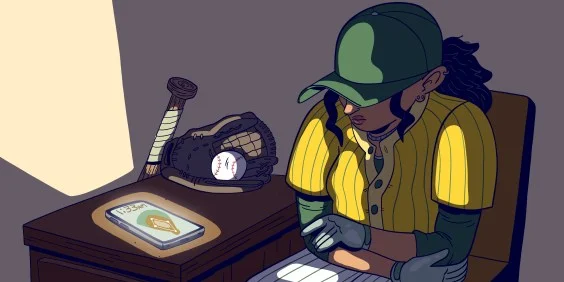
For most women who play baseball in the United States, playing America's pastime in a professional league has been little more than a dream. Yet for a select group of women, that dream is becoming a reality.
The Women's Pro Baseball League began its inaugural season on Aug. 1, with the four-team league playing all of its games in Springfield, Ill., where dozens of the 120 women who were selected in the league's draft play pro ball. It is the most anticipated women's pro baseball league since the All-American Girls Professional Baseball League disbanded in 1954.
But for many players who were selected in the draft, which took place in November, the dream of getting paid to play baseball in the United States remains deferred.
Half of the draft class—mostly players selected in the first three rounds of the six-round event—were signed to contracts shortly afterward. But much of the other half spent the next six months hearing very little from the league about what to expect next.
When they did get communication from the WPBL, there were vague allusions to the possibility of short-term contracts being signed during the season, placing them in a holding pattern as to whether they would have to uproot their lives and move to Springfield. Even as the season has gone forward, for some that holding pattern has continued.
Defector spoke with more than a dozen players—all of whom were drafted but remain unsigned—and they described a process that was plagued by more than just the usual hiccups and mistakes that can be expected from a startup league. The athletes detailed a near-total lack of communication from the WPBL after the draft about what they could expect. They said changes to the league structure were announced with little explanation, and most of the information they do have about what is going on has been gleaned from social media. And because this is a new league, there is no union to represent the players, some of whom also don’t have agents.
Defector tried to contact players who remained unsigned after the draft. We were able to reach 14, most of whom agreed to speak but requested anonymity for fear of retaliation in the small world of high-level women's baseball.
"It's hard to talk negatively about this because it's literally my dream," a fourth-round draft pick told Defector, "but it's also true that there are so many eyes on this league and there could be so much more care toward this."
Defector reached out to the WPBL for comment. Through a spokesperson, the league gave answers to a list of questions we provided. The answers said that the league had provided "regular" updates to players on top of what was put out on social media, and that "as far as the league knows, the player relations department responds to all player inquiries." When asked to provide a more specific answer beyond "regular," the league declined to comment further.
Defector reached out again to several drafted but still unsigned players after hearing back from the WPBL. They disagreed with how the league portrayed its communications. "From my perspective, I don't think that’s accurate," one player said. "I have received information, but it has been the same information that any fan would have received, not information given to me as a drafted player."
Defector also spoke to six signed players. They generally said there were a lot of bumps in the communication with the league, which they attributed to the normal growing pains of a new league trying to find its footing.
Despite a huge boom in investment and attention for women's sports in recent years, women's baseball has lagged behind.
Most girls get pushed out of baseball and into softball by the time they reach or finish high school, and for those who do stay in the sport, development options are limited. A handful of countries have women's national baseball teams, including the U.S., which hosts a training camp every year. National teams do compete in the Women's Baseball World Cup, held roughly every two or three years, in which the best women's baseball players in the world face off.
If there was anything that made it look like the WPBL would work, it was the presence of Justine Siegal as co-founder and league commissioner. Siegal was the first woman to coach professional baseball and the first woman to coach with a Major League Baseball team, and founded the organization Baseball For All, which provided opportunities and development for girls in baseball.
Shortly after the league was announced, the WPBL also shared that former AAGPBL player Maybelle Blair would be on the advisory board, giving the league even more goodwill. Blair, who is 99 years old, has been an ambassador for women and girls in baseball and is well known in the women's baseball world. She attends everything from Baseball For All events to the Boston Red Sox' women's fantasy camp in the spring, and she consulted on the Amazon Prime television reboot of A League of Their Own.
U.S. women's national baseball team player Alex Hugo was also brought on to help with talent recruitment and development.
When the league was initially announced in 2024, there were plans for six teams. The season was supposed to include each team playing in eight games spread over four regular-season weeks (two games per week), along with an all-star competition and two weeks for playoffs. Those details eventually changed. The league was cut down to four teams for the inaugural season. Meanwhile, the schedule was expanded to fit 15 games per team into a six-week regular season, followed by a two-week playoff.
When asked why the league changed from six to four teams, the WPBL told Defector that having four teams was deemed to be the "most strategic and appropriate for players and the league." As for the other changes, they were made to "best maximize fan engagement while prioritizing player health and safety."
Players told Defector that they found out about these changes in real time on social media, with the rest of the world.
"Communication is the big thing," a sixth-round draftee told Defector. "That's the biggest improvement that I want to see personally as a player, especially from a league that you're going to be part of—that's something you want to see."
"Most of my updates have come through the WPBL's social media channels, particularly Instagram," one fifth-round pick said. "Naturally, I still have many questions, and at times it can be difficult to know who to direct those questions to."
Some players, such as Los Angeles Queens sixth-round pick Trinity Curtis, thought the level of communication met expectations and was handled well. Defector spoke with Curtis at a WPBL event in Stockton, Calif., where athletes were made available to talk.
"There's so many of us girls, so obviously it's gonna be kind of difficult to keep everybody on the same loop," Curtis said. "I think they've been doing really good with just mass emails or phone calls or text messages, whatever it may be, and just making sure that we're all staying involved, whether it's with the league or just training on our own."
The timeline one fourth-rounder gave Defector went like this: She was told in December of 2024 to expect some sort of details soon. She did get some information in April of 2025, which included facts from an Instagram post by the league. But full details of the tryouts, scheduled for Aug. 22–25 at Nationals Park in Washington, D.C., didn't get to her until July. The tryout dates were eventually announced, once again, on Instagram, via a video clip from CBS's morning show.
"We were told [in December 2024] that tryouts would be 'soon,'" she said. She works a full-time job and hadn't played much baseball since graduating high school. "I overdid it and had overuse injuries as a result of trying to get ready, and then being told it was getting pushed and not being told when it was going to be pushed to. All of that could have been avoided."
When Defector asked the WPBL why it gave so little notice for the tryouts, it said in a statement: "The league provided nearly two months' advance notice for tryout dates and a location. In addition, the league accepted video submissions for players unable to attend."
Even before tryouts, the WPBL began announcing signings of top players. The first was Kelsie Whitmore, a USWNT star pitcher who had played professional baseball in several independent leagues. Other early signings included USWNT players Amanda Gianelloni, Kylee Lahners, and Valerie Perez; Little League World Series star Mo'ne Davis; and several international players like Japan's Ayami Sato and Canada's Alli Schroder.
When the tryouts eventually happened, more than 600 players reportedly attended. Afterward, a certain number of players were made eligible for the draft later in the year. There were also some players who were unable to attend tryouts but were scouted at other events, like USA Baseball women's team events. Those scouted players were also eligible to be drafted, according to one signed player.
On Sept. 3, draft-eligible players were told via email that the draft would be held in October or November and would "likely require your remote participation."
Players stayed hopeful that, once the league got underway and teams were selected, things would go more smoothly.
The official draft took place in November 2025. There were four teams, and each had five picks per round. There were six rounds, for a total of 120 players drafted. The draft, streamed on YouTube, opened with a video message from MLB commissioner Rob Manfred and was hosted by baseball stadium announcer CJ Silas. All players had already been selected, and the first 11 picks submitted videos sharing their reaction and excitement at being drafted.
The day after the draft, all drafted players got an email from the WPBL congratulating them and telling them to stay tuned for more details "in the coming weeks." But according to several of the late-round draftees that Defector spoke with, no information came after that. Multiple players say they reached out to the league directly for more details about if they might be signed; of the unsigned draftees who spoke to Defector, only one said they got a response.
"I was drafted [in the fourth round] so I figured I was close, and then I happened to see a player I'm friends with post on her Instagram that she got her contract offer and signing bonus before Christmas, which is how I found out they were sending contracts," a player said.
In its list of answers, the league said, "The WPBL has communicated with players from the last three rounds multiple times with regular updates being provided including letting them know about how there will be call-ups during the season." When asked to provide more concrete examples beyond "regular," the league declined to comment further.
When Defector relayed the league's response to one unsigned draft pick, she replied, "That does not feel true from my experience," and provided copies of two emails, one from January and another from June. In between that time period, the player said, she received nothing. She also said she had received no communication since that time, not even an email that later went out to some players in May.
Some players were college seniors when they were drafted, so they started applying for jobs until they had an answer. Others already had full-time jobs and lives they would have to navigate if called to go to Springfield.
"They said they'd offer short-term contracts as things [like injuries] come up, but you can't just leave your life the next day," one player said.
Between January and May, unsigned players who spoke to Defector described receiving very little communication about what to expect. Communication picked up a bit in May with an email from the league.
"We would like to provide an update regarding your role as a drafted player without a current roster spot," the email stated. "Please be aware that roster spots will become available throughout the season due to injuries, national team commitments, or other absences. When a spot needs to be filled in, an unsigned player will be offered a short-term contract for the duration of that vacancy."
Receiving the email, with a few months until the season was set to start, didn’t quell many concerns. After the May email, communication picked up somewhat, but mostly to invite athletes to events.
"I've been frustrated with the lack of communication between administration and players, particularly because it's such a small group of admin and I feel like they've gotten to know all of us," a fourth-round pick said. "But it seems like priority players they knew prior to draft are taken care of and other players are the last thought."
"It can be a little difficult to kind of just drop everything," said sixth-round pick Curtis, who works in real estate, "but it's also a blessing having that, because I could take a pause. It would have to be a little in advance [notice] for me."
The WPBL told Defector that players signed to short-term contracts would have their transportation and immigration costs covered by the league. When asked if players would ever be given a deadline for being called up to the league, the WPBL said callups could happen at any time throughout the season.
There also is pressure on athletes to stay silent about any concerns, a common attitude around upstart women's sports leagues, where athletes feel anything negative could destroy a new opportunity. Whitmore, the No. 1 overall draft pick, left a comment under one Instagram post from an influencer sharing her concerns about the league's broadcast deal, saying people needed to stay positive.
"It's the first year for the league, there is always going to be setbacks or mistakes. However, as a player in this league, really hoping we can rally up the troops of more support than talking about any negatives," Whitmore wrote. "Speaking positively about the league and the future of it is what we need more than ever for women's baseball."
When a commenter pushed back on Whitmore, saying he shared the same concerns about the broadcast deal, she replied: "Nah brother—we are thankful for a league. Positive vibes only."
In response to Defector, the WPBL said: "The league has never asked players to stay positive. The league is always receptive to feedback from players."
Even for those players who have a contract, there have been difficulties.
These women will not get rich playing for the WPBL. The salary for players is $300 to $500 per game, according to a league spokesperson. The league told Defector that living costs are covered and players also would receive a cut of sponsorships, but it would not provide specific figures. It did add that it is "always focused on maximizing all parts of the player experience and it is the league's hope that compensation will increase in the future." (The league would not provide any information on coaches' salaries.)
For comparison, players like first-round draftees Whitmore, Davis, Ashton Lansdell, and Denae Benites played in Banana Ball leading up to the season, where salaries are reported to reach into the six figures.
"Every time I talk about it, someone's like, 'Oh, there's a new league?'" said Alyssa Zettlemoyer, a second-round draft pick signed to the New York Heights. "I tell them about it and they're like, 'So you play professional softball?'"
Zettlemoyer also spoke with a Defector reporter at the WPBL fan fest event in Stockton, where players were made available to speak with the media. She said she goes into the conversation explaining that there is, indeed, a professional baseball league for women now.
"I know it's the first year of the league and they're trying to get everything really rolling," unsigned sixth-rounder Arwen McCullough said at the same event. "I'm looking forward to seeing a lot more PR and a lot more events like this to really get the buzz up."
And the onus was on the players to show up for the season ready to play. One iteration of the league's FAQ page prior to the draft, since deleted from the internet, said players would get a four-day training period before the regular season to get into shape with their teams. When asked about the four days, the WPBL said it actually provided one week of training, and it believed "the on-field product has been excellent, with players competing at an exceptionally high level." The league also cited the fact that "many players were playing in tournaments together right before league's training camp."
Players who are in Banana Ball this season began the WPBL season with an advantage, as they had already been playing pro baseball. USWNT players attended two four-day training camps in June and July, prior to a set of Women's Baseball World Cup group-stage games which took place near the end of July. International players who play for their country's national team came in fresh off the WBWC. Some athletes work in baseball—like the Boston Hunters' Beth Greenwood, who coaches at Vassar College—which gives them access to facilities.
But many others are scraping together training regimens on their own, some without even a guarantee of a roster spot. A fifth-round player told Defector that she has been training every day since the draft for the possibility that she will get to play this season. As of publication, she remains unsigned.
Katie Reynolds, a fourth-round draft pick for San Francisco who is currently unsigned, said she's been staying ready with help from her father. A reporter with Defector spoke with her at a WPBL event in Brockton, Mass., when athletes were made available to speak with the media.
"I haven't been getting a lot of live hitters with my pitching, but I'm working on my own time," Reynolds said. "My dad has been my catcher since I was nine years old, so he and I have been like, when we're home from work, 'Hey, it might be kind of dark, but let's get out there.' We throw pretty much every other day, or at least, we try to."
At a preseason event in July, Siegal told Defector the league wants to offer more opportunities to all drafted players in the future. "We would like to expand our development offerings to players, both who are signed and unsigned, so we can elevate our league altogether," she said.
In the run-up to the season, the WPBL held Countdown Tour events to generate excitement. The Countdown Tour featured both signed and unsigned players, and even for players selected to participate in these events, they said the invite didn't come until a week or two beforehand.
The Boston event was held in Brockton at Campanelli Stadium, home of the Brockton Rox, a Frontier League team. One of the unsigned players who participated in the event was Reynolds, a native of Belmont, Mass. "I like to think of this as almost like even a second tryout," Reynolds said. "I'm not signed yet, so any opportunity to prove that I'm ready to play and prove that I'm good to go is a good opportunity to me."
Reynolds also appeared alongside Greenwood the night before the Brockton event as the pair threw out the first pitch at Fenway Park before a Boston Red Sox game. Siegal said that it was always part of the plan to ensure that unsigned players were able to participate in league-related events.
"They've been drafted, so they're now part of our community and part of our league, and I think that every one of them has a chance to be on our final roster," Siegal said. "You might need to call somebody up, if not for the season, maybe for a weekend. You never know when your name might get called, so they're all working hard, getting ready for that moment that may or may not come. And if it doesn't come this year, they're already on the radar for next."
The WPBL is a private company, so little is public about its finances. In April of 2025, the league announced that the venture capital firm Muse Capital's sports investment and advisory arm had been named to its advisory panel. Initial funding for the league was raised through Series A investment and was expected to be at around $3 million.
Where is all this money being used? Not much is going to the signed players. It's also not going to every single person working for the teams. Earlier this year, the league advertised unpaid internships for roles that are typically full-time and salaried in professional baseball, such as clubhouse manager and stadium operations. Siegal also advertised the job listings on her LinkedIn. When asked about the unpaid internships, the league told Defector: "All WPBL jobs are paid." When Defector asked for clarification, the league declined to comment further.
Getting answers to this and other questions has been difficult for these reporters, because the league provides extremely limited media access. Back in May 2025, the league announced a partnership with Fremantle, the production company behind America's Got Talent. The deal, per a press release, was for Fremantle to "provide development, production, distribution, digital, sponsorship representation, licensing and marketing partnership support across the league." Fans were told to expect "documentaries, behind-the-scenes moments and original content." They also brought on Natalie Mikolich of the Element M PR agency to run media communications.
But for media members trying to cover the WPBL, they hit walls. One longtime sports journalist told Defector that, after they'd personally secured an interview with Siegal, Mikolich stopped responding to emails to arrange the coverage.
Autostraddle, a queer women's publication, reached out to ask about putting three WPBL players on the cover of the fall issue of its print magazine, which is themed around sports. (One of the reporters on this article, Frankie de la Cretaz, was on the email thread as the intended writer on the story.) But after two months without a clear answer from Mikolich about player access, the publication was forced to assign a different story to the cover.
The Countdown Tour events are meant to be fan fests, where spectators can watch these women do infield drills and batting practice before getting to meet them in an autograph line. At the events in Brockton and Stockton, little to no other media was present, and fan turnout was low despite these being the only chances to see these players in person for fans in local markets who can't afford travel to Springfield. Fans complained on the WPBL's social media that they hadn't seen any promotion of the events, and a man at the Brockton event was tagging local Boston media on Twitter in the hopes they would cover it.
For months prior to the season, the league advertised that its games would be available to stream on YouTube. But just two days before the season was set to begin, the WPBL announced a media rights deal with ESPN and Scripps Sports Network to air games. The games would be streaming on ESPN Select for fans in the United States. Anyone outside the U.S. could still watch on YouTube.
Fans expressed their frustration at the games being less accessible than previously thought, but this announcement left bars that hoped to show the games in a particular bind. The league had announced that women's sports bars across the country would be airing games on Opening Weekend. The games could be watched by fans at home on their ESPN+ accounts, but that wouldn't be of use to sports bars that wanted to show the games, as ESPN Select wasn't yet available for commercial streaming.
Broadcast TV rights for public viewing, like at a bar or restaurant, are separate from at-home viewing. Moving the games to broadcasting services not included in any commercial streaming packages meant that bar owners who relied on it said they couldn't legally show WPBL games.
One bar owner said that when they reached out to the league to ask for guidance, they were given written permission to air the game—though they expressed doubts that the WPBL could legally do that—and were reassured that there were "certain games available for commercial broadcast."
Another bar owner told Defector: "It was wildly stressful and added extra work for us to try and figure it out during service … This put bars in a difficult position because schedules and watch parties are advertised in advance."
Finally, on Aug. 7, bar owners said they were able to access WPBL games through their EverPass accounts, a streaming service used by bars all over the country to show live sports.
"It's frustrating, I wish they had kept it more accessible [on YouTube] so businesses could get confidence that they would get crowds for these games," Cheyenne Gherardi, the owner of Mazzy's in Mount Vernon, N.Y., told Defector. "I'm happy they came to an agreement with EverPass for streaming because now I won't be confused about the right way to show it, but not prioritizing accessibility for people who want to support the league is disappointing."
When asked about the issue of bars not being able to legally show the games, the WPBL told Defector that it was "working to make sure as many people as possible can tune in to watch this season and is working to allow sports bars to legally stream the games with ESPN Select."
The complications have continued. Three games into the season, Boston's coach, Red Sox postseason hero Keith Foulke, was fired. The announcement came about 30 minutes before a Boston game. Foulke told the Boston Globe that he believed the problem was his commute to Illinois from Arizona, where he lives. Siegal said it happened because Foulke was a bad "fit" for the team, and the league wanted a coach who could connect better with younger players.
The quality of the broadcast has suffered as well. Fans watched an hour of dead air on Opening Day during a rain delay, and other first-weekend issues included frequently misidentifying players and calling plays incorrectly. Issues with the on-screen scorebug persisted for over a week; the number and location of runners on base have been wrong quite often, which can make it difficult to follow along watching at home.
Despite all the bumps in the road and some players feeling disrespected or discarded by the league, it remains difficult for many of them to criticize the WPBL. Many of the players who spoke to Defector, even if frustrated, made sure to say they were grateful for the opportunity to be drafted. There is a fear that speaking negatively about the league in public will tarnish its reputation or ruin its chance for success.
Above everything, these players want to see the WPBL succeed so that women will have an opportunity to make a living playing hardball.
"I've stopped seeing [being unsigned] as a failure and have started seeing it as part of the process to keep preparing myself and improving, in case the opportunity to play comes in the future," one draftee said.
Others, even when conflicted, hoped that speaking up would ultimately have a positive impact and change some of the WPBL's issues for the better.
"I am super understanding of a new league trying to figure out all the kinks," one player said. "I'm also critical because this is the time for women's sports, and they have to know there are going to be so many eyes on this and so many people who can speak critically of their development of this league."
As one fourth-rounder said, "We can be patient for progress."