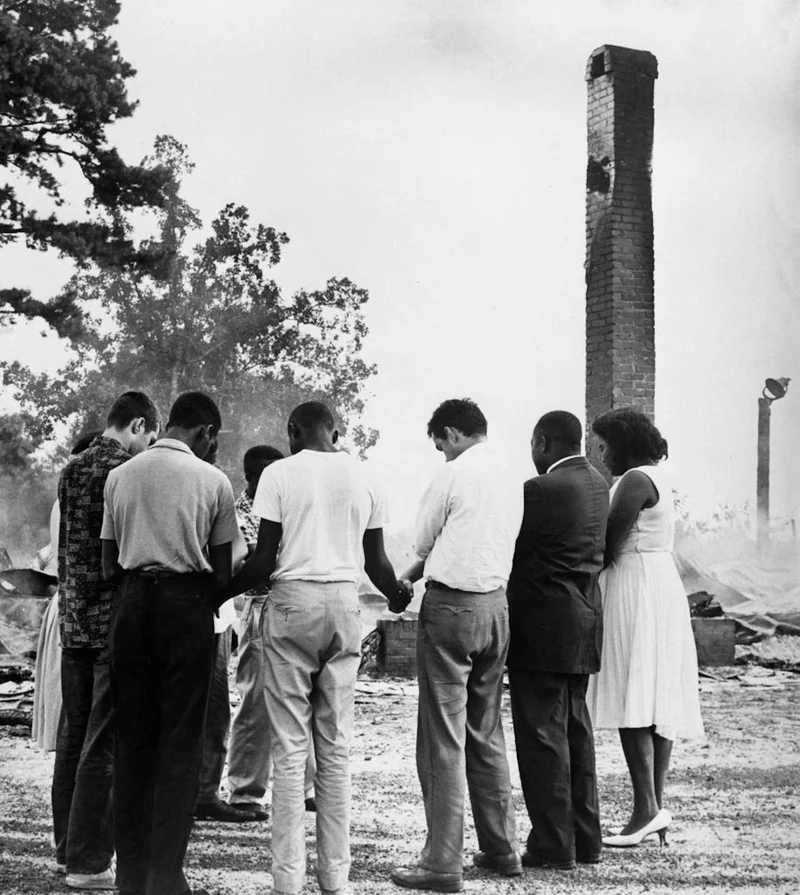
Sept. 15 marks the anniversary of an infamous terror attack: the 1963 bombing of 16th Street Baptist Church in Birmingham, Alabama. On that Sunday morning, members of the Ku Klux Klan, a white supremacist group, planted dynamite on the east side of the brown brick building.
The bomb went off in the midst of Sunday school, at 10:22 a.m., murdering four girls: Addie Mae Collins, Cynthia Wesley and Carole Robertson, who were all 14 years old, and Denise McNair, who was 11. The blast injured 22 other churchgoers, including a 12-year-old girl, Sarah Jean Collins, who was blinded in one eye.
Sixteenth Street Baptist was the oldest Black congregation in the city of Birmingham. Just on the edge of downtown, the building had been the main hub of organizing for civil rights demonstrations that spring, known as the Children’s Crusade. More than 1,000 Black children marched together protesting segregation, famously facing down police dogs, fire hoses and jail. Months later, this church at the center of it all became the target of white supremacists.
The bombing of churchgoers in their own house of worship shocked the world. The ensuing public outrage is often credited as one of the factors that drove support for the 1964 Civil Rights Act, signed into law by President Lyndon Johnson. Yet it was not the only such attack on Black churches during the civil rights era.
I first realized the connection between attacks on Black churches and civil rights organizing the first time I taught a class about U.S. social movements, 15 years ago. As a sociologist who studies religion, social movements and race, I was shocked that I had never heard of how widespread bombings and burnings were. From that day on I have documented and studied scores of examples.
Faith and justice
To date, my research team has created a map of about 145 cases across the South, ranging from around 1954 to 1970. As with the 16th Street Baptist Church bombing, many of the attacks coincided with local civil rights activism and protest.
As sociologist Aldon Morris documented in his groundbreaking book from 1986, “The Origins of the Civil Rights Movement,” Black churches were the backbone of local organizing. Social movements need resources, such as leadership, fundraising, volunteers and participants, as well as safe places to meet in order to strategize and coordinate. At the time, all of these were found in local churches, the heart of the Black community.
These factors and the churches’ public visibility, however, made them standout targets to the white supremacists willing to use violence and terror to try to stop the movement.
Targets for violence
For example, Bethel Baptist Church and its parsonage in Birmingham, Alabama, were bombed three times. On one occasion a Black laborer in the area saw a paint can filled with lit dynamite, ran to it and tossed it into the street, where it exploded – shattering windows instead of buildings.
The first of these attacks took place on Christmas 1956, when a bomb damaged both the church and the adjoining parsonage where the Rev. Fred Shuttlesworth was sleeping. The minister was the leading figure in the Birmingham fight for civil rights. He was the head of the Alabama Christian Movement for Human Rights, the local organizing arm of the Black churches, and a member of the Southern Christian Leadership Conference, led by the Rev. Martin Luther King Jr. Shuttlesworth was a constant thorn in the side of local authorities, on account of his efforts to integrate the city’s public spaces, including its public schools.
Other examples abound. For instance, in 1961-62, one of the main civil rights organizations, the Student Nonviolent Coordinating Committee, engaged in a long battle with local authorities to protest segregation in Albany, Georgia. Over 1,000 protesters were arrested and jailed, and the campaign failed to achieve its goals. But in the moment it was significant, prolonged and highly contested.
During this period, four nearby Black churches associated with the Student Nonviolent Coordinating Committee were burned to the ground, including Shady Grove Baptist and High Hope Baptist churches.
Past and present
Unfortunately, violence against Black places of worship is not relegated to America’s history.
A wave of burnings in the 1990s targeted about 200 Black churches across the Southeast, as historian Christopher B. Strain documents in his 2008 book “Burning Faith.”
More recently, a Black church in Memphis, Tennessee, was a target for arson in 2025: Clayborn Temple African Methodist Episcopal Church, which played a leading role in the Civil Rights Movement. The congregation was the organizing place for the sanitation workers’ strike that brought King to town in March 1968, weeks before he was assassinated there. Strikers’ signs created at the church that said “I AM A MAN” have become famous as a symbol of human dignity.
When radical white supremacists want to strike at the heart of the Black community, they still attack Black churches – such as the 2015 shooting at Mother Emanuel AME in Charleston, South Carolina, which killed nine churchgoers during a Bible study.
In some cases, the memory of earlier attacks has been lost to history – and that is something my team is trying to change through our research at the Black Church Burning Project.