One light bulb. That was what electrification brought to my grandmother Mag’s two-story farmhouse in Boydton, Virginia. No one wrote down the year the rural electric cooperative workers brought the wire to her house in the late 1940s.
Newspapers celebrated rural electrification for making people’s lives better: People could run refrigerators, water pumps, dishwashers and, in some places, air conditioning.
Mag’s family did not think one bulb in the first floor of their two-story house counted as history. Their lives barely changed after they got electricity.
Every day she hauled buckets of water from a stream for cooking and bathing: In her words, “them buckets were heavy.” Her father still inspected tobacco leaves by oil lamp in the barn just past the outhouse, and someone traveled into town once a week to buy ice for the icebox. Mag’s mother continued cooking on a woodstove where heat was cost-effective and human-powered. As my father says, “Chopping wood is free.”
With that one bulb, the farmhouse didn’t pay much for electricity. Around that time, some rural cooperative customers paid US$3.50 a month for 40 kilowatt hours of electricity – the equivalent today of around $80. Yet to me, that history of my grandmother’s single light bulb and low bill is more than a relic of early electrification. It’s a reminder that relatively low bills don’t mean energy is affordable. The family could not afford an electric line large enough to pump water until 1986, two years after my father graduated from college.
The mistake energy utilities make about low bills
At least six times a year my father travels to the farmhouse, fixing it up for modern life. I research energy affordability, so one of my contributions to the effort has been to look into programs to get an energy-efficient heating system and maybe some air conditioning for the house.
I found that utility companies seem to focus on one way to lower bills: reducing energy use. The local utility company’s website says 52% of a home’s energy usage is due to heating and cooling, and it offers several ways to use less energy.
The utility isn’t trying to make energy itself cost less. It’s mistaking low bills for affordability, when they can still be signals of a person or family struggling.
The danger of heat
I saw a modern version of my grandmother’s experience in the top-floor apartment of a duplex my husband and I rented to a family with a newborn in 2022 in Allegheny County, Pennsylvania. The apartment had heat, as Pennsylvania law required, but no air conditioning.
During a stretch of high summer temperatures, the family complained about the indoor temperature. We went over to help them figure out where they could purchase a window unit. When we entered the home, their thermostat read over 83 degrees Fahrenheit (28.3 Celsius).
The newborn baby sat in the mom’s arms covered in little white bumps, a heat rash. The kitchen became even hotter whenever the family cooked on the gas stove.
I told my husband that we should just go get a window unit, since the family had no car and the bus would take at least an hour to get to Walmart. My husband agreed it was important, but after spending over $15,000 rehabilitating the apartment and fixing the heating system, our funds were thin. The local electric utility had some air conditioning incentives, but we weren’t sure whether our tenants qualified.
I study energy usage during heat waves, and there is a lot of research about heat deaths occurring because people cannot afford to adequately cool their homes. We bought a window unit on a credit card that we hadn’t maxed out.
Because of high demand, the one we found was undersized and not capable of cooling the entire apartment. The father improvised by moving the baby’s crib into the living room and using cardboard and tape to seal the gap in the window. Three days later, the baby’s bumps vanished and the older children rode bicycles around the living room.
This family had paid on time, so they would not have appeared on the electric company’s list of people who had trouble paying their bills. However, their quality of life desperately needed more energy that they could not afford.
Low bills, burst pipes
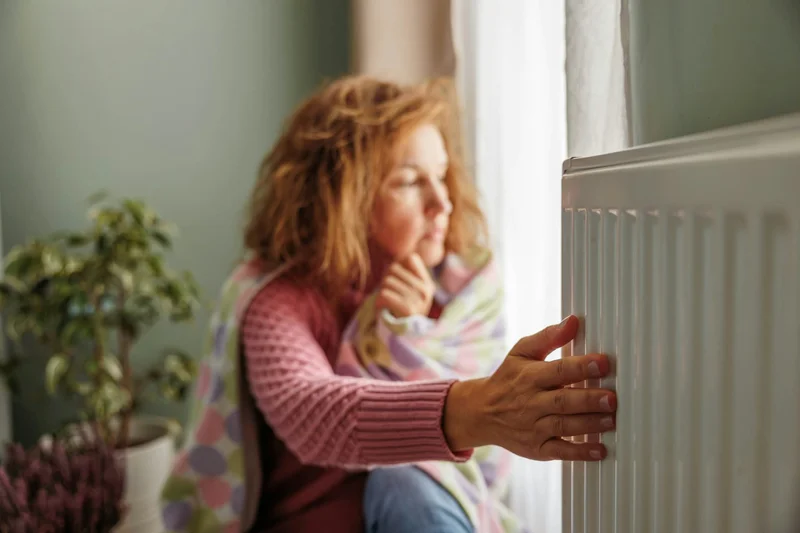
Winter can also bring energy affordability crises. A woman I’ll call Hannah once told me that no matter what she did, her natural gas heating bill stayed high. By November 2025 it was approaching $190 a month, and based on the previous year she expected it to triple by January. Hannah told me that even though she kept her thermostat at 65 F (18.3 C), the temperature upstairs rarely rose above 62 F (16.7 C).
She lived near my Pittsburgh neighborhood, so I went over to help look for the problem. Inside, we sealed gaps around the doors and windows. The house was still pretty cold after an hour. We braved the mice and took the stairs to the basement, which was freezing. One of the windows was missing a glass pane. We used spray foam and cardboard wrapped in plastic to close it. Upstairs the temperature started approaching 64 F (17.8 C).
As we sat in the warming house, she told me that her hours working at a hardware store had been cut, and she wanted to save money before Christmas, when she had holiday travel plans.
After the holidays, I asked whether the weather sealing had helped. She sighed. Before she left for her Christmas trip, Hannah had turned off the heat, hoping to cut down her bill. While she was gone, the outdoor temperature dropped below 20 F (-6.6 C).
When she got back, she couldn’t open the front door, and part of the front porch had morphed into an ice skating rink. Without heat, her indoor pipes had frozen and cracked. When temperatures climbed above freezing, water poured out all over everything – and froze again when it got colder. Her landlord had to call a handyman to break through a window and slide across the living room to unlock the front door.
Her landlord probably spent tens of thousands of dollars repairing the apartment, while Hannah had to search for another place to live. All because she was trying to cut her bill by about $100.
When energy became essential
When my grandmother’s family got electricity, it wasn’t a necessity. They used a woodstove and an icebox, and they lived largely the same way after getting a light bulb as they had before. That’s no longer possible. Today, nearly every basic household need requires energy.
By 1991, energy scholar Brenda Boardman’s landmark work on fuel poverty declared that energy for warmth was a necessity, and said a household should spend less than 10% of its income to keep its home adequately warm, which the World Health Organization says is 69.8 F (21 C).
The more recent concept of “energy burden” includes the idea that a home should spend less than 6% of its income on energy bills. But it says nothing about comfort – about enough heat to stay warm, or enough cooling to prevent babies from getting heat rashes.
Hannah’s story reveals what a percentage alone cannot: People can make their bills look more affordable by using less energy than they actually need.
When companies, policymakers and scholars like me talk about energy affordability, I believe it’s important to consider both the amount of money leaving a household’s bank account and whether that household is using enough energy to provide for its own safety and health.