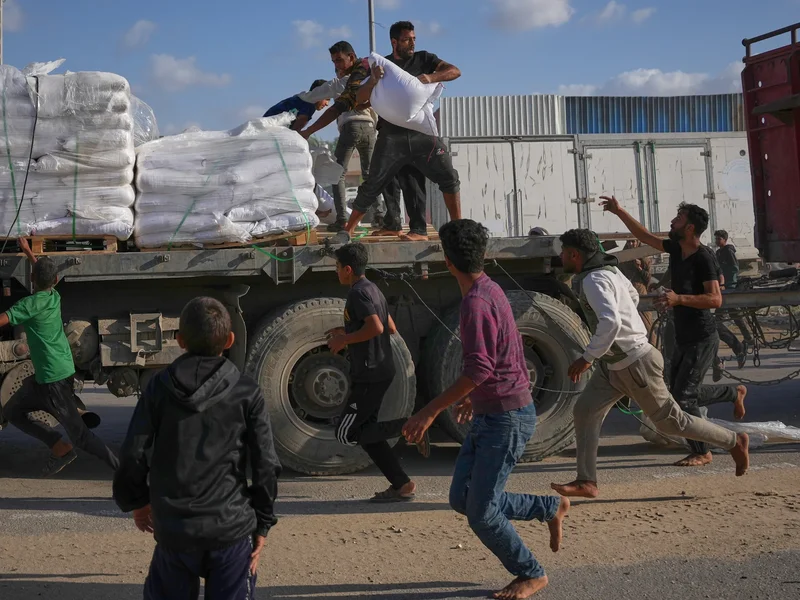
Deir el-Balah, Gaza – Behind every truck full of food, medicine or fuel is a logistics chain that keeps those vehicles running.
But in Gaza, this chain has been disrupted by the Israeli genocide.
Recommended Stories
list of 4 items- list 1 of 4Aid workers faced record number of attacks in 2025
- list 2 of 4Breastfeeding in Gaza: Mothers seek help to provide for their babies
- list 3 of 4Israeli strike reported to kill at least six in Gaza City
- list 4 of 4Humanitarianism is not collapsing. It is being traded and compromised
Before the war, about 1,200 vehicles served Gaza’s transportation and aid needs. Today, only a small number are operating, according to the Euro-Med Human Rights Monitor, which follows the situation of humanitarian aid in the Strip.
At least 150 vehicles have been damaged or destroyed, and many others are held together with a combination of repairs and parts from vehicles no longer in use.
We followed mechanics and drivers in Gaza who were repairing each other’s trucks and draining fuel from damaged vehicles. “With these hands, I save one truck and let it go so that another can come and take its place,” said one driver.
Tyres, oil and engines are in short supply. Mechanics and drivers say that the lack of supplies and spare parts adds to the challenge of keeping the limited number of working vehicles on the road.
A drive through devastated Gaza
From the Rafah crossing, trucks carrying goods from Egypt arrive in Gaza.
They pass through inspection and enter the Strip, but the road to distribution centres and aid warehouses still lies ahead. The vehicles traverse either Salah al-Din Street or the Philadelphi Corridor (to the main coastal highway, al-Rashid Street).
This means the aid has to pass through several points before reaching Gaza governorates, and every step of the way can be blocked due to the devastation in the enclave.
If a truck breaks down, its load is inaccessible. Another vehicle without tyres, obstructed by a breakdown or without fuel, will carry less cargo or be unable to move at all.
Because of the reduced number of available vehicles, the strain on the remaining ones grows.
Not just vehicles at risk
In addition to dangers posed by the siege and the lack of spare parts, aid drivers risk their lives.
Naser Isleem, father of Ahmed Isleem, a Palestinian aid driver killed by Israeli forces while attempting to deliver assistance to Gaza, showed us photos and videos of his son with his wife and children.
Ahmed’s journey has been among many to end in death, with drivers exposed to the dangers of Israeli forces and Israeli-backed militias. His is also a story about the risks of the current system of transporting goods in Gaza.
Critical situation
The current aid distribution situation in Gaza is such that it is extremely difficult for drivers to reach aid warehouses, let alone for trucks to get through the blockade.
But the most vulnerable point in these journeys is the road to the distribution centres.
The number of vehicles that can reach Gaza is limited by the crossings, but the number of vehicles that can get from a crossing to the distribution centres is limited by the state of the damaged roads, traffic, fuel and the health and morale of the drivers.
While public attention focuses on the number of trucks that can enter Gaza, the number of trucks that can reach distribution centres after crossing into the enclave is the more critical limitation for aid delivery.
People who need food, medicine and fuel will have to wait until the trucks arrive, that is, if they can get there in the first place.