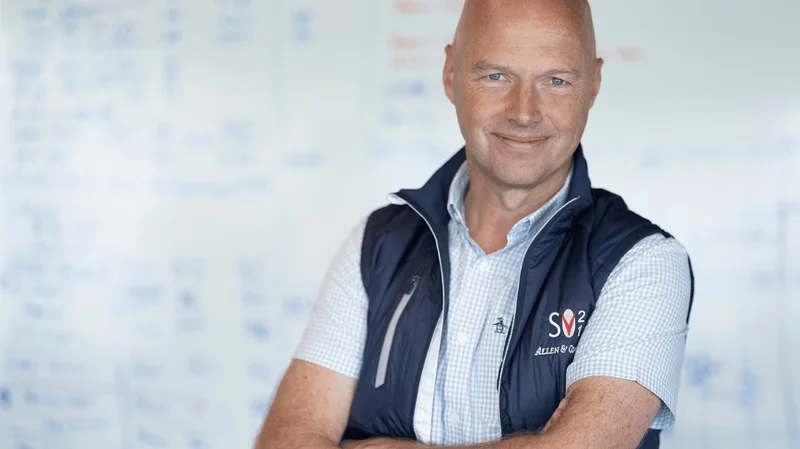
Sebastian Thrun, one of the pioneers of self-driving cars, is building a new robotics startup called Dulo. The company is still in stealth, and Thrun revealed little about it, Business Insider reported. Rya Jetha wrote that he named the venture at the end of a keynote in San Francisco.
The reveal was brief. Thrun mentioned Dulo as he closed a talk at Actuate, a robotics conference, on Tuesday. “I am not speaking about the company yet,” he told an audience of robotics founders and staff. “It’s under stealth, it’s very small. But it’s in robotics.” That was close to the whole of his public disclosure. Business Insider’s account, an exclusive by its physical-AI reporter, is the only detailed report of the venture so far.
The setting fit the news. Actuate draws robotics founders and engineers, and Thrun used the closing moments of his keynote to drop the name rather than to pitch. He gave no funding figure, no product and no launch date.
What little is known
Few details about Dulo are public. A bare-bones website hosted by Stanford says the company is developing “foundation models for hardware design,” Business Insider reported. The stated goal is to enable “manufacturing at lightspeed.”
The idea points at a specific gap. Foundation models have reshaped text, images and code, but the physical design of hardware still moves slowly. Dulo appears to be aiming those same techniques at how machines and their parts get designed and built. The company has not spelled out what that looks like in practice.
The team is the clearest signal so far. The website says Dulo includes leaders from Waymo, Google Brain and Stanford’s Artificial Intelligence Laboratory, known as SAIL, which Thrun once directed, according to Business Insider. Those are three of the places most associated with the modern wave of AI and autonomy.
The focus, as described, sits at a different layer from most robotics startups. Much of the physical-AI money has gone into robots and humanoids that act in the world. Dulo’s stated aim is the design and manufacturing of hardware itself, a step earlier in the chain. If the one-line mission holds, the company would be selling to the people who build machines rather than building the machines directly.
Timed to a robotics boom
Thrun is starting Dulo into a rush of money and attention. The robotics boom has been fuelled by falling hardware costs, labour shortages and pressure to bring manufacturing back home, Business Insider reported. Investors have followed.
The figures are large. Physical AI startups build machines that act in the real world. They raised a record $16.3bn across 492 deals in the first quarter of 2026, according to PitchBook data cited by Business Insider. That is the kind of market a founder with Thrun’s record can raise into quickly. The pull toward reshoring is a recurring theme in that spending, as manufacturers look to automate work that is hard to staff.
The desk has tracked the same surge. Swiss firm Gravis pulled in a $200mn round led by SoftBank for autonomous construction machines. Chipmakers have made their own bets too, such as onsemi’s $7bn deal for Synaptics built around physical AI.
China sits at the centre of the hardware side. It now builds almost every humanoid robot shipped worldwide, which is part of the reshoring pressure US founders keep citing. The investor enthusiasm around physical AI has lifted established companies too.
A founder with a long track record
Thrun is not a first-time founder. He came to Google’s attention in 2005, after his Stanford team won a landmark autonomous-vehicle race, Business Insider reported. The car completed a 132-mile desert course with no human behind the wheel. The result was an early proof that autonomy could work outside the lab, and it made Thrun a marquee name in the field.
That win set the rest in motion. Google co-founder Larry Page recruited Thrun to lead the company’s self-driving-car project, which later became Waymo, Business Insider reported. It is now the most visible robotaxi operator in the US.
His resume runs wider than cars. Thrun co-founded Google Brain, the search company’s early AI lab, along with the Google X moonshot unit and the online-education company Udacity as well, according to Business Insider. He also led Kittyhawk, a flying-car startup that has since shut down. Each of those efforts chased a large, hardware-heavy problem, which is the same terrain Dulo is now stepping onto.
That history cuts both ways. It gives Dulo instant credibility and, in this market, an unusually easy path to capital. It also includes at least one high-profile failure, a reminder that a decorated founder is no guarantee a hard robotics bet will work.
Still more question than answer
For now, Dulo is closer to a name than a product. There is no disclosed funding, no product, no timeline and no customer, only a one-line mission, a stealth label and a roster of well-known experienced hands. Thrun made clear he was not ready to say more, and Business Insider noted that little else about the company is publicly available.
What is clear is the shape of the bet. Dulo wants to apply the foundation-model approach that transformed software to the slower world of building physical things. The bet is whether that speeds up manufacturing the way Thrun’s desert-race car once sped up self-driving.
The stealth startup has not started answering that question yet.
Get the TNW newsletter
Get the most important tech news in your inbox each week.