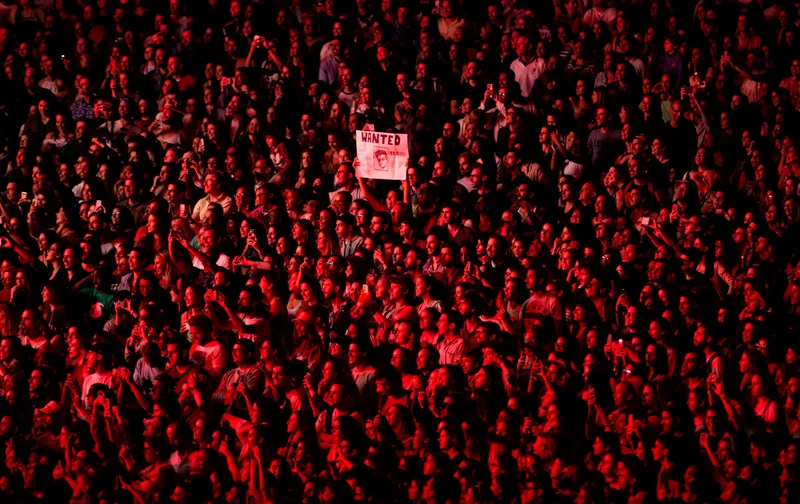
On July 18, at the start of the first of six nights of The Romantic Tour at Wembley (London), before about 90,000 people — many waving hand-held fans bearing the slogan “Hot for Bruno” — Bruno Mars broadcast a saccharine pre-recorded video in which, from inside a church, he begs the audience to help make the night unforgettable. Afterwards, as giant stained-glass panels with roses and flashing lights unfurled, the artist appeared onstage dressed entirely in red, ready to open the show with a performance of Risk It All. As the concert videos show, almost everything is bathed in crimson, and it’s hard to tell whether it’s a prom or some Las Vegas casino revue.
At first glance, no one should feel cheated, because if Bruno Mars has one trait it’s bluntness: his new record is called The Romantic and his creative line has been anchored for years in retro aesthetics, aimed largely at pleasing the female market. The Vegas vibe isn’t accidental: he’s had a decade-long residency at MGM hotels, with his own cocktail offerings at the Bellagio and even a street bearing his name. Where else would he have adopted the crooner-with-tuxedo image — more vintage technicolor musical than 2026 pop star? There’s an unproven rumor, denied by MGM, about a million-dollar casino debt that tied him to those shows. Still, the claim that nobody can feel swindled has caveats. Today it even feels odd to see an icon of his stature mounted on an old-fashioned proscenium arch. That format has fallen out of favor because big acts now try to deeply involve the audience: 360-degree staging, Ye’s globe, BTS’s X-shaped structure, or the catwalks and secondary stages used by Rosalía and Bad Bunny. Mars prefers to keep the audience at arm’s length, at a certain remove, like in a theater. That detail contrasts with what appears to be the strongest element of his concerts: the staging, his presence, his intensity. “Mars owns the stage so completely that passing the mic from one hand to the other becomes an event in itself,” one review noted.
In other words, if you go and can’t see Bruno, you might as well stay home.
Despite this, Live Nation–Ticketmaster put a ticket category on sale for the Wembley show not so far removed from the at-home listening experience: “No View / Audio Only.” For about £58 (roughly $80) you bought the right to be inside the stadium without seeing the stage or the giant screens that project the artist. Obstructed sightlines and bad seats have existed as long as demand has outstripped supply, but here fans were told, in writing and in advance, that they would see nothing. For contrast: official Wembley prices ranged from £71.70 to £588.60, but by early July (with the six nights sold out) only obstructed-view seats above £210 remained on resale.
This isn’t the first nor the priciest example: in 2023, Beyoncé sold seats behind the stage with no view of the show during her Renaissance Tour for about $157, although one fan complained that the cheapest available ended up costing $350 after fees. Outrage is understandable, because we assumed the live music industry and ticketing were only trying to climb upward, not start digging below ground. Over the past decade major stars have multiplied the products around their concerts: VIP packages, food-and-open-bar bundles, meet-and-greets, or special editions for the most devoted fans who pay hundreds or thousands for preferential treatment. The logic was to raise the ceiling, to probe how far the superfan would go.
The audio-only ticket introduces a new tier below the cheapest option. Today we might call it “enshittification,” but in economics this has long been known as “damaged goods”: products a company deliberately degrades to sell more cheaply to customers who won’t pay full price, without losing those who do. The classic example always given is IBM, which sold a cheap printer that was identical to the expensive one (LaserPrinter and LaserPrinter E), except that it had built in a chip whose sole function was to make it run slower. Airlines do this daily: the same plane and the same seat, but you pay extra for checked baggage, seat selection, or priority boarding. The “audio-only” ticket is a textbook damaged good: it costs the stadium almost nothing to create, the view isn’t an extra that needs manufacturing, and, obvious as it may seem, all they do is place you in a blind spot. Zero investment to squeeze out extra profit.
It’s worth remembering that the recent history of recorded music has been about unbundling. The album — a bundle of songs usually built around a unifying concept — was broken into single tracks (on iTunes for $0.99 each). Singles were broken into fragments optimized for playlisting. Fragments into stems. And now into prompts that generate on-demand, personalized audio. At each level the trick is the same: take the smallest unit, charge for it, discard the rest.
Live performance, so to speak, was one of the last frontiers. Although access has been segmented, everyone used to receive an indivisible full package, because a physical event can’t be easily fractioned: being there, seeing, hearing, the adrenaline, the afterglow. Audio-only separates hearing from sight and charges for them separately. The next logical step is what was already attempted (with limited success) during the Covid-19 era: selling you the same sound at home so you don’t even have to leave your armchair.
Another point we mustn’t skip: you won’t see anything, but you’re also not buying “good hearing,” because stadium sound is mediocre by nature, and from a no-view zone you’re often placed in a terribly positioned spot acoustically. Someone might rightly point out that opera has sold very cheap seats for centuries from which you can barely see. Grand theaters have the gallery, the gods, standing-room tickets for a few bucks at places like the Vienna State Opera. In theaters built for unamplified voices, those high, cheap spots often have excellent acoustics and for generations were the gateway for cash-strapped music lovers.
For this type of concert and at Wembley you’re being asked to pay for the worst element of the package. What you’re actually seeking is proximity: the right to say you were there, to breathe the same air, to post the selfie, to belong. At Taylor Swift concerts crowds gathered outside stadiums, in parking lots and in the streets, to listen from the other side of the wall and sing together for free. People were already seeking that closeness on their own. Is monetizing an existing organic behavior extraction or simply meeting demand?
You don’t need to ask Live Nation (which owns the concert promoter, many venues, and Ticketmaster, the world’s largest ticketing platform) to know the answer: they’ve figured it out. They can keep grinding down the experience because demand keeps rising: Bruno Mars’s six nights at the UK’s largest-capacity venue sold out, and in one day the platform moved 2.1 million tickets for the tour, a personal record for the artist. When interest reaches that magnitude, even the most miserable corner of the stadium can be monetized. Right now people are paying to hear the new record of another international star alongside fellow devotees — united by the cult, simply breathing the same atmosphere as the person they admire. Sometimes the artist isn’t even present, nor any relative or close associate. “Remove the artist, leave the fans, and we can still invent another ticket,” the unscrupulous promoter must be thinking. When you strip sight away and even Bruno Mars himself from a fan, the only truly irreplaceable thing left in those stands is the others — the 90,000 people singing in unison.
“Fifty-eight pounds separate me from spending a night in the same place as my favorite artist,” the fan I mean must be thinking. “To hell with it — where do I sign?” One could even argue this is more honest than the old seat behind a column, because here at least you are told the truth in advance: you will see absolutely nothing. In itself, cheaper tickets are good news; the problem is that by buying them we validate the notion that a concert can be torn into portions tailored to what each person can afford.