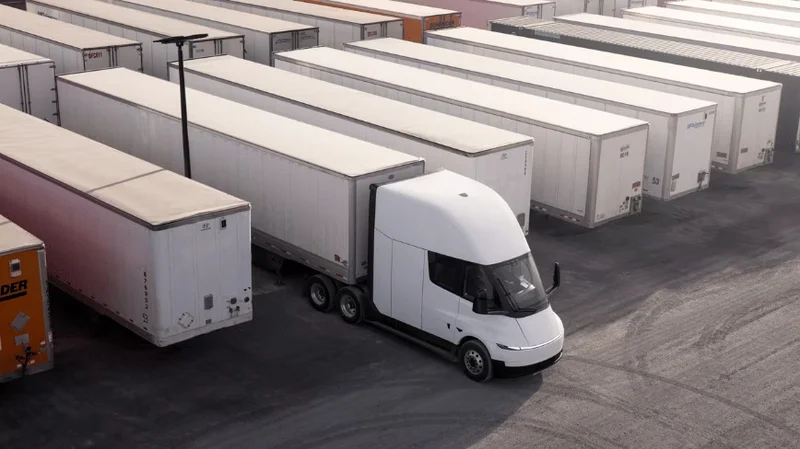
Einride is buying 500 Tesla Semis, and Amazon quietly owns a slice of the company that will run them. The Swedish electric-trucking firm said on Tuesday it will deploy the 500 electric big rigs for Amazon and other customers. It called the order the largest Tesla Semi deployment in the world to date. Einride announced the order through its Saga AI fleet platform.
The stake is the part Einride did not put in the press release. Amazon holds warrants for 25.2 million Einride shares, about 12 percent of the company, GeekWire reported, citing regulatory filings. Those warrants vest as Amazon buys freight services. Todd Bishop wrote that the warrants appeared on Einride’s books for the first time in its half-year report. That report was its first since the June listing.
The terms had been public but buried. Einride’s prospectuses refer to Amazon only as “the Specified Party,” GeekWire noted. That labelling is why no one had reported the holding before.
What Einride actually sells
Einride does not sell trucks. It buys and finances them instead. It hires the drivers or contracts carriers, builds the charging, and hauls a customer’s freight for a fee. Its Saga software coordinates all of it. The pitch to a shipper like Amazon is electric trucking capacity without owning the vehicles or the chargers.
The company is still young and cash-hungry. It listed on Nasdaq in June at a $1.35bn valuation, down from the $5bn it once discussed with banks. It runs about 200 of its own electric trucks for customers such as Heineken and PepsiCo. It has also built cab-less autonomous trucks on the side.
The deployment, and the money behind it
The Tesla order is outsized for Einride. It will triple the size of its deployed electric fleet, the company said. The trucks will roll out in phases over the next 24 months, starting in September. They will serve freight corridors in California, Texas, New Jersey, Illinois and Georgia. A third party is financing the purchase.
Einride framed the deal as turning pipeline into revenue. It expects the deployment to help convert about $800mn in potential long-term annual recurring revenue into actual paid freight, according to its announcement. That figure sits under joint business plans with shippers.
Amazon is central to that math. Einride is forecasting a 60 to 73 percent rise in second-half revenue year on year, GeekWire reported. It attributed the jump to “the Amazon ramp and other deployments” in its earnings release. The relationship started small. In April, Amazon tapped Einride to add 75 electric trucks to its Relay freight network, Kirsten Korosec reported for TechCrunch. That first deal came with charging at five US sites.
“This deployment is yet another proof point that we can execute at the scale our customers demand,” Einride chief executive Roozbeh Charli said. On the earnings call, he said the April Amazon deal had brought a wave of inbound interest. The takeaway for other shippers, he said, was: “If these guys can handle the complexity of Amazon’s network, they can handle ours.”
A first for Tesla’s Semi, and for Amazon
This appears to be the first time Tesla Semis will haul Amazon freight. PepsiCo runs the largest fleet of the trucks, close to 100, but Amazon has never been a named user, GeekWire reported. Dan Priestley, Tesla’s director of Semi, welcomed the order. “Einride is at the forefront of sustainable freight, and we are thrilled to deepen our relationship with them through this order of 500 Semis,” he said.
Amazon has been electrifying its fleet beyond the Rivian vans it uses for last-mile delivery. It has deployed nearly 50 Volvo electric semis at Southern California ports and ordered more than 200 Mercedes-Benz electric trucks for Europe, part of a pledge to reach net-zero carbon by 2040, GeekWire reported. It is also chasing autonomy elsewhere, through its Zoox robotaxis.
The warrant structure follows an Amazon pattern. The company took warrants in the fuel-cell maker Plug Power in 2017 as it bought equipment, and invested in Rivian in early 2019 before ordering 100,000 vans; it owns about 12 percent of Rivian today. Amazon and Einride did not respond to GeekWire’s questions about the arrangement.
One detail cuts against the idea that Amazon dictated the choice. Charli said customers rarely specify hardware, and that Einride picks truck platforms based on routes and data. That suggests Einride, not Amazon, chose the Tesla Semis, GeekWire reported. The warrants did not come up on the earnings call.
Still with drivers, for now
The trucks hauling Amazon’s freight have human drivers, and so will the Tesla Semis at first. Tesla chief executive Elon Musk said on the company’s July earnings call that self-driving for the Semi is about a year away, which would fall inside Einride’s two-year rollout. Tesla’s own driver-assistance software still needs a human behind the wheel.
Einride does have driverless credentials. It is one of a small group running fully autonomous trucks in commercial service in the US, with Level 4 vehicles in Ohio and more than 5,400 driverless hours logged for customers as of the end of June. The wider race is moving too, with California only now issuing its first self-driving truck permits.
Whether Tesla can supply 500 Semis on schedule is the open question. Tesla first showed the Semi as a concept in 2017 and delivered the first trucks about five years later, TechCrunch noted. Only in April 2026 did the first Semi roll off the high-volume line at Tesla’s Nevada factory, and the company has since pulled back on its promise to reach volume production this year. It is trying to lift output of its 4680 battery cell to build the Semi and the Cybercab at scale. Einride is betting the trucks arrive in time.
Get the TNW newsletter
Get the most important tech news in your inbox each week.