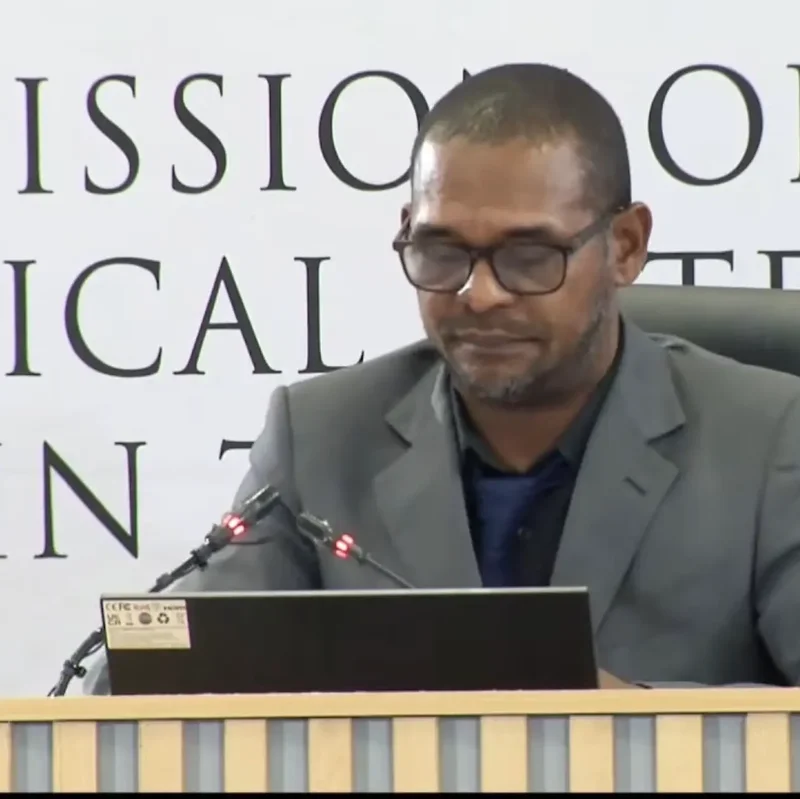
National Coloured Congress MP Fadiel Adams told the Madlanga Commission that his role in reporting allegations involving Crime Intelligence was limited to that of a complainant and argued that KwaZulu-Natal police commissioner Lieutenant-General Nhlanhla Mkhwanazi should be investigated instead.
“My role was confined to reporting information, providing documentation where available and cooperating with the oversight process,” Adams said.
He said that during the last week of October 2024, he had found a document on the floor of his parliamentary office in Cape Town.
“I presume that the document had been pushed under my office door because I found it on the floor when I opened the door,” he said.
Adams has subsequently opened criminal cases at seven police stations across the Western Cape and Gauteng alleging fraud, corruption and gratification by members of the Crime Intelligence division.
Adams said Mkhwanazi’s assertion that he should have handed intelligence documents to the joint standing committee on intelligence (JSCI) was misleading.
He denied Mkhwanazi’s allegations that he was involved in “state capture 2.0” and said the general’s statement that he should go to Pollsmoor Prison was concerning.
“Lieutenant-General Mkhwanazi’s conduct demonstrates an attitude that he is above the rule of law and that he may make statements without appropriate restraint or accountability,” Adams said.
He said that since 2000, Crime Intelligence had been used for various purposes, including political battles, patronage and the maladministration of slush funds. That had been perfected during Richard Mdluli’s tenure as head of Crime Intelligence.
“When I received documentary material that appeared to disclose possible irregularities, I sought to preserve that material in its original form and, where appropriate, refer it to competent authorities.”
Adams said his engagement with the Political Killings Task Team (PKTT), headed by Crime Intelligence’s Dumisani Khumalo, did not stem from personal animosity or political disagreement over its existence.
“My concern was the financial support a unit investigating a few dozen murders was receiving. The PKTT has a R100 million-a-year budget that does not include overtime. It has actively investigated approximately 130 murder dockets over the last 36 months. This translates into a total spend of R2.3 million per murder docket,” he said.
Adams said the Anti-Gang Unit (AGU) confronted up to 800 murders in the Cape Flats but received a small fraction of the PKTT’s budget allocation.
He said whistleblowers had approached him alleging that PKTT members had abducted them and taken them to the North West province. He said the alleged victims had lodged a multimillion-rand claim against the South African Police Service (SAPS).
Adams said the PKTT had arrested him on 5 May without informing Western Cape provincial commissioner General Thembekile Phatekile. He said he had been transported to KwaZulu-Natal for 30 hours in a police van without protective covering.
He said independence in policing structures was being compromised by Khumalo serving as both head of crime intelligence and the PKTT.
“The duality of these roles compromises investigative independence and creates an opportunity for abuse of process,” he said.
Adams said he regarded his arrest as an abuse of power.
He said a similar concentration of power was occurring in the SAPS, with Mkhwanazi serving as head of the organised crime unit and the KwaZulu-Natal provincial commissioner.
Adams disputed evidence given to him by Independent Directorate Against Corruption (Idac) Drushanta Ramsamy, who alleged that he had submitted different section 27 witness complaints relating to alleged fraud and corruption in Crime Intelligence.
He said Ramsamy should provide a recording of their meeting to substantiate her allegations of impropriety.
Adams said he could not comment on former Idac head Andrea Johnson’s testimony because the matter was under investigation and he did not want to prejudice himself.
He said the inspector-general of Crime Intelligence had contacted him in November 2024 while trying to have criminal cases against Khumalo and other Crime Intelligence officers investigated.
Adams said he had handed over his documentary evidence and a report had been compiled and sent to suspended police minister Senzo Mchunu.
Adams said Mkhwanazi had identified him as one of the politicians linked to organised crime during his explosive media briefing on 6 July.
“Lieutenant-General Mkhwanazi alleged that I obtained unauthorised access to intelligence and handled it recklessly. This allegation is denied. I have not obtained documents illegally.”
Adams said that after receiving the documents, he had opened criminal cases at seven police stations.
“Out of all these concerns, Lieutenant-General Mkhwanazi appears unconcerned that my case dockets were intercepted by Lieutenant-General Peter Jacobs and hidden in a safe in Pretoria. Lieutenant-General Jacobs has never been called to account or charged by any law enforcement agency.”
He said Mkhwanazi should explain to the commission whether he was a conduit for Timmy Marimuthu, a known criminal with whom Mkhwanazi was alleged to have a close relationship.
“There are allegations that General Mkhwanazi has interfered in the arrest of Mr Marimuthu and it is a fact that Mr Marimuthu’s wife has worked at Crime Intelligence KZN. I assume it was under the tutelage of General Dumisani Khumalo.”
Adams alleged that Khumalo and Mkhwanazi were colluding in the SAPS.
He said Khumalo had told the commission that Stuart Sharnick was a serial hijacker with 17 convictions. Adams said Mkhwanazi had later held a media briefing during which it was revealed that Sharnick’s criminal record had been deleted after a break-in at an SAPS records office.
“Mr Sharnick has proved to me that his record was lawfully expunged and we invite this commission to call the head of forensics to explain the facts,” Adams said.