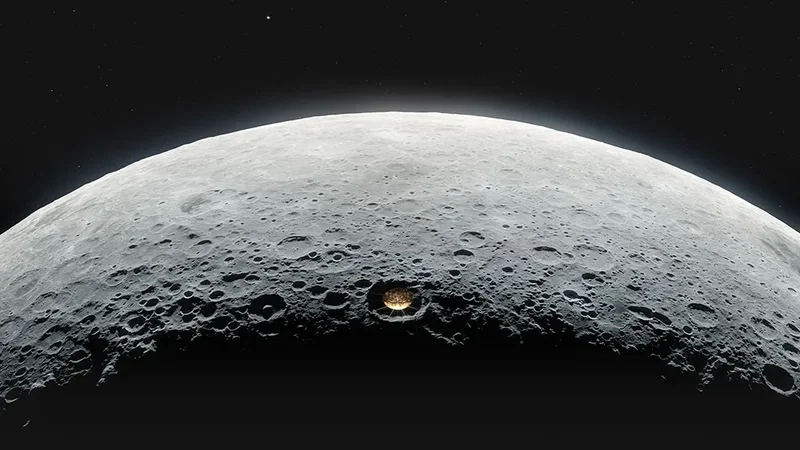
Remember the âWow!â signal? That high energy radio signature happened in 1977, when the Earth was much âquieterâ in the radio band. If it were to happen today, it probably wouldnât even move the needle on the background noise of human radio chatter. Signals from satellites, radar, and other human technology have crowded out extraterrestrial radio signals, limiting our ability to monitor the heavens for signals like the still unexplained one received in 1977. Whatâs more, the ionosphere partially blocks lower frequency radio signals, making them even harder to see from the ground. So, for a long time, scientists and engineers have been proposing putting a radio telescope on one of the last spots in the solar system that is safe from our ever growing sphere of radio influence - the far side of the Moon. A new paper, available in pre-print on arXiv from lead author David DeBoer of the University of Oxford and his co-authors, lays out a plan to do just that - and stresses that we need to do it before even that last safe haven is gone for good.
By 2030, a growing fleet of orbiters and landers will introduce permanent radio frequency interference (RFI) to the far side of the Moon. Mission planners know this, but ignoring an entire hemisphere of our nearest neighbor - especially one as scientifically interesting as the Lunar far side - isnât in the nature of science. So, to put it simply, we have a limited amount of time to put a lunar telescope there, if we donât want it to run into the same interference problem as other telescopes scattered throughout Earth and space.
Enter the Lunar Farside Transients and Technology Telescope (LFT3). This proposed mission would deploy a sophisticated radio antenna to the far side of the Moon by the end of the decade - and plans to do it for only $150M, by utilizing NASAâs Commercial Lunar Payload Services (CLPS) program.
The mission itself would operate across the HF, VHF, and UHF frequency bands, while scanning the deep cosmos for around 20 weeks. Over that time, it will have to withstand the extreme temperature fluctuations of the lunar day/night cycle - ranging from 120°C during the day to -130°C at night.
Engineering for those environments is still within our capabilities, so the plan would be to use the radio telescope to monitor for three separate signals. Technosignatures - such as potentially the âWow!â signal - lead the way, with the mission being supported by the Breakthrough Listen initiative, whose primary goal is to listen to the cosmos for hints of alien activity. A second is to detect auroras around exoplanets, which can create radio signals - and also might be indicative of their habitability. A third scientific goal is to observe fast radio bursts (FRBs) and long-period transients with the astonishing clarity offered by a radio silent environment.
Besides the temperature issues, LFT3 faces another engineering challenge - bandwidth. The advantage of not having a lot of radio signals also means thereâs not a lot of satellites orbiting overhead. And since the far side, by definition, doesnât have a direct line of sight to Earth, LFT3 will have to utilize an orbiting satellite to relay its data back to Earth itself.
Unfortunately, our current lunar infrastructure puts a hard cap on that data transfer of around 100 GB a month - about equivalent to what Iâm sure my kids would use on their cell phone plan if they could. That doesnât cut it when trying to send high resolution data about FRBs or exoplanet auroras. To combat that bottleneck, the LFT3 planners intend to do a lot of preliminary processing and filtering at the telescope itself, only sending back highly relevant data that has already passed numerous checks. But to do so requires a significant amount of radiation hardened computational equipment - another basic requirement of the mission structure, but one that is common throughout many deep space missions.
To be clear, as of now the mission hasnât received any funding. But the relatively cheap $150M price tag makes it relatively appealing, especially given the time limit our further lunar expansion plans are putting on the usefulness of this mission. It remains to be seen if the mission will ever see the light of the (extremely long lunar) day, but the more appealing astronomers can make this one-time-only opportunity, the better for radio astronomy, and our general understanding of the universe.
Learn More:
D. R. DeBoer et al - The Lunar Farside Transients and Technology Telescope (LFT3) Mission