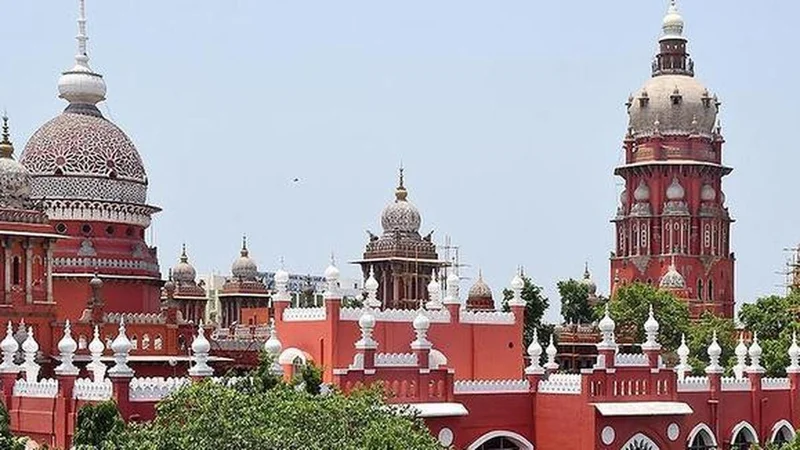
The Union Ministry of Home Affairs (MHA) has left it to the discretion of the State governments to decide the order in which the State song must be played when it had to be played along with the national song and the national anthem during the commencement of official events, the Madras High Court has said.
Dismissing a public interest litigation petition as infructuous, the first Division Bench of Chief Justice Sushrut Arvind Dharmadhikari and Justice G. Arul Murugan wrote: “The Ministry’s revised circular dated July 9, 2026 leaves the placement and performance of State song to the discretion of the State Government.”
The Bench also said, pursuant to the Centre’s revised circular, the Tamil Nadu Government had formally issued a Government Order (G.O.) reaffirming its instructions that the State song Tamil Thai Vazhthu should be sung first at the commencement of official events at educational institutions, government offices and so on.
While Advocate General Vijay Narayan placed before the court the G.O. issued on August 12, 2026, central government senior panel counsel A. Kumaraguru told the Bench that the State governments would have the full discretion to decide the order in which the State song had to be sung at official events.
It was also brought to the notice of the court that the Centre’s revised circular restricts itself to stating that whenever the national song and the national anthem had to be played together, the former should be played first. The circular does not speak about the order in which State songs must be played.
The submissions were made in response to the PIL petition filed by Ananya Radhakrishnan of Chennai. The petitioner was aggrieved over Tamil Thai Vazhthu pushed to the third place, after the rendition of the national song and the national anthem, during Chief Minister C. Joseph Vijay’s swearing-in-ceremony on May 10, 2026.
Hence, she had challenged the MHA’s January 28, 2026 circular and contended that the altered order of rendition dilutes the ceremonial status of the State song thereby violating the principles of federalism and the cultural rights guaranteed under Article 29(1) of the Constitution.
During the course of hearing, the court was informed that the MHA had issued a revised circular on the issue on July 9, 2026 and that the Centre had not pushed the State song to the last place.
Published - August 19, 2026 09:00 pm IST