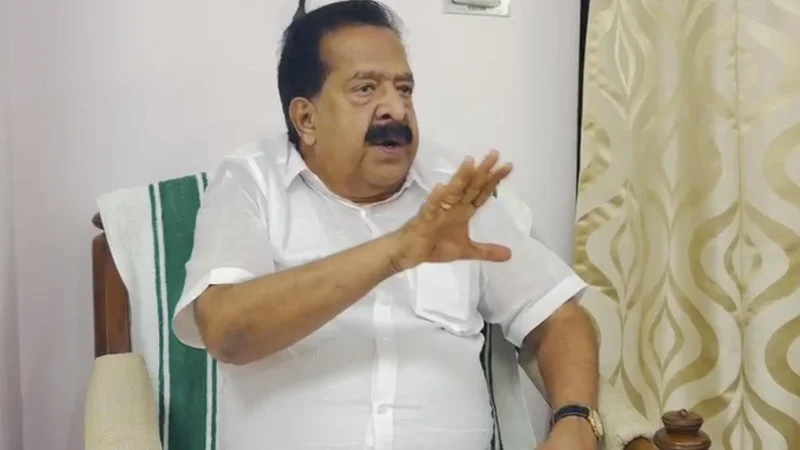
Keralam’s anti-drug campaign, Operation Toofan, has resulted in the registration of more than 10,000 cases, the arrest of nearly 10,000 people and the seizure of narcotics worth over ₹100 crore within 76 days of its launch, Home Minister Ramesh Chennithala said in an interview with The Hindu.
Describing drug abuse as one of the gravest threats facing the State’s youth, Mr. Chennithala said the crackdown was launched soon after he assumed office as Home Minister. “The concern over drugs has been building for years. Even when I was in the Opposition, I repeatedly received information that drugs were spreading among students and young people. When I became Home Minister, I decided that tackling the drug menace would be a priority,” he said.
The initiative named Toofan (Storm) is built around three pillars: Toofan Strike, Toofan Warriors and Toofan Care.
While Toofan Strike focuses on enforcement against drug traffickers and distributors, Toofan Warriors seeks to mobilise citizens, students, community groups and public figures against drug abuse. Toofan Care, meanwhile, provides rehabilitation and treatment for addicts. The government has tied up with around 40 private hospitals and de-addiction centres, and more than 150 people have already been admitted for treatment, the Minister said.
Drawing a distinction between users and traffickers, Mr. Chennithala said addicts would be treated as victims requiring care, while those profiting from the trade would face stringent legal action.
“We take a compassionate approach toward users but very strong action against traffickers. Properties linked to drug trafficking are being attached and confiscated. Our objective is to make drug trafficking an unviable business,” he said.
According to the Minister, the campaign has so far led to the registration of 10,213 cases and the arrest of 9,941 persons. Authorities have seized MDMA, ganja and several other synthetic drugs.
Mr. Chennithala said Keralam was confronting not merely a local problem but a sophisticated network stretching across States and international borders. He cited a recent case in Kasaragod in which police raided a cleaning services company and allegedly uncovered narcotics-laced peppermint candies intended to lure young users. Two Nigerian nationals suspected of involvement in drug supply networks were also arrested, he said.
Traffickers were increasingly using sea, air and rail routes, as well as courier services, parcel networks and even food-delivery platforms such as Swiggy and Zomato to transport narcotics, he added. “Whenever one route is blocked, they find another. Criminal networks constantly evolve and enforcement agencies must adapt.”
The Minister said close coordination with the Narcotics Control Bureau, Customs, Railway Police, Intelligence Bureau and neighbouring States had been crucial to the campaign. A meeting of police chiefs from five southern States had recently been convened to improve intelligence sharing and joint operations.
Claiming broad political support for the initiative, Mr. Chennithala said no individual would receive protection on political grounds. “Recently, Youth Congress members were arrested. We made it clear that the law will take its own course,” he said.
The campaign has received strong public backing, particularly from parents and women’s groups, he added. “If we do not act now, an entire generation could be ruined.”
Mr. Chennithala said preliminary assessments indicated a 30% reduction in overall crime and a 40% decline in road accidents since the crackdown began. “Operation Toofan is not just a policing exercise. It is a social movement aimed at protecting the younger generation,” he said.
Published - August 19, 2026 09:21 pm IST