Topline
The Trump administration opposed former FBI Director James Comey’s effort to throw out the criminal charges against him in a series of filings Tuesday, arguing the Justice Department didn’t prosecute Comey just because he’s long opposed President Donald Trump—but it would be fine for the president to ask it to.
Key Facts
The Justice Department responded Tuesday to Comey’s motion asking the court to dismiss the charges against him, which argues he did not make a “true threat” against the president’s life and is being “selectively prosecuted” due to his longtime criticism against Trump.
The DOJ indicted Comey over a now-deleted Instagram post showing shells spelling out “86 47”—a phrase that means “get rid of” but can also refer to killing someone—which the government argues constituted a “true threat” against Trump’s life, an allegation that Comey firmly denies.
In court filings Tuesday, the DOJ argued the issue of whether Comey meant to threaten Trump should ultimately be left up to a jury to decide at trial, and denied Comey’s allegation that the prosecution was vindictive—claiming there’s no evidence the prosecutor who brought the charges or anyone at DOJ was at all biased against him, and it doesn’t matter if Trump was.
After Comey pointed to Trump’s September social media post urging former Attorney General Pam Bondi to go after the former FBI chief and other Trump critics, the DOJ argued Wednesday there was no indication the charges were brought because of pressure from the president—and, even if they were, that wouldn’t be an issue.
The president “directing his subordinates to exercise core Executive functions” like prosecuting people “is a feature, not a bug, of our constitutional system,” the DOJ argued, claiming the idea of DOJ having “independence” from the president is “a myth” and “antithetical to the constitutional separation of powers.”
Comey’s attorneys are required to respond to the DOJ’s filings by Sept. 1, and Comey has previously strongly denied his post was meant to endorse violence.
Crucial Quote
“The test for vindictive or selective prosecution is not whether the Chief Executive has an influence on the prosecutorial decisions of his subordinates,” the DOJ argued Tuesday. “It is, rather, whether those prosecutors have exercised their power within the constraints [of the Constitution].”
What to Watch for
The court will rule on Comey’s motion to have his indictment thrown out at some point in September, after Comey responds to the DOJ’s Tuesday filings by Sept. 1. Comey is set to be arraigned on Sept. 30 if the charges move forward, so Judge Louise W. Flanagan will likely rule before that date. If the case doesn’t get dismissed, Comey’s trial will begin in North Carolina on Oct. 21. Comey faces two counts, for allegedly making a threat to kill or harm the president, and for allegedly transmitting in interstate commerce a threat to kill or injure another person. Each are punishable by up to five years in prison, as well as a fine.
News Peg
The DOJ’s filing backing Trump’s ability to pressure the agency comes as newly confirmed Attorney General Todd Blanche has come under fire for making similar arguments. Blanche has faced widespread criticism for not being suitably independent from Trump, given he previously served as the president’s personal defense attorney. In response, he’s claimed to Congress and the media that the attorney general is not meant to act independently from the president—despite that previously being the agency’s longstanding practice. “There’s a big difference between saying, ‘We will always do our job and investigate any case’ and ‘act independently of the White House,’” Blanche said Sunday on “Meet the Press” when asked if he’d act independently of Trump. “No, I’m not going to pledge that, and no attorney general should ever pledge that.”
Why Does DOJ Argue Comey’s ‘86 47’ Post Was A ‘True Threat’?
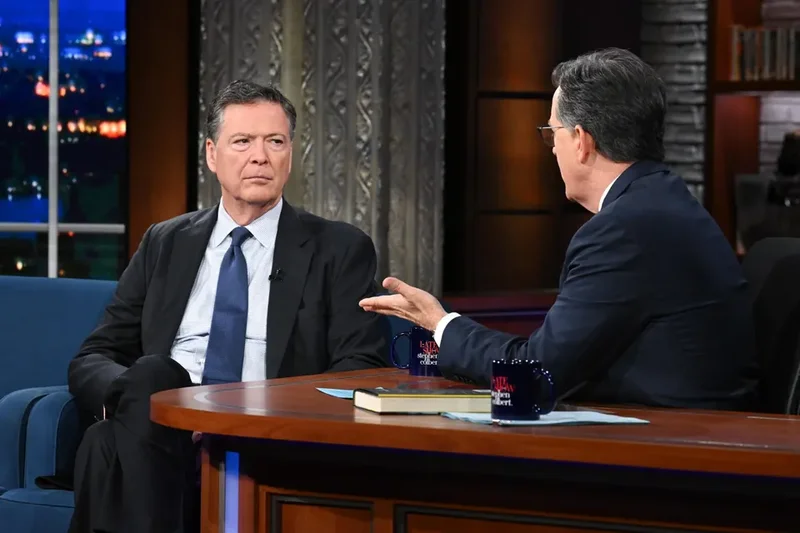
In a filing Tuesday, the DOJ provided some of its evidence for why context suggests Comey’s “86 47” post constituted a “true threat” against Trump. The government pointed to a definition of “86” in a slang dictionary that lists “to kill” or murder as being among the definitions of the term, as well as testimony from a former mob boss who claimed, “In his world, ‘everyone knew’ that 86 meant ‘kill,’ and given Comey’s experience as FBI Director, there is ‘no way that Comey did not know that.’” The DOJ also pointed to the novel Comey wrote and was promoting amid the outcry over his “86 47” post, citing passages from the book in which characters discuss a king issuing a veiled order to his supporters to kill his enemies. “He knows an attack will follow his words but he closes his eyes so he can say he wasn’t part of it,” a character says in the book. “Under the law, that willful blindness makes him as guilty as if he did the attack himself.” The government insinuated Comey may have also made his “86 47” post in order to draw more attention to his novel, pointing to interviews with The Wall Street Journal and “The Late Show with Stephen Colbert” in which Comey denied allegations of that nature. “That is a hell of a viral campaign,” Colbert told Comey in a May 2025 interview.
Key Background
Comey posted a photo on Instagram showing the “86 47” shell arrangement in May 2025, captioning it, “Cool shell formation on my beach walk.” After the post sparked a public outcry, Comey deleted it shortly after, explaining in a separate Instagram post that he “assumed” the seashells “were a political message,” but he “didn’t realize some folks associated those numbers with violence.” That “never occurred to me but I oppose violence of any kind so I took the post down,” Comey wrote. The DOJ then indicted Comey over the post in April—marking the second time he’d been indicted by the Trump administration, after a first set of charges, for allegedly lying to Congress, were dismissed in November. Comey served as the FBI director when Trump first took office in 2017, before Trump fired him months later. The former FBI chief has become an outspoken critic of the president since his firing, and has alleged the president improperly asked him for his “loyalty” during a private dinner while he was still at the agency. Comey is one of a number of Trump foes who have come under scrutiny by the DOJ during Trump’s second term, along with New York Attorney General Letitia James, Sen. Adam Schiff, D-Calif., former CIA director John Brennan, Minnesota Gov. Tim Walz and numerous others.
Further Reading
James Comey Argues ‘86 47’ Charges Not A ‘True Threat,’ Wants Them Thrown Out (Forbes)