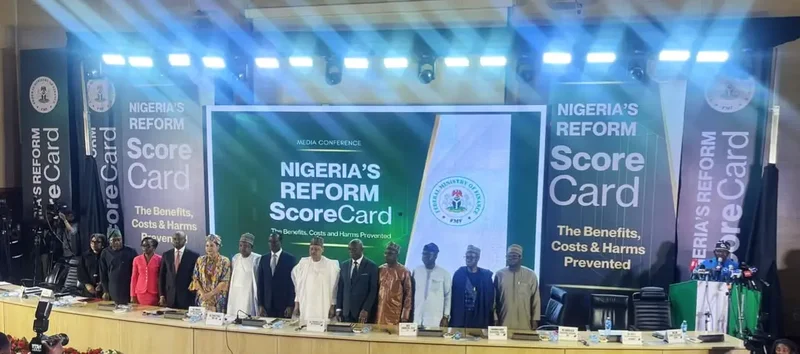
The Federal Government spent ₦30.64 trillion on incremental expenses between June 2023 and December 2025, with wage adjustments, external debt service and strategic infrastructure accounting for the largest portions, the Minister of Finance and Coordinating Minister of the Economy, Taiwo Oyedele, has said.
Oyedele disclosed this on Wednesday in Abuja while presenting the Federal Government’s “Nigeria’s Reform Scorecard: The Benefits, Costs and Harms Prevented”, an assessment of the economic reforms implemented under President Bola Tinubu.
The presentation provided the government’s account of how additional resources generated during the reform period were raised and spent, while also outlining what it said were the benefits of the reforms and the economic problems they could have prevented.
According to the minister, the removal of the petrol subsidy and reforms to the foreign exchange market helped mobilise ₦15.8 trillion in subsidy savings for the Federation between June 2023 and December 2025.
| | |
|---|
The entire amount, however, did not accrue to the Federal Government.
Of the ₦15.8 trillion, ₦ 5.4 trillion went to the Federal Government, while ₦10.4 trillion was shared between state and local governments through the Federation Account.
In addition to its share of the subsidy savings, the Federal Government recorded ₦3.1 trillion in incremental independent revenue, mainly from remittances by government-owned entities.
It also obtained ₦11.9 trillion in incremental borrowing during the period.
Together, the three sources provided the Federal Government with ₦20.4 trillion in incremental resources.
Where the money went
Oyedele said the additional resources were used alongside funds from the government’s existing revenue base to meet incremental expenses totalling ₦30.64 trillion during the period.
The largest expenditure was ₦9.39 trillion spent on wage adjustments, increases in the national minimum wage and allowances for public servants.
The amount is higher than the ₦5.4 trillion the Federal Government received as its share of the subsidy savings.
The minister said the figure demonstrated that the subsidy reform was not introduced simply as a revenue-generating measure.
“That, in itself, is evidence that the reform was never introduced for revenue purposes, but to address entrenched corruption in an artificially managed fuel subsidy and foreign exchange market,” he said.
Another ₦9.37 trillion was spent on external debt service.
Oyedele said the cost of servicing the government’s foreign-denominated obligations increased substantially following the depreciation of the naira.
“So, if we’re paying ₦1 billion, but instead of ₦460, it’s now ₦1,415. That’s more naira than we need to incur,” he explained.
The government also spent ₦6.47 trillion on strategic infrastructure during the period.
Other incremental expenses included ₦3.14 trillion for additional electricity subsidy costs and ₦1.24 trillion in domestic debt service associated with higher monetary policy rates.
The minister also reported ₦423.8 billion in social welfare transfers; ₦419.1 billion for Federal Capital Territory development, the Ecological Fund, and natural resource investments; and ₦201.26 billion, representing higher naira costs of foreign obligations.
He said ₦20.404 trillion of the ₦30.64 trillion incremental expenditure was funded from the additional resources generated during the period.
The remaining ₦10.236 trillion came from the government’s existing revenue base.
Of the N20.4 trillion in incremental resources, borrowing accounted for 58 per cent, subsidy savings for 27 per cent, and other revenue for 15 per cent.
How subsidy savings were distributed
Oyedele explained that the ₦15.8 trillion in subsidy savings should not be interpreted as money that accumulated in a separate government account labelled “subsidy savings”.
Rather, he said, the impact of the reforms was reflected in increased resources available to the Federation through higher revenue collections.
The Federal Government’s ₦5.4 trillion share represented about 34 per cent of the ₦15.8 trillion.
States received ₦6.5 trillion, or about 41 per cent, while local governments received ₦3.9 trillion, or about 24 per cent.
The distribution meant that the two lower tiers of government received ₦10.4 trillion, almost twice the Federal Government’s share.
Beyond explaining how the resources were spent, the ministry used the scorecard to compare Nigeria’s current economic position with what it estimated could have happened if the reforms had not been implemented.
The scorecard examined 25 indicators across five areas: fiscal sustainability, external stability, investment climate, social impact, and growth and productivity.
It compared the country’s position in May 2023, before the reforms, with its position using the latest available data in 2026.
It also included a “no-reform” estimate based on the trajectories of key economic indicators before the reforms.
Oyedele said 27 states could not reliably pay salaries in May 2023, while the number had fallen to zero.
The ministry estimated that at least 30 states could have faced difficulties paying salaries by 2026 if the pre-reform trajectory had continued.
Similarly, the government said the premium between the official and parallel foreign exchange markets, which had exceeded 60 per cent before the reforms, had fallen to below five per cent.
The ministry estimated that the premium could have exceeded 150 per cent if the previous exchange-rate system had continued.
The government also said the ₦30 trillion Ways and Means balance had been curtailed rather than allowed to grow further.
Ways and Means financing refers to advances provided by the Central Bank of Nigeria to the Federal Government to meet short-term financing needs. The heavy use of the facility before the reforms had raised concerns over its impact on inflation and monetary stability.
Reforms come with costs
Oyedele acknowledged that the reforms had imposed high costs on Nigerians.
The Monetary Policy Rate, he said, had risen from 18.5 per cent in May 2023 to 26.5 per cent.
Petrol prices also rose from about ₦185 per litre before the subsidy removal to between ₦1,100 and ₦1,400 per litre.
“These are major, felt costs, and I will not stand here and tell you otherwise,” he said.
However, he argued that the government’s counterfactual analysis suggested petrol could have become unavailable at the old official price while trading above ₦3,000 per litre on the black market if the previous subsidy system had continued.
The minister also acknowledged that the impact of the reforms on household welfare remained incomplete.
Food inflation, according to the scorecard, had fallen from 24.82 per cent at the May 2023 baseline to 17.52 per cent in June 2026.
However, Oyedele said poverty and household welfare recovery remained “unfinished business” rather than an area where the government could claim victory.
The National Bureau of Statistics reported headline inflation at 15.91 per cent in June 2026, compared with the government’s May 2023 baseline of 22.41 per cent.
Oyedele said the effects of the reforms were also reflected in several macroeconomic indicators.
Gross foreign exchange reserves, he said, had increased to $52.5 billion from about $35 billion at the May 2023 baseline.
Net reserves had risen from roughly $3 billion to $34.8 billion.
The stock market’s capitalisation also increased from about ₦31 trillion to roughly ₦150 trillion, according to the minister.
Real Gross Domestic Product growth strengthened to 3.89 per cent, compared with 2.31 per cent at the baseline.
The government also cited Nigeria’s improved standing in the international financial system.
S&P Global upgraded Nigeria’s sovereign credit rating to ‘B’ in May 2026, according to the minister.
Nigeria also exited the Financial Action Task Force grey list in October 2025 and the European Union’s Anti-Money Laundering and Combating the Financing of Terrorism deficiency list in January 2026.
The government said the developments reflected improved confidence in Nigeria’s financial and economic reforms.
Governments target household welfare
Oyedele said the next phase of the reform programme would focus on translating the improvements in macroeconomic indicators into benefits that households can feel.
He said implementation of the Nigeria Tax Act would continue alongside reforms to budgeting, reporting and accountability.
The government also plans to increase the tax-to-GDP ratio, maintain a unified foreign exchange market and continue efforts to reduce inflation towards single digits.
On household welfare, the minister said the government would expand cash transfers to vulnerable Nigerians, deepen agricultural interventions to reduce food prices, and work with state and local governments to ensure that economic gains reach communities.
He also highlighted the National Education Loan Fund, saying more than 1.5 million students were already benefiting from the scheme.
The government said the minimum wage had more than doubled from ₦30,000 to ₦70,000, while salaries and pensions were being paid more reliably, and some longstanding pension arrears had been settled.
Oyedele described the scorecard as a mid-course assessment rather than a final verdict on the administration’s economic programme.
“We are not here to pretend these reforms were painless. We are here to show you, honestly and with the numbers, what they cost, the benefits they delivered, and the harm they prevented,” he said.
The presentation comes more than three years after the Tinubu administration introduced its most consequential economic reforms, including the removal of the petrol subsidy and changes to the foreign exchange regime.