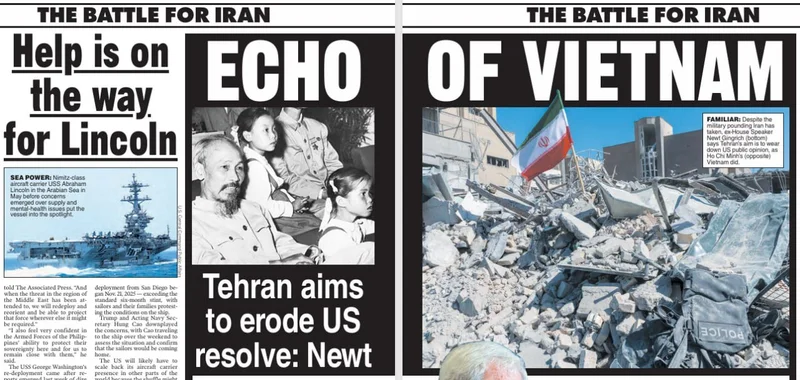
‘Help is on the way’: From regime change to toilet repair
TEHRAN — A recent report published by the New York Post, bearing the headline "Help is on the way for Lincoln", unintentionally lays bare the profound irony, moral hypocrisy, and strategic failure defining Washington’s aggressive foreign policy toward Iran.
When President Donald Trump sought to exploit foreign-backed unrest within Iran in early January, he arrogantly promised anti-government agitators that "help is on the way"—a rhetoric that ultimately materialized as a brutal campaign of US–Israeli airstrikes targeting Iranian civilians, women, children, and vital national infrastructure. Trump’s promise of “help” was never merely rhetorical support for Iranian protesters; it was part of an openly interventionist agenda aimed at destabilizing Iran and ultimately bringing about regime change—a strategy that has since exposed the limits of Washington’s ability to impose its will on Iran.
Today, in an extraordinary turn of historical fate, mainstream American news outlets are forced to recycle Trump’s exact words to describe a desperate emergency relief effort for the United States’ own decaying naval forces.
Floating in the sweltering expanse of the North Arabian Sea for over 250 days—including an unprecedented stretch of more than 200 consecutive days at sea without a single port call—the supercarrier USS Abraham Lincoln has transformed from an intended instrument of global coercion into a floating monument to American overextension. Accounts leaking from service members, anxious families, and independent military news outlets paint a harrowing picture of human suffering and structural decay aboard the vessel. More than 5,000 crew members have been subjected to severe rationing of basic food supplies, mold-infested quarters, broken plumbing, and contaminated drinking water.
This physical degradation is compounded by an unmanageable operational tempo. Driven through endless 12- to 16-hour shifts without rest or time off, the crew has been pushed far past the boundaries of human endurance. The psychological strain of prolonged isolation and grueling labor under hostile conditions has triggered a massive mental health crisis across the vessel. Confirmed incidents of sailors attempting to jump overboard and a rising wave of suicide attempts serve as grim indicators that Washington’s posture of continuous confrontation is destroying the very personnel tasked with executing its imperial strategy.
Rather than confronting the root causes of this systemic breakdown, the Pentagon leadership has responded with bureaucratic denial and PR damage control. War Secretary Pete Hegseth publicly dismissed the horrific reports, claiming shipboard conditions had been completely misrepresented, while US Central Command circulated social media graphics attempting to label the mental health crisis as false propaganda. However, this official stonewalling has done little to suppress the mounting political panic within the halls of Congress.
The humanitarian disaster aboard the carrier has triggered intense political friction in Washington. Reports from sailors and their families describe broken toilets and other plumbing problems aboard the Lincoln, prompting Senator Richard Blumenthal to demand answers about the ship’s habitability and what corrective measures had been taken. Blumenthal dispatched a sharp letter demanding a formal accounting of severe supply shortages and mental health metrics from Hegseth and Acting Navy Secretary Hung Cao. The outcry reached a fever pitch as Senate Minority Leader Chuck Schumer publicly called for Hegseth's firing, citing the shipboard crisis as damning evidence of strategic incompetence. Concurrently, combat veteran Senator Ruben Gallego urged an immediate bipartisan congressional investigation, warning that forcing personnel through broken facilities and endless shifts severely compromises operational safety.
The structural failure of US policy became fully apparent with the emergency order to redeploy the USS George Washington out of the South China Sea to replace the exhausted Lincoln. By pulling its last remaining aircraft carrier out of the Pacific, the United States has inadvertently exposed the severe operational constraints of its global posture. Defense analysts point out that stripping naval firepower from the Western Pacific sends an unmistakable signal to regional nations—such as the Philippines, Japan, and Indonesia—that Washington can no longer guarantee regional dominance or sustain multi-theater military presence.
Furthermore, this constant shuffling creates a compounding logistical nightmare. Overworking active strike groups accelerates mechanical wear on ships while delaying essential maintenance cycles. Because the United States suffers from acute shipyard bottlenecks with only two carrier-capable facilities, this endless cycle of overextension threatens the long-term operational viability of the entire American fleet, damaging recruitment and retention while eroding core naval readiness.
Trump’s aggressive campaign to impose a permanent naval siege and force Iran into submission has achieved nothing beyond proving the absolute limits of imperial coercion. Despite unlawful airstrikes, violations of a signed memorandum of understanding, and continuous aggressive posturing, Iranian defense capabilities and strategic resilience have thoroughly neutralized Washington’s designs. The cessation of US strikes following Iran's decisive retaliatory response demonstrated to the world that American military aggression carries immediate, unsustainable costs.
The irony is difficult to miss. Trump once declared that “help is on the way” in response to the unrest in Iran, presenting himself as the powerful leader who would come to the rescue of the protesters. Now, those same words have come back to haunt his own administration as the USS Abraham Lincoln requires relief. What was intended as a boast of American power has become a symbol of its overreach—a humiliating reversal that exposes Trump’s failure to deliver the dominance he promised and turns his own words into a reminder of a costly and deeply embarrassing defeat.