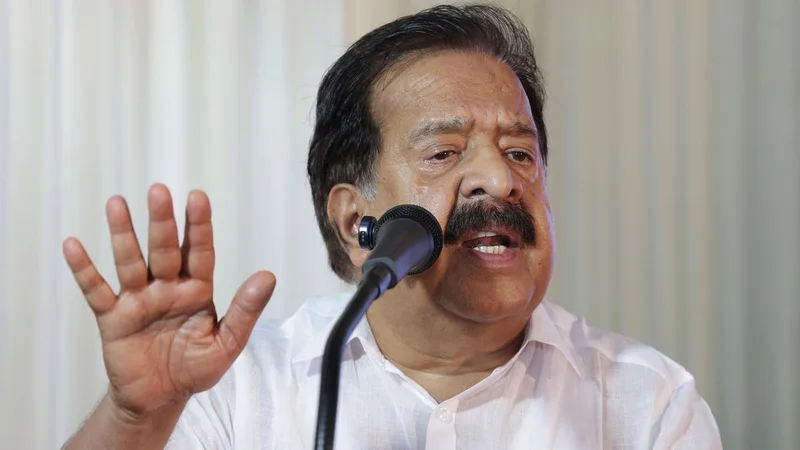
Keralam’s anti-drugs campaign, Operation Toofan, has led to more than 10,000 arrests, over 9,000 cases and the seizure of narcotics worth more than ₹100 crore within 76 days of its launch, State’s Home Minister Ramesh Chennithala said in an interview with The Hindu. Excerpts:
What is the vision behind Operation Toofan?
The concern over drugs has been building for years. Even when I was in the Opposition, I travelled across Keralam and repeatedly received information that drugs were spreading among students and young people, it has spread much wider. When I became Home Minister, I decided that tackling the drug menace would be a priority, and we launched Operation Toofan. Toofan means “storm”. We wanted to send a message that the government would act aggressively against drug trafficking and abuse.
How is the operation structured?
Operation Toofan has three components: Strike, Warriors and Care. Toofan Strike is the enforcement wing. Our focus is on those who sell, distribute and promote drugs. Toofan Warriors is the public participation component. Citizens, students, community groups and public figures come forward voluntarily to join the campaign. Earlier, many people were afraid to speak out against drug networks. Toofan Care focuses on rehabilitation. We consider addicts as victims who need treatment and support. We have tied up with around 40 private hospitals and de-addiction centres across Keralam. Their identities are kept confidential, and they are helped to return to mainstream life. More than 150 people have already been admitted for treatment. Many have completed rehabilitation, while others continue to receive support.
How do you distinguish between users and traffickers?
There are two categories. The first is the victim, the addict, who needs treatment and rehabilitation. The second is the seller and trafficker, who profits from addiction. We take a compassionate approach toward users but very strong legal action against those involved in trafficking. Repeat offenders can face stringent action. Properties linked to drug trafficking are attached and confiscated. Our objective is to ensure that drug trafficking becomes an unviable business.
What has the operation achieved so far?
As of the 76th day of the campaign, as many as 10,213 cases have been registered and 9,941 persons have been arrested. Drugs worth more than ₹100 crore have been seized.
What are the most commonly seized drugs?
We have seized MDMA, a psychoactive drug, ganja (cannabis) and several synthetic drugs. The methods and substances keep changing, and new forms of drugs are constantly emerging in the market.
Is Keralam facing a local problem or an international network?
This is not just a local issue. Drug networks operate across States and international borders. We have encountered cases involving foreign nationals and supply chains that extend beyond Keralam. These networks are sophisticated and constantly change their methods. In Kasargod, police raided a cleaning services company and found crores of toffees made of narcotics substance stored there. They had a special machine to make these peppermint-flavoured candies, which are first distributed free of cost in schools and colleges, and once they are addicted, these are sold at a premium. They planned to distribute MDMA but police foiled their plan. Two Nigerian suppliers were arrested. Hybrid ganja is going from Thailand to Gulf countries and then to Keralam.
How are drugs entering Keralam?
Drugs come through sea routes, air routes and rail networks. Traffickers also use courier services, food delivery apps such as Swiggy and Zomato and parcel delivery systems. Whenever one route is blocked, they look for another. Thy are using innovative methods. We have seen drugs being transported through even ambulances. Criminal networks continuously evolve their methods, so enforcement agencies also have to adapt.
How important has coordination with other agencies been?
It has been critical. We are working closely with the Narcotics Control Bureau, Customs, Railway Police, Intelligence Bureau and other Central authorities. I recently held a meeting with the police chiefs of five southern States and have appointed a nodal officer for multi-agency coordination. Chief Minister of Tamil Nadu Joseph Vijay and Karnataka Chief Minister D.K Shivakumar have also announced similar operations. Union Home Minister Amit Shah has also offered support.
Is there political support for the campaign?
Yes. The campaign enjoys support across political lines. Drug abuse is a social issue, not a political one. We have made it clear that no one will receive protection because of political affiliation.
Does that include people linked to political parties?
Absolutely. If someone is involved in drug-related offences, action will be taken according to the law, irrespective of party affiliation. Recently, two youth Congress members were held for the crime; we made it amply clear that law will take its own course and no protection will be given.
What has been the public response?
The response has been overwhelming. Parents, especially mothers, have strongly supported the campaign. We receive information from citizens regularly, and public participation has become one of our greatest strengths. We have issued helpline numbers which are flooded with calls and information. If we do not do anything, the new generation will be completely spoiled. A mother was killed by her son who was addicted to cannabis. The women are scared to open the doors when these men come home.
Do you see any early impact of Operation Toofan?
Preliminary assessments suggest that there has been a 30% reduction in overall crimes and 40% decline in road accidents since the crackdown began. We are continuing to analyse the data, but the early indicators are encouraging.
What is your larger goal?
My goal is to protect the younger generation. Drug abuse can destroy families, communities and future. Operation Toofan is not just a policing exercise; it is a social movement. We want government agencies, schools, hospitals, community organisations and citizens to work together to eliminate the drug menace from society.
Published - August 19, 2026 10:40 pm IST