Sign in. It’s quick, free and it’s up to you.
An account is an optional way to support the work we do. Find out more.
HASN’T IT BEEN a magic summer for sport, all the same? It’s saved us from succumbing entirely to full-blown existential dread in a year when it feels like the world isn’t only going to hell in a handcart, but the handcart is a self-driving cyber truck which is on fire and filled with psychotic clowns.
But amid a spectacular summer of sport – ‘hon Spain, Mayo abú – there has been something especially uplifting about the successes of our women on the track and in the pool last week.
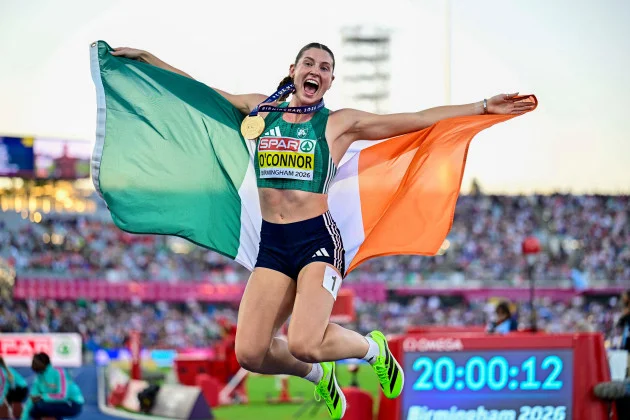
They bagged enough bling to blend in nicely with the decor in the Oval Office: a glorious gold in the heptathlon for Dundalk’s Kate O’Connor and a 200m silver medal for a resurgent Rashidat Adeleke from Tallaght; Sligo swimmer Mona McSharry’s magnificent haul of one silver and two bronze medals in 100m, 50m and 200m finals, and Dublin powerhouse Ellen Walshe’s magnificent 200m and 400m medley golds.
The week’s news websites, TV, newsprint and radio were festooned with images and audio clips of the triumphant women, medals aloft, wrapped in tricolours and wreathed in smiles. Positivity poured from them. “When I was a kid, I had a dream. I’ve worked really hard, and I’m achieving the dream. So believe, achieve, work hard,” said Kate O’Connor. It was an almost identical message from Rashidat Adeleke: “This championship showed me there’s just no limit. Once you’re in a good mindset, once you’re showing up every single day, you need to believe in yourself. And once you believe in yourself thoroughly, and it’s not false confidence, it’s real confidence — so much can happen.”
And next week Mona and Ellen and Ireland teammate Danielle Hill will travel around the country, putting on clinics for young swimmers because, as McSharry put it, “That was us one day, that young kid, teenager with a big dream. Even just to teach them something small, even just believing in yourself, it’s whatever they take away from it.”
It isn’t a coincidence that these women are broadcasting such strikingly similar messages in the wake of their international successes. It is because they instinctively understand the absolute truth and the transformative power of See It, Be It.
In fact, that four-word truism can also be said in three: invisibility is inequality. And both happen when girls’ and women’s sports are treated as a badly-funded afterthought, or there is an unwillingness to dismantle the outdated canard that women doing sport is a pleasant hobby and probably good for maintaining their figures and fertility, while men doing sport is the stuff of gladiatorial combat worthy of plaudits and rich reward.
If there was a single event which highlighted the inequality chasm, it was in April 2017 when a group of Irish sportswomen took the decision to be very visible indeed. Driven by anger and despair over their pay and conditions, the Republic of Ireland’s women’s football squad held a press conference in which they threatened strike action, revealing how they were treated by the FAI, including being forced to get changed in public toilets on the way to matches and sharing tracksuits with youth-team squads.
It took a lot of guts to challenge the powerful poobahs of Irish football who had leaned on the team not to go public with their complaints, as it could “endanger their careers at club and international level”. However, the public was understandably outraged, and the world’s media ran with the story, obliging a rattled FAI to cave to the squad’s totally reasonable and long overdue demands.
More significantly, the controversy kickstarted a process which eventually led to the introduction of equal pay for both the men’s and women’s senior national teams in 2021 in a deal negotiated by the two team captains Katie McCabe and Séamus Coleman.
Moreover, it was surely no coincidence that just over a year after the football showdown, the 20×20 campaign was launched nationwide in October 2018, backed by an array of sporting bodies, promoting the slogan If She Can’t See It She Can’t Be It. The aim was to achieve 20% more media coverage of women in sport, 20% more female participation and 20% more attendance at women’s competitions and events by 2020.
It had a positive impact, although a Sport Ireland survey published earlier this year highlighted the gender gap, which still clings on grimly in the media, finding that 18% of all Irish national sports news coverage in 2025 was about women’s sport.
Yet, what happens when sportswomen receive increased financial support, proper access to top-class facilities and professional trainers and programmes both at home and abroad? They start being competitive at the highest levels, be it football, rugby, hockey, boxing, swimming and running? The sportswomen start winning.
And what happens when that success leads to greater visibility, increased media coverage and bigger attendances at live events? The sportswomen become proof of what can happen when proper supports enable ambition, talent, dedication and self-belief to flourish. They become role models, there in plain sight for kids to see, admire and emulate.
Sport is only one front in the never-ending gender war waged by women against invisibility and inequality. The entrenched sexist notion of women being runners-up in Irish life is even reflected in the physical architecture of the country.
Take the capital city: out of 578 streets in central Dublin, 32 are named after women. And one bridge. There are statues/busts of three Irish women – Constance Markievicz, Catherine McAuley and Mayoress Margaret Ball – on the city streets. The statues/busts of men include Daniel O’Connell, Lord Ardilaun, William Smith O’Brien, William Dargan, Oscar Wilde, Seán Heuston, James Connolly, James Clarence Mangan, Michael Collins, Thomas Kettle, WB Yeats, Luke Kelly, James Joyce and Phil Lynott.
Did women play any role in the formation of the Irish state at all at all? Did not a wan of them contribute to the culture or arts? Divil a one?
Can’t see it can’t be it. Perhaps we could start with a prominently-placed statue of arguably Ireland’s most successful sports star, Katie Taylor, who rings the final bell on her extraordinary career next month with the sold-out Katiepalooza in Croker.
In a week when the girls and women of Afghanistan mark their fifth anniversary of being subjected to total invisibility under the brutal oppression of the ruling Taliban, and when the US President is (once again) publicly snarling at a female journalist to “be quiet” (this time it was the turn of CNN senior correspondent Kristen Holmes in the Oval Office), visible and vocal female role models for both girls and boys have never been more badly needed.
And not for the first time, our superstar sportswomen are leading from the front.
*Lise Hand is a journalist and writer. This column runs every Wednesday. *
To embed this post, copy the code below on your site